
Italian Stone Pine Bonsai
Pinus pinea
Italian stone pine bonsai (Pinus pinea) is appealing for its unmistakable Mediterranean character, and I understand the appeal of taking one on given how much it looks the part, but I'd rather tell you plainly upfront that it's generally considered one of the more awkward pines to refine, not one I'd point a newer grower toward without a clear-eyed sense of what they're taking on.
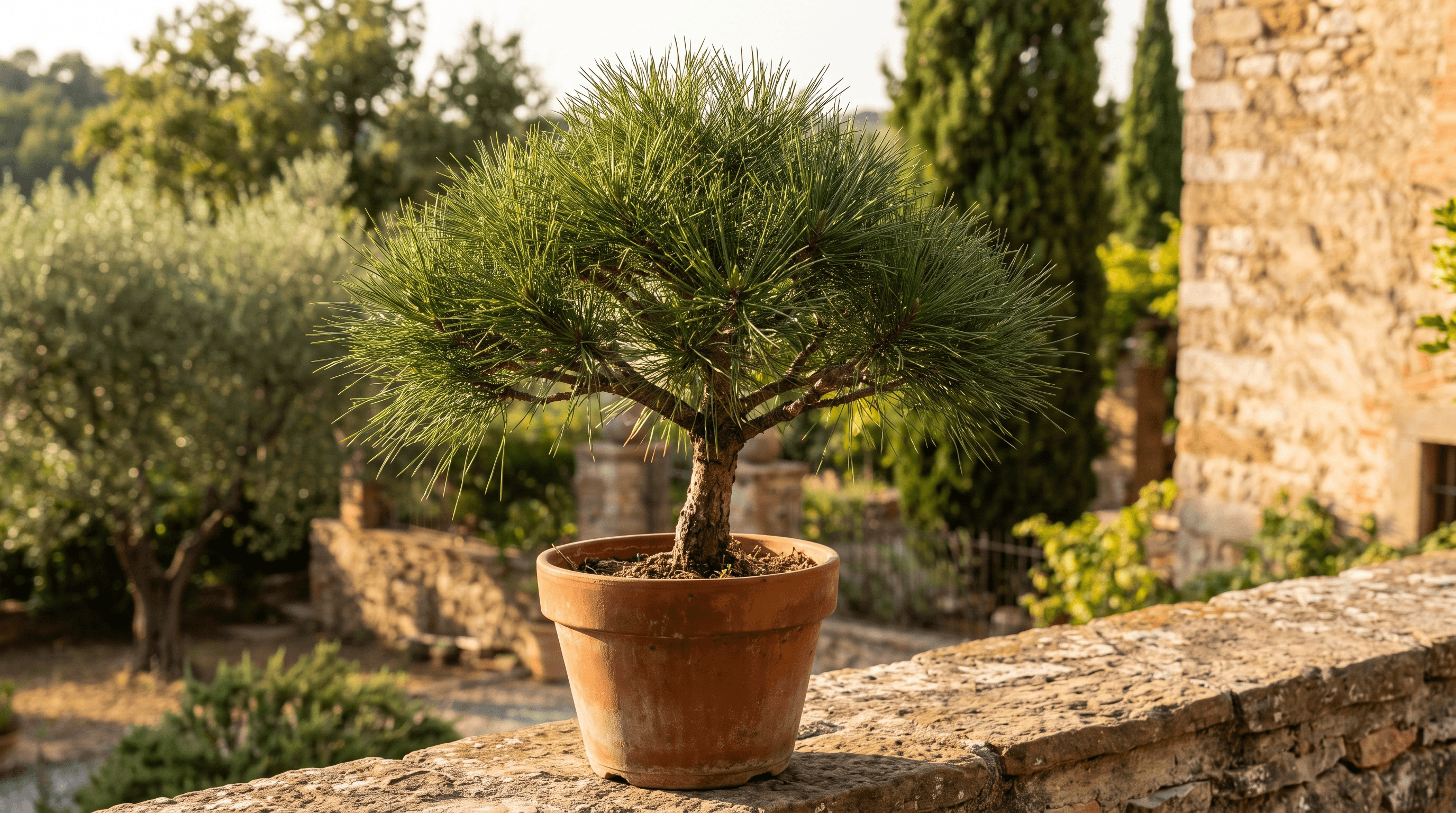
Anyone who's spent time in central or southern Italy knows the silhouette of a mature stone pine, that broad, flat-topped umbrella crown on a long bare trunk, standing along roadsides and coastlines everywhere from Rome south. It's a beautiful tree in the landscape, and I get why people want to bring that image down into a pot. But the qualities that make stone pine such a striking full-size tree don't translate cleanly to bonsai scale, and I think the fair thing to do is explain why before you invest years into one, rather than after.
Two things are generally considered to make stone pine more awkward to refine than black pine, red pine, or Scots pine, this is more a matter of practical bonsai experience than a strict scientific ranking, but the reasoning holds up. The first is needle length: mature stone pine needles run long even by pine standards, and while some reduction is achievable through light, feeding, and technique, I wouldn't promise a stone pine bonsai the tight, compact needle mass you can reasonably expect from a well-developed black pine. If mature foliage and a convincing full-size look matter to you, a medium-to-large bonsai carries long needles far better than a small one, so it's worth deciding on size alongside foliage strategy early on rather than fighting the needles down to a scale the species doesn't really support. The second is the juvenile-to-adult foliage transition. Juvenile stone pine needles are much shorter than the mature form and can persist for years, sometimes mixed in with the first adult growth, and that's not automatically a problem: some growers deliberately keep a tree in juvenile foliage for exactly that shorter needle length, while others aim for mature foliage and its more authentic full-size character. What actually complicates refinement isn't juvenile foliage itself, it's mixing the two and trying to build a uniform canopy out of foliage that hasn't settled into one type or the other. None of this makes stone pine impossible. It makes it a project for someone who already has real pine experience, has decided which foliage strategy they're pursuing, and wants a challenge. I wouldn't call it a first tree, and I wouldn't recommend chasing black-pine-level fine ramification on it at all costs.
Care
Light
Full sun, without question. Stone pine grows naturally in open, exposed coastal and hillside ground across the Mediterranean and it wants the same as bonsai, on a bench with unobstructed light for most of the day. It handles hot, intense sun about as well as any pine on this list, which makes sense given where you see it growing in the wild. Reduced light produces the usual pine response of thin, pale foliage and stretched growth, though on stone pine that stretching also works against needle length control, which is already a struggle for this species without adding weak light into the mix.
Watering
Let the soil surface dry before watering thoroughly again. Stone pine tolerates drought about as well as any pine I grow, again a reflection of the dry coastal and hillside ground it's adapted to, but that drought tolerance doesn't extend to tolerating wet feet; the roots dislike sitting in constantly moist soil as much as any other pine's do. Overwatering symptoms build slowly here too, as gradual needle dulling and yellowing rather than sudden collapse, so it's worth checking the mix and drainage before assuming pests or disease when a stone pine starts looking off.
Temperature & hardiness
Stone pine is thoroughly at home in a hot, dry Mediterranean climate and handles summer heat as well as any pine here, which is part of why it's such a common sight across coastal and central Italy. It's less reliably cold-hardy than a species like Scots pine or even black pine, and in my experience it doesn't want a truly harsh, prolonged winter freeze the way those two can tolerate. For most of southern Italy this isn't a practical concern, but if you're somewhere with real hard winters, stone pine is a riskier long-term bet than black pine. Outdoors year-round, pot protected from any hard freeze, is the right general approach.
Soil & potting
A fast-draining, mineral mix is essential, the same baseline you'd use for other pines: akadama, pumice, and lava rock in roughly equal parts works well, and I'd lean toward the more open end of that range given how much this species dislikes wet roots. Stone pine also forms mycorrhizal relationships in the soil the way other pines do, so carrying some of the old mix forward at repotting helps that fungal community reestablish rather than starting sterile each time. None of this differs much from general pine practice; the real challenges with this species show up in pruning, not the pot.
Fertilizing
Stone pine feeds well through spring into early autumn, tapering as growth slows, in line with pine practice generally. I don't push feeding especially hard on this species in an attempt to compensate for its needle length or foliage transition issues; overfeeding tends to just produce longer growth rather than solving either problem, which is the opposite of what you want, and this matters even more if you're experimenting with cutback or decandling, both of which need a genuinely healthy, well-fed tree to succeed. A steady, balanced feed through the growing season, with organic pellets for slow release, is a sensible default; keep it moderate rather than heavy, but don't starve the tree in an attempt to shorten needles, that isn't a real technique and a nutrient-deficient pine is simply a weak pine.
Pruning & wiring
I want to be straightforward here rather than dress this up. Stone pine isn't managed with the same confident, well-established candle technique that black pine and red pine are; it isn't a reliably annual two-flush species in that standardized sense. But it shouldn't be filed away as a true single-flush pine either, the way Scots pine genuinely is. Vigorous stone pines in long, hot growing seasons can respond to decandling and cutback, the response is just less standardized than on black or red pine, and it can push the tree toward juvenile foliage rather than the second mature flush you'd get on a classical two-flush pine. My approach is to start conservatively, light candle selection and thinning in spring, and judge the individual tree from there rather than assuming any one technique will behave predictably; a strong, established tree may tolerate more than a young or recently repotted one. Building fine ramification on stone pine is a slow, patient project either way, and even experienced growers often settle for a looser, more open pad structure on this species rather than the tight, dense pads achievable on black pine, since adult needle length places a real limit on how far the tree can be brought down in scale, even if some reduction is achievable with patience. Wiring works in the usual way on lignified growth in cooler months; the wood isn't unusually brittle, but branch structure tends to be sparser at a given age than on the classical bonsai pines, so I'm more conservative about removing branches on stone pine than I would be on a black pine with foliage to spare.
Repotting
Stone pine follows a broadly similar repotting rhythm to other pines, often every three to five years for an established tree, guided by the individual tree's vigor and root growth rather than a strict interval. Early spring, as the buds swell, is the right window. Root work should be conservative, the same as with other pines, working the outer portion of the root mass and avoiding heavy bare-rooting, then getting the tree back into a fast-draining mix promptly. Give it a couple of weeks of shelter from harsh sun and wind afterward while the roots settle.
Common problems
Yellowing needles trace back to the same usual causes as other pines: soil staying too wet, roots disturbed too heavily at a recent repot, or insufficient light. The question specific to stone pine that comes up most is needle length, adult needles are long by nature and don't reduce down to black-pine scale no matter how the tree is fed or pruned; that's a real limitation of the species rather than something you're doing wrong. Some reduction is achievable with light, restrained feeding, and patience, and juvenile foliage offers a genuinely different, much shorter-needled option if you're willing to manage the tree that way instead. Persistent juvenile foliage on its own isn't a problem, it's normal for this species and some growers keep it deliberately; the complication comes when juvenile and adult foliage mix on the same tree and you're trying to build a uniform canopy out of both. Aphids and scale affect stone pine much as they do other pines and are worth checking for on new growth if the tree looks stunted.
Styling
Stone pine's natural form, that broad, flat-topped umbrella crown on a long clean trunk, is distinctive and worth working with rather than against; a broom or flat-top style that echoes the tree's landscape silhouette tends to look more convincing on this species than trying to force it into a dense, tiered pine profile borrowed from black pine styling. I'd generally set expectations around an open, airy canopy rather than the tight, cloud-like pads you'd aim for with black pine, since the needle length makes that density hard to achieve. If you're aiming for mature, adult foliage rather than keeping the tree juvenile, a medium-to-large size generally carries those long needles more convincingly than a small one, so it's worth deciding on foliage strategy and scale together early on rather than after the tree is already trained small. Older nursery or collected trunks with real taper and interesting bark can carry a striking, characterful silhouette even with looser foliage, so I'd put more design weight on trunk and structure with this species and treat the canopy as a complement rather than the main event. It's a tree I'd recommend to someone who wants a patient, long-term project and appreciates the Mediterranean landscape look, not someone chasing a fast, refined result.
Common questions
Is stone pine a good species for bonsai?
It can make an interesting, characterful bonsai, but it's generally considered a more awkward species to refine than black pine, red pine, or Scots pine, and I won't pretend otherwise. Long adult needles that don't reduce as far as black pine's, plus a slow juvenile-to-adult foliage transition, make fine ramification difficult. It suits a grower who wants a patient, long-term project, has decided whether they're keeping juvenile or mature foliage, and likes the tree's natural umbrella silhouette, more than someone chasing a tightly refined pad structure.
Can I decandle a stone pine like a black pine?
Not in the same reliable, standardized way. Stone pine isn't a consistent annual two-flush species like black or red pine, but it also isn't a true single-flush pine like Scots pine, vigorous trees in long, hot growing seasons can respond to decandling and cutback, just less predictably, and the response can push the tree toward juvenile foliage rather than a clean mature second flush. I start conservatively, light candle selection and thinning in spring, and judge each tree individually rather than assuming a fixed rule either way.
Why won't my stone pine's needles get shorter?
Adult needle length places a real limit on how far stone pine needles will reduce, they're long by nature and won't reach black-pine scale no matter how patient the technique. Some reduction is achievable through restrained feeding, good light, and patient work, and juvenile foliage is another route entirely since it's much shorter than the adult needle form, though managing a tree that way is its own commitment. I'd treat the length limitation as a real feature of the species rather than a mistake on your part, and plan for an open, airy canopy on mature foliage rather than expecting the tight needle mass you'd get from black pine.
What is the juvenile foliage transition in stone pine, and why does it matter for bonsai?
Young stone pine foliage is much shorter and looks distinctly different from the mature needle form, and it can persist for years, sometimes desirably so, since some growers deliberately keep a tree in juvenile foliage for its shorter needles. The complication isn't juvenile foliage itself, it's when juvenile and adult foliage mix on the same tree and you're trying to build a uniform canopy out of both. Deciding early which foliage you're aiming for, and staying consistent with technique toward that goal, makes stone pine far more manageable than treating the transition as an obstacle to just get through.
Is stone pine suited to the Italian climate?
Very much so in terms of heat and drought tolerance; it's a common Mediterranean landscape tree for good reason and handles hot, dry summers as well as any pine. It's less reliably cold-hardy than black pine or Scots pine, so in areas with truly hard winters it's a riskier long-term choice, though that's rarely a concern across most of southern Italy.
Should a beginner start with stone pine?
I wouldn't recommend it as a first pine. It's not fragile in terms of survival, but the needle reduction and foliage transition issues make it a species that's generally considered harder to develop into a refined bonsai than black pine, red pine, or Scots pine. I'd suggest building experience on one of those first and coming to stone pine once you understand pine technique generally and are prepared for a slower, more open result.
General guidance based on 20+ years of practice. Every tree and every climate is different — when in doubt, ask us.