
Pine Bonsai
Pinus thunbergii (Japanese black pine) and P. sylvestris (Scots pine)
Pine bonsai care is the technical test that separates people who've done a bit of bonsai from people who've done a lot of it, and the two-flush candle-pruning technique that makes a classical pine silhouette possible is worth learning properly rather than guessing at.
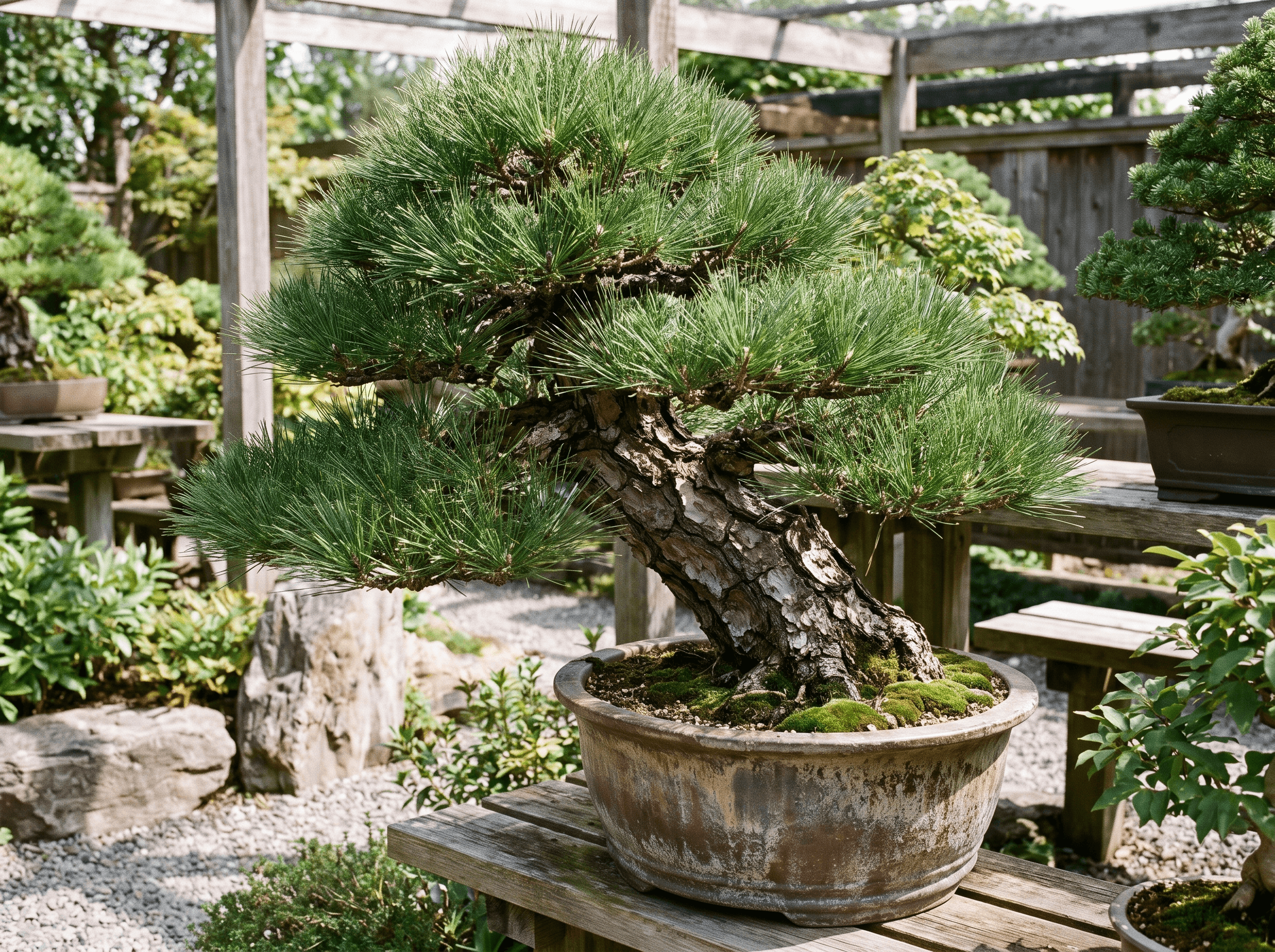
I tell people to get a couple of years of juniper or Chinese elm under their belt before they take on a pine seriously, and I stand by that. It's not that pine is fragile. Japanese black pine in particular is a tough, sun-loving tree that shrugs off a lot of what beginners throw at it. The difficulty is technical, not survival: getting the dense, tiered, cloud-like pad structure you see on show-quality pines takes a specific annual rhythm of candle work and needle thinning, and if you skip that rhythm for a year or two the tree doesn't die, it just turns into a leggy shrub with pine needles on it.
Black pine and Scots pine get lumped together as "pine bonsai" but they behave differently enough that it's worth being clear about which one you have, and which one you have also determines whether classic candle-pruning applies at all: it's a technique for two-flush pines like Japanese black pine and Japanese red pine, not for pines generally. Japanese black pine is a strong, sun-loving tree that tolerates hot, dry summers well, which is part of why it suits most of the Mediterranean climate found across southern Italy. Scots pine is generally considered better suited to colder, more northern or montane winter climates than black pine, and in my experience it tends to grow less vigorously in a consistently mild coastal spot. If your winters barely dip near freezing, black pine is the more forgiving choice.
The biggest misconception I run into is people treating pine like they'd treat a juniper: pinching new growth by hand all season, cutting wherever they like, expecting the tree to back-bud from bare old wood the way a juniper does. Pines don't work like that. New buds mostly form near existing foliage, not from bare interior branches, which is why the pad structure has to be built up deliberately over years rather than corrected after the fact. Get the fundamentals of candle-pruning and needle plucking right, though, and pine rewards you with some of the most convincingly aged, powerful trunks in the whole hobby.
Care
Light
Full sun is essential for pine, with very few exceptions. Pines are among the most light-hungry species you'll grow as bonsai, and insufficient light shows up as long, weak internodes and sparse, yellowish needles rather than the tight, dark green growth you want. Outdoors, on a bench with unobstructed sun for most of the day, is the only real option. I've never had a pine do well in partial shade for any extended period, even species that supposedly tolerate it; growth just slows and the tree loses density. If you're growing black pine in a hot southern climate, it handles full midday sun better than most conifers, so there's rarely a need to shade it the way you might a maple.
Watering
Let the soil surface dry out a little between waterings, then water thoroughly. Pines are considerably more tolerant of brief dry spells than junipers or broadleaf species, which is part of why they're forgiving once established, but they genuinely dislike sitting in constantly wet soil far more than most conifers do. Root problems on pine tend to show up slowly, as gradual needle yellowing over a season rather than sudden collapse, which makes overwatering an easy mistake to make repeatedly without noticing the cause. In summer heat a pine in a shallow bonsai pot still needs checking daily, but resist the urge to water on a fixed schedule just because that's what worked on your juniper.
Temperature & hardiness
Japanese black pine handles hot, dry summers well and doesn't have the strict cold-dormancy demands of some other conifers, which makes it a solid choice for most of southern Italy. Scots pine is generally considered better suited to colder, more northern or montane climates than black pine; growers in consistently mild, frost-light regions often find it less vigorous there, though I'd treat that as a general tendency rather than a hard rule. If you want a hardy, cold-climate pine specifically and your winters stay mild, black pine will likely reward you more than Scots pine will. Either species left outdoors, pot protected from hard freezes if they occur, is the right approach; neither wants to come indoors.
Soil & potting
A fast-draining, mineral mix is essential, if anything more strictly than for junipers, since pine roots are particularly sensitive to staying wet. Akadama, pumice, and lava rock in roughly equal parts is a reliable baseline, and some growers push the pumice and lava ratio higher for pine specifically to guarantee airflow around the roots. Pines also form a beneficial relationship with mycorrhizal fungi in the soil, which helps with nutrient uptake, so when you repot it's worth reusing a little of the old soil rather than starting completely sterile every time, since that's the simplest way to carry some of that fungal community forward.
Fertilizing
Pines are heavier feeders than junipers and respond well to a full season of steady fertilizing from spring through early autumn, tapering off as growth slows. The timing gets more nuanced if you're decandling a black pine for the classic two-flush technique: some growers adjust feeding around decandling, easing off in the weeks before and resuming once the second flush of buds appears, though exact practice varies and is worth learning from a local grower experienced with your climate rather than following one fixed rule. If you're not decandling and just growing the tree on, a straightforward balanced feed through the growing season is fine, and organic pellets left on the soil surface work well for slow, steady release.
Pruning & wiring
This is the technical heart of pine bonsai. Candle-pruning, also called decandling, is a technique for two-flush pines like Japanese black pine, done on established, vigorous trees in early summer: the new elongating shoots (candles) are cut back, which forces the tree to push a second, shorter flush of growth with smaller needles and tighter internodes, and it's exactly this two-flush cycle that builds the dense, refined pads people associate with quality black pine bonsai. Scots pine and other single-flush pines aren't decandled the same way; forcing a second flush isn't part of how they grow, so black pine technique doesn't transfer directly to them. It's not something to do on young, weak, or recently repotted material, and timing matters more than most other techniques on this list, so it's worth researching your specific climate's window before attempting it the first time. In autumn, thin and pluck older needles by hand to let light reach the inner canopy and to balance vigor between strong and weak areas of the tree, since pines that are left to grow unchecked tend to get leggy at the branch tips and bare in the interior. Wiring is done on lignified, not brand-new, growth, generally in the cooler months, and pine branches can be brittle at bends, so work slowly and check regularly as the wood thickens.
Repotting
Pines are repotted less frequently than junipers, often every three to five years or so depending on age and vigor, since disturbing the roots too often works against the mycorrhizal relationships the tree relies on. Let the tree's own vigor and root growth guide the exact timing rather than following the interval rigidly. Early spring, just as buds begin to swell, is the right window. Root work should be more conservative than you'd do on a juniper or elm; remove old, spent soil from the outer portion of the root mass but avoid aggressive bare-rooting, and get the tree back into a well-draining mix quickly. After repotting, keep the tree somewhat sheltered from harsh direct sun and wind for a couple of weeks, though full shade isn't necessary or even desirable for long.
Common problems
Yellowing needles are the most common complaint, and the cause is almost always one of a handful of things: soil that's staying too wet, roots that were disturbed too aggressively at the last repot, or simply not enough light. Aphids and scale insects show up on pines from time to time, usually clustering on new candles or the undersides of needle clusters, and are worth checking for whenever growth looks stunted or sticky residue appears. Needle drop from the interior of the tree is often perfectly normal, since pines naturally shed older needles after a couple of years, but if it's happening on young, current-season growth that points to stress rather than natural aging. A pine that pushes weak, undersized candles across the whole tree, rather than in just one area, usually means the roots need attention rather than the foliage.
Styling
Pine is the species most associated with the classical, powerful bonsai image: thick, tapering trunks, strong deadwood, and dense, cloud-like foliage pads built up over years of candle-pruning and needle thinning. Formal and informal upright styles suit black pine especially well, and older nursery or collected material often has enough trunk movement and bark character to support a bold, masculine silhouette without much additional work. Windswept and semi-cascade forms work too, particularly for pines that have grown in exposed, coastal conditions, which gives the trunk a naturally weathered look. Deadwood techniques like jin are used on pine as well, though pine deadwood needs more maintenance than juniper's to resist rot, since it isn't naturally as resistant.
Common questions
What's the difference between black pine and Scots pine for bonsai?
Japanese black pine tolerates hot, dry summers well and doesn't need a severe winter, which makes it the better choice for most of southern Italy. Scots pine is generally better suited to colder, more northern or montane climates and tends to be less vigorous in consistently mild conditions. Both are classic bonsai subjects, but they suit different climates.
What is candle-pruning and when do I do it?
Candle-pruning, or decandling, is cutting back the new elongating shoots on an established, vigorous two-flush pine, most commonly Japanese black pine, in early summer to force a second, more refined flush of growth with shorter internodes and smaller needles. It's a technique for mature, vigorous trees, not young or weak ones, and it doesn't apply to single-flush pines like Scots pine. The exact timing depends on your local climate, so it's worth learning from a local grower or a dedicated guide before trying it for the first time.
Can I grow pine bonsai indoors?
No. Pines need full outdoor sun and a genuine seasonal cycle to stay healthy, and indoor light is nowhere near strong enough. A pine kept indoors will decline slowly, with thinning, yellowing foliage over a season or two, which makes the cause easy to miss until the tree is in serious trouble.
Is pine bonsai good for beginners?
I'd generally say no, or at least not as a first tree. Pines are hardy and forgiving in terms of survival, but building the tight, refined foliage pads pines are known for takes a specific technical rhythm of candle work and needle thinning that's easy to get wrong. It's a great second or third species once you've got some pruning and wiring experience under your belt.
Why are my pine needles turning yellow?
Usually one of three things: soil staying too wet, roots that were disturbed too much at the last repotting, or insufficient light. Check drainage and root health before assuming disease, and remember that pines shed some older interior needles naturally each year, which isn't a problem on its own.
How often should I repot a pine bonsai?
Often every three to five years or so for an established tree, done in early spring as buds begin to swell, though the right interval really depends on the individual tree's vigor and root growth. Pines don't want the frequent, aggressive root work that junipers tolerate well; be more conservative, and try to preserve some of the beneficial fungal relationships in the existing soil when you do repot.
Do I need to pluck needles on my pine?
Yes, for a refined tree it matters. Thinning older needles in autumn lets light reach the inner canopy, keeps the tree from getting leggy and bare in the middle, and helps balance vigor between strong and weak branches. It's a routine maintenance task on a mature pine, done by hand rather than with scissors.
You might also like
General guidance based on 20+ years of practice. Every tree and every climate is different — when in doubt, ask us.