
Montpellier Maple Bonsai
Acer monspessulanum
Montpellier maple bonsai care flips the usual maple rulebook: this is a Mediterranean native that tolerates full sun and short dry spells better than most maples, and for anyone gardening in a hot, dry southern climate like mine, that trait makes it one of the more practical maples you can grow.
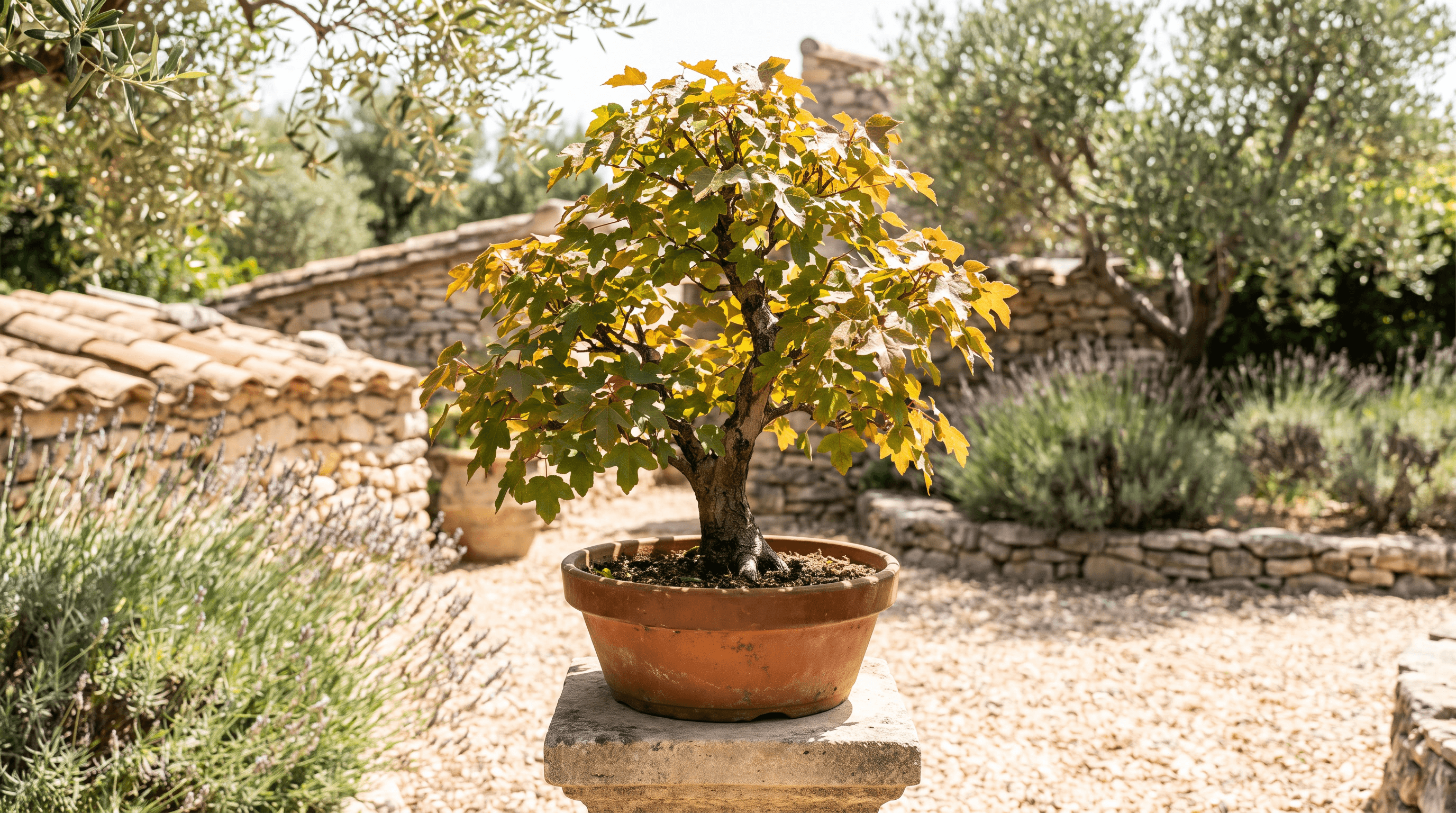
Acer monspessulanum grows wild across rocky hillsides and scrubland from southern Europe through western Asia and Iran, and across North Africa, and it looks the part. The small, leathery leaves are simple and typically divided into three rounded lobes, glossy and quite different in texture from the palmate, multi-lobed leaf of Japanese maple, giving the foliage a distinctive character even at a glance. Growth is slower and more compact than Japanese maple's, which suits fine bonsai work once a tree is established, and the bark on older trunks develops a rugged, fissured quality that reads as properly old even on a moderately sized tree.
The real reason I'd point a grower toward this species, though, is what it tolerates. Most maples are sun-shy and thirsty by comparison, wanting protection from harsh afternoon light and soil that never fully dries out, and getting that placement wrong is the most common way people damage a maple bonsai. Montpellier maple is more forgiving on both counts. It evolved on dry, sun-baked limestone slopes, and EUFORGEN rates it the maple species best adapted to dry conditions, so an established tree tolerates short periods of drying and strong sun better than most maples in the genus. It's still a deciduous tree that needs a proper outdoor dormancy, and a bonsai rootball should still be watered thoroughly before it becomes completely dry, so it isn't a low-maintenance species overall, but the sun and drought tolerance set it apart from the rest of the genus in a way worth building your placement decisions around.
Care
Light
Full sun suits Montpellier maple well, and it tolerates hot afternoon sun noticeably better than many maples. That said, full sun isn't mandatory: RHS lists full sun to partial shade for this species, and in low, hot inland positions a little afternoon shade can help, while trees at cooler, higher elevations generally want the sunnier spot. Young trees and anything recently repotted still benefit from a little shelter while roots reestablish, but a mature, healthy specimen can sit in a sun-baked position through summer that would be a mistake for almost any other maple in this genus.
Watering
This is one of the places Montpellier maple departs from the rest of the maple family, though less dramatically than its wild drought tolerance might suggest. It tolerates short periods of drying better than many maples, a trait inherited from growing wild on dry, rocky Mediterranean hillsides, but a bonsai rootball confined to a shallow pot is a different matter from a mature tree rooted in open ground, and it should still be watered thoroughly before it becomes completely dry. A young tree or one still building its root system needs even more careful, regular watering during its first couple of seasons, so I wouldn't treat this as a species you can neglect from day one. Good drainage matters, as it does for any maple, but that's a reason to avoid waterlogging rather than a reason to let the pot run dry.
Temperature & hardiness
Montpellier maple handles winter cold well for a Mediterranean-associated species: RHS rates it H6, the same hardiness category as field maple and Deshojo, and its natural range runs from central and southern Europe through western Asia and Iran, plus parts of North Africa, so it's not simply a mild coastal tree. It is less cold-adapted than Amur maple, and in genuinely warm-winter locations it can stay semi-evergreen rather than losing its leaves fully, but as bonsai it belongs outdoors year-round and follows a natural seasonal cycle like any deciduous maple. For growers in southern Europe, and especially anywhere with hot, dry summers, it's a well-matched species that handles heat at least as easily as it handles cold.
Soil & potting
Use a free-draining mix with good structure; this species tolerates a wide range of soils in the wild, including poor and alkaline ground, but RHS still recommends moist, well-drained conditions rather than anything deliberately dry. A bonsai mix that drains freely without holding excess water around the roots suits it well. Good drainage matters as much here as it does for most maples, so avoid anything that stays soggy for extended periods.
Fertilizing
Feed through the growing season with a balanced fertiliser, but keep the quantities moderate. This is a naturally slower, more restrained grower than Japanese maple, and I've found it doesn't want or need the same level of feeding to stay healthy and develop well. Light, regular applications suit it better than heavy doses, and I taper off going into autumn the same as with any deciduous maple, letting the tree wind down toward dormancy rather than pushing late soft growth.
Pruning & wiring
The small, already compact leaves mean ramification reads as fine relatively early, but the overall growth rate is slower than Japanese maple, so building a dense branch structure takes patience measured in additional seasons rather than being a quick process. On refined trees, pinch selected strong shoots as they extend; on trees still building branches or trunk thickness, allow extension before cutting back, since repeated pinching on an undeveloped tree does more harm than good over time. As with the rest of the genus, avoid hard structural cuts in late winter when sap is rising strongly; late autumn through midwinter, or late summer once growth has hardened off, are generally lower-bleed windows. Wiring works well on the flexible young growth, and the bark, while rugged on older wood, still marks on younger branches, so check wire regularly and remove it before it cuts in.
Repotting
Repot less frequently than you would a Japanese maple, since the slower growth rate generally means the roots take longer to fill the pot. Inspect root density and drainage each spring; younger, vigorous trees may need repotting sooner than established specimens, so let what you find in the pot guide the interval rather than a fixed schedule. Early spring, just before buds break, remains the right window. Because growth is naturally more measured, I'd give a Montpellier maple a bit more time to recover afterward before expecting vigorous new growth, compared with a faster-growing species.
Common problems
Leaf scorch, the single most common complaint with Japanese maple, is something I rarely see on this species even in a hot, sun-exposed position, and it's usually the first thing I rule out when a tree is struggling for some other reason and someone assumes it's sun damage out of habit. The more common mistake I see is the opposite: keeping the soil too consistently wet, out of a reflex built from growing other maples, which can lead to root problems since this species still wants good drainage even though it tolerates brief dry spells better than most. Aphids can still appear on new spring growth, though in my experience infestations tend to be lighter and less frequent than on Japanese maple. Tar spot and other leaf-surface fungal blemishes can occur but in my experience seem less common on the tougher, more leathery leaves of this species. Verticillium wilt, a soil-borne disease affecting maples generally, remains a possibility and typically shows as sudden decline on one side of the tree rather than an even, gradual one, so it's worth ruling out if a tree that's been growing well suddenly struggles without an obvious cause.
Styling
The small, simple, three-lobed leaves and naturally compact, twiggy growth habit suit Montpellier maple well to smaller and medium-sized bonsai, and the rugged, fissured bark that develops with age gives even a modestly sized trunk a convincing sense of maturity. Because it comes from rocky, exposed hillside terrain, it takes naturally to styles that echo that origin, informal upright with some windswept character, or planted among rock to emphasise the tough, weathered look the species carries honestly rather than artificially. Autumn colour tends toward yellow and orange rather than a vivid red display, so like field maple, this is a species I'd grow as much for its bark, silhouette, and sheer resilience in a hot garden as for a big seasonal colour show.
Common questions
Can Montpellier maple bonsai really tolerate full sun?
Largely, yes, and this is one of the traits that makes it unusual among maples. An established tree tolerates hot, direct afternoon sun noticeably better than most maples in the genus. RHS lists it as full sun to partial shade rather than full sun only, though, so in a very hot, low-elevation spot a little afternoon shade is a reasonable compromise.
Is Montpellier maple actually drought tolerant?
More so than most maples, once it's established, though less dramatically than its wild drought tolerance might suggest. EUFORGEN rates it the maple species best adapted to dry conditions, and it tolerates short periods of drying better than Japanese maple does. That said, a bonsai rootball in a shallow pot should still be watered thoroughly before it becomes completely dry, and a young tree still building its root system needs regular water.
Why is my Montpellier maple growing so slowly compared to my Japanese maple?
That's normal and expected. It's a naturally slower, more compact grower than Japanese maple, which is part of why the leaves stay small and fine looking even without heavy pruning. Ramification takes patience over additional seasons rather than arriving quickly.
Is Montpellier maple a good choice for a hot, dry climate?
It's one of the best maples for exactly that situation. Most maples want protection from strong sun and consistent moisture, but this species tolerates heat and dry spells unusually well for the genus, which makes it a practical choice for southern or Mediterranean gardens where Japanese maple often struggles.
Why does my Montpellier maple's autumn colour look muted?
That's typical for the species. It tends toward yellow and orange rather than the vivid red Japanese maple can produce, so it's better appreciated as a tree grown for bark, structure, and toughness across the year than for a dramatic autumn display.
How often does Montpellier maple bonsai need repotting?
Less often than Japanese maple, generally, since the slower growth rate means the roots take longer to fill the pot. It's still worth checking root density and drainage each spring, since younger, more vigorous trees can need repotting sooner than an established specimen. Early spring, just before the buds break, is the right time to do it when needed.
General guidance based on 20+ years of practice. Every tree and every climate is different — when in doubt, ask us.