
Aleppo Pine Bonsai
Pinus halepensis
Aleppo pine bonsai (Pinus halepensis) is especially well suited to hot Mediterranean climates: this is a tree built for heat, drought and thin, rocky soil, and once you stop treating it like a delicate import it turns out to be one of the more forgiving pines you can grow in a genuinely hot climate.
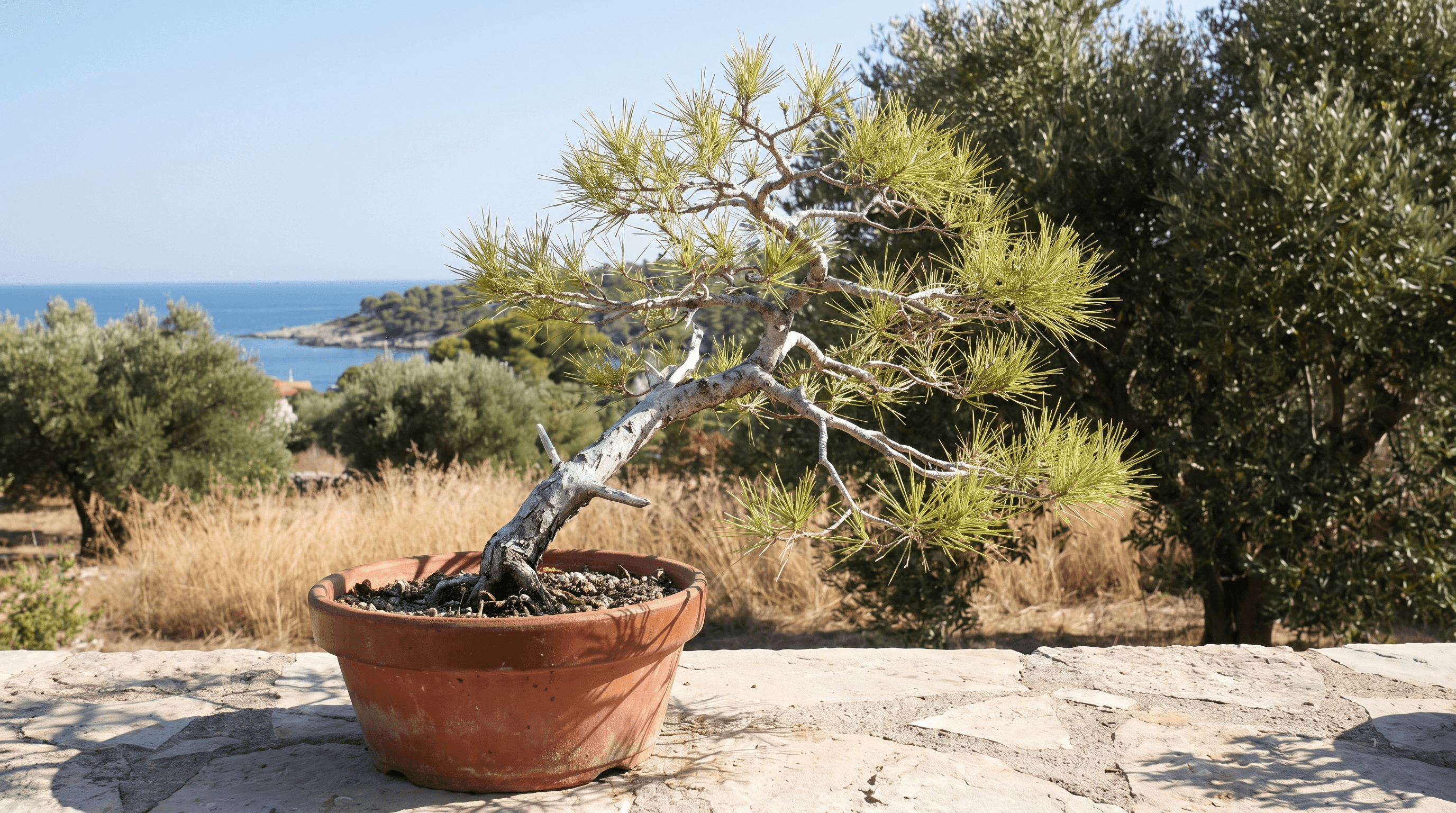
Anyone who has driven along a Mediterranean coastline has seen Aleppo pine without necessarily knowing its name: the loose, wind-shaped trees clinging to limestone cliffs and roadside embankments from Spain across to Greece and deep into southern Italy. It's one of the most drought-adapted pines in cultivation, at home on poor, dry, often barely-there soil where a lot of other conifers would simply give up. That background matters for bonsai, because it means the tree arrives with a genuine tolerance for the kind of summer conditions that stress out species bred for a cooler, wetter native range.
Compared with Japanese black pine, Aleppo pine has a noticeably lighter, more open growth habit. The foliage reads as finer and airier rather than simply longer, needle length between the two species actually overlaps more than people assume, but the branching is less densely packed, and the whole tree reads as looser and less muscular than the classic black pine silhouette. That's not a flaw, it's just a different character, closer in spirit to the loose, sun-bleached pines you see growing wild on a Mediterranean hillside than to the dense, cloud-pruned pads of a show-quality black pine. If you're after that heavier, more sculpted look, black pine or red pine will get you there more directly.
Where Aleppo pine genuinely earns its place on this list is climate. Growers working in the hottest parts of southern Italy, or anywhere with long, intense, dry summers, sometimes find that Japanese species need real babying through August, extra shade, closer watering attention, more stress-related dieback than the books suggest. Aleppo pine tends to handle that same stretch with less drama. It evolved for exactly this weather. That doesn't mean it's a beginner tree in every sense, pine technique in general takes time to learn properly, but if your climate is the limiting factor with other pines, this is the one built to shrug it off.
Care
Light
Full sun, without reservation. Aleppo pine comes from open, exposed, often rocky ground with nothing shading it, and it wants the same in a pot. It handles harsh, direct midday sun in high summer as well as any pine I grow, so there's rarely a reason to give it afternoon shade the way you might for a maple or even a juniper. Insufficient light shows up the same way it does on any pine: elongated, weak growth and thin, pale needles rather than the tight, healthy density you're after.
Watering
Let the soil dry out toward the surface between waterings and then water well. Aleppo pine's drought tolerance in open ground is real, but a shallow bonsai pot is a different environment altogether, and a hot, dry rootball can stress or even kill a genuinely drought-adapted pine faster than the same tree would tolerate growing in the ground. Don't mistake habitat toughness for a tree that likes wet feet either, because it doesn't. In the ground it survives on soils that drain almost instantly; in a pot it still needs a mix that clears water fast and roots that never sit soggy. In peak summer heat, check daily regardless of how tolerant the species is supposed to be, since a small pot dries unevenly and heats up in ways open ground never does.
Temperature & hardiness
This is fundamentally a warm-climate, coastal-to-lowland Mediterranean tree, and it's less at home in hard, prolonged winter cold than either Japanese black pine or Scots pine. For most of coastal and southern Italy that's a non-issue, it's arguably better matched to the local climate than either of those two. If you're further inland or at altitude, where winter frosts are harder and longer, I'd be more cautious with this species than with black pine, and would want the pot given some real protection during any serious cold snap rather than assuming the tree will shrug it off the way it shrugs off summer heat.
Soil & potting
A fast-draining, mineral mix along the same lines as any other pine works well, akadama, pumice and lava rock in a roughly even split is a sound starting point. Given how well this species tolerates lean, rocky, low-nutrient ground in habitat, there's little to gain from a richer mix, and a lot to lose if drainage is even slightly compromised. Like other pines, Aleppo pine benefits from the mycorrhizal fungi that build up around its roots over time, so at repotting it's worth leaving part of the established root mass undisturbed rather than bare-rooting the whole thing, to preserve those root and fungal associations.
Fertilizing
This is a vigorous grower when it's happy, often more vigorous than black pine in a hot climate, and it responds well to steady feeding through spring and into early autumn, tapering off as growth slows. Because the natural habit is already open and extension-prone, I tend to watch fertilizer a little more carefully on Aleppo pine than on a tighter-growing species, since overfeeding a tree that already wants to throw long shoots just gives you more long shoots to deal with later. A balanced feed at sensible strength, adjusted down if the tree is clearly getting leggy, works better than pushing maximum growth.
Pruning & wiring
Aleppo pine isn't as standardized a decandling subject as Japanese black or red pine, but it shouldn't simply be written off as a single-flush pine either. In hot, long Mediterranean growing seasons, vigorous, well-established trees can respond strongly to decandling and may throw several flushes in a year even without any candle work at all; growers in hot climates such as Israel and Malta have had real success managing it much the way they manage red pine. In cooler or shorter-season climates, the response to decandling is far less predictable, and forcing the technique on a weak or newly potted tree is more likely to cost you a season than gain one. So before deciding whether to decandle a given tree, weigh three things: your climate (long, hot summers favor it), the tree's vigor (only decandle a genuinely strong, healthy tree), and whether you're aiming to hold juvenile or mature foliage, since hard cutback tends to stimulate a flush of juvenile growth rather than the mature needle form. If any of those factors are working against you, fall back on shortening or removing overly long new shoots during the growing season and thinning congested areas to keep light reaching the interior, since the tree's naturally open habit can tip into genuinely sparse and leggy if left unchecked for a season or two. Its finer foliage and naturally open growth habit can make dense classical pad construction different from black pine's, although mature needle length itself isn't necessarily any greater. Wiring follows the usual pine rules: work on wood that's hardened off rather than brand new growth, and go slowly, since pine branches in general can be brittle at sharp bends.
Repotting
Repot on a similar interval to other pines, roughly every few years for an established tree rather than annually, timed for early spring as the buds begin to swell. Root work should be moderate rather than aggressive: clear old soil from the outer portion of the root mass, keep some of the beneficial fungal network intact, and get the tree back into a fast-draining mix promptly. Given how well this species tolerates poor soil and heat, it's tempting to assume it tolerates rough root handling equally well, but I wouldn't push that assumption; treat the roots with the same general care you'd give any pine.
Common problems
The problems that show up on Aleppo pine aren't always the ones you'd expect from a tree this tough. Wet roots are a common cause of trouble, soil that isn't draining as well as it should, or roots disturbed too heavily at the last repot, can both show up as yellowing needles, and it's worth ruling those out before assuming the tree is simply thirsty. That said, a hot, dry rootball in a shallow pot can stress a tree quickly too, so don't swing to the opposite extreme and assume this species is immune to drought stress in a container the way it is in open ground. Unexpected hard frost, if the tree is somewhere colder than its comfort zone, can cause dieback on tips or whole branches, which is the flip side of a species this warmth-adapted. Aphids and scale can turn up on new shoots the same as on any pine and are worth checking for if growth looks stunted or sticky. Pine processionary moth (Thaumetopoea pityocampa) is a real pest risk on Aleppo pine specifically, and one that matters most to Mediterranean and Italian growers; its silky winter nests and the irritant hairs on the caterpillars are worth learning to recognize and deal with promptly rather than leaving in place. And because the natural habit is open, a tree that's been left unpruned for a year or two often just looks thin and straggly rather than diseased, which is a training issue rather than a health one.
Styling
Aleppo pine's naturally loose, wind-shaped character in habitat, clinging to exposed cliffs and coastal slopes, makes it a strong candidate for windswept and informal upright styles where that lighter, airier structure is an asset rather than something to fight. Literati suits it well too, since the longer internodes and thinner branching that make dense classical pads harder to achieve translate nicely into a tall, sparse, weathered silhouette. It doesn't lend itself as naturally to the heavy, powerful, densely padded look black pine is known for, and I'd steer people away from chasing that particular result with this species. Older field-grown or collected material, especially anything with real trunk movement picked up from growing in exposed, rocky conditions, tends to give the most convincing results, letting the tree's own history do a lot of the styling work.
Common questions
How is Aleppo pine different from Japanese black pine for bonsai?
Aleppo pine has a lighter, more open growth habit with finer, airier foliage, compared to black pine's denser, more compact structure; needle length between the two actually overlaps rather than Aleppo's reliably being the longer of the two. It's also more genuinely suited to hot, dry Mediterranean summers, where some Japanese species need more careful attention in a container. Black pine builds the classic dense, cloud-pad silhouette more directly; Aleppo pine tends toward a looser, more windswept character.
Is Aleppo pine a good choice for a hot southern climate?
Yes, it's one of the better choices specifically for that reason. It evolved in exposed, dry, rocky Mediterranean conditions and generally tolerates summer heat with less fuss than the Japanese pine species can show in the same weather. It's not a shortcut to skipping pine technique altogether, but the climate side of the equation works in its favor.
Do I decandle Aleppo pine the way I would black pine?
It depends on your climate and the tree's vigor rather than being a simple yes or no. Aleppo pine isn't as standardized a decandling species as black or red pine, but in hot, long Mediterranean growing seasons a strong, healthy tree can respond well to decandling and may throw multiple flushes in a year on its own. In cooler climates or on a weaker tree, the response is far less reliable, and I'd fall back on shortening long shoots and thinning instead. Hard cutback also tends to trigger juvenile foliage rather than mature needles, which is worth knowing before you commit to the technique on a given tree.
Does Aleppo pine need winter protection?
It depends heavily on where you are. In mild coastal or southern climates it's generally fine outdoors year-round. In colder inland or higher-altitude spots, it's less cold-hardy than black pine or Scots pine, so I'd give the pot real protection during any hard freeze rather than assume the tree's drought toughness extends to cold tolerance, since it doesn't.
Why does my Aleppo pine look thin and straggly?
Most often that's just the species' naturally open habit left unchecked, rather than a health problem. Left unpruned for a season or two it tends toward long, sparse growth. Shortening overly long shoots and thinning congested areas during the growing season keeps it denser and more compact.
Can Aleppo pine handle poor soil and infrequent watering?
In the ground, remarkably well, it's adapted to exactly that. In a bonsai pot the calculation changes: a shallow pot dries and heats faster than open ground, and a hot, dry rootball can stress this species faster than its reputation for toughness would suggest. It still needs a genuinely fast-draining mix and doesn't want to sit wet, so treat watering with the same care you'd give any pine in a container rather than relying on drought tolerance alone.
Is Aleppo pine suitable for a beginner?
It's a reasonable pine to start with if your climate is hot and dry, since the survival side of care is genuinely more forgiving than with some other species. That said, all pine bonsai involves a learning curve around pruning and structure, and I'd still recommend getting some general pruning and wiring experience first, on any species, before taking on a pine as your first serious project.
General guidance based on 20+ years of practice. Every tree and every climate is different — when in doubt, ask us.