
Dark spots on bonsai leaves (fungal leaf spot)
Discoloured spots on bonsai foliage, often with a defined edge or a yellow halo, usually point to fungal leaf spot rather than a pest, though a yellow halo alone isn't proof, so it pays to rule out other causes before treating.
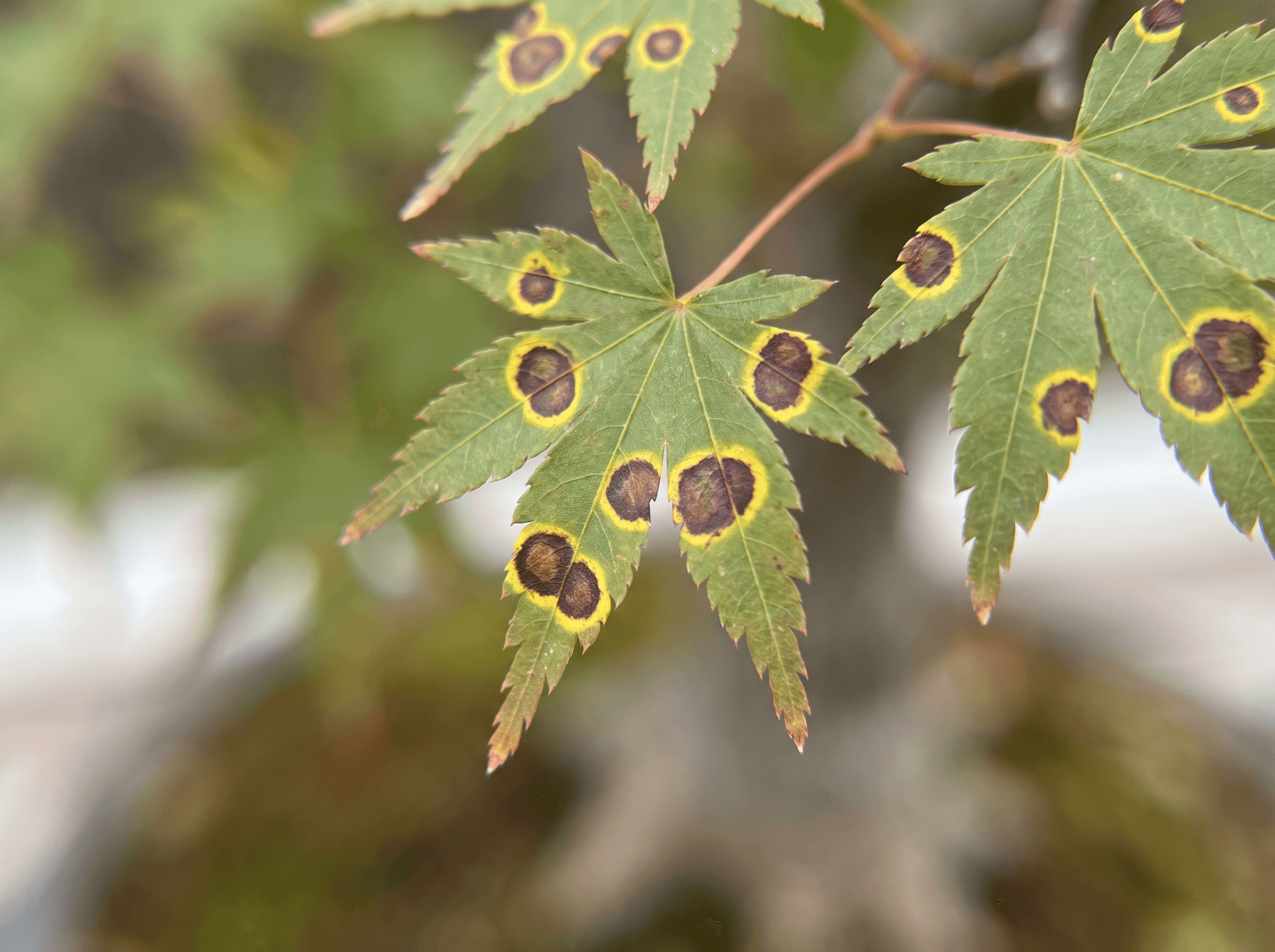
Fungal leaf spot isn't one single disease, it's a catch-all name I use for a handful of fungi that all do roughly the same thing: land on a wet leaf, establish themselves in the tissue, and produce a visible spot as they feed. They're opportunists. They don't attack a healthy, dry-leafed tree with any real success, they wait for conditions to tip in their favour, then move fast. That's why the same tree can sit clean for months and then, after a wet week, be covered in spots within a few days.
What's actually at risk depends on how far it gets. A handful of spots on older leaves is mostly cosmetic, and I wouldn't lose sleep over it on a tree that's otherwise growing well. Left to spread through the canopy, though, it starts cutting into the leaf area the tree has available for photosynthesis, and a bad infection late in the season can trigger premature leaf drop right when the tree should be building reserves for winter. On a tree that's already stressed, from a recent repot or a hot summer, that extra drain matters more than it would on a vigorous one.
You'll see it most after stretches of humid or rainy weather, or on trees that get watered overhead in the evening and go into the night with wet foliage. It also shows up disproportionately on trees kept too close together on the bench, where air barely moves between the canopies, and on anything brought indoors for winter without proper ventilation. In my experience the first spots usually appear on the lower, older leaves, closest to the soil and the most sheltered from air movement, before working their way up if nothing's done about it.
Likely causes
Fungal leaf spot infection
How to tell: Brown, black or reddish spots scattered across the leaves, sometimes ringed with a yellow halo, appearing during humid or rainy weather. The spots often start small and roughly circular, then merge into larger blotches as the infection spreads, and on a bad case you'll find them on both young and old growth at once. I see this most on ficus, elm and maple bonsai, though almost any species can pick it up given the right conditions. A yellow halo isn't proof of fungus on its own though, bacterial leaf spot can produce a similar ring, so if the spots look water-soaked or have angular edges that follow the leaf veins, if they're spreading fast over a few days, or if this is a particularly valuable tree, it's worth getting the diagnosis confirmed before you start treating it as a fungal problem.
The fix: Remove visibly affected leaves where it's practical to do so, but don't strip a badly defoliated or already stressed bonsai of all its foliage in one go, take the worst leaves first and clear the rest over a week or two if the canopy has taken a real hit. Bin what you remove rather than tossing it on a home compost pile near your other trees, casual cold composting often doesn't get hot enough to kill the spores, and only a properly hot compost heap reliably will. Improve airflow around the tree by thinning crowded interior growth and spacing it away from neighbouring plants, and switch to watering the soil rather than the foliage. If the spots keep appearing after that, a copper-based fungicide can help protect the healthy growth that's left, though it won't cure leaves that are already infected, it mainly stops new tissue from being colonised. Use a product labelled for the plant and disease, follow the label's rate and interval, and test it on a small area of foliage first since some bonsai species are sensitive to it. Disinfect your scissors with alcohol between cuts so you're not spreading spores yourself from leaf to leaf.
Water splashing onto leaves
How to tell: Spots cluster on the lower leaves closest to the soil, where splash-back from watering lands with every pass of the can. Look closely and you'll often see a faint dirt or soil residue on the underside of those same leaves, which is a good sign the water, not the air, is the delivery mechanism here.
The fix: Water directly at the soil level with a can that has a narrow spout, rather than overhead with a rose, so the foliage stays dry. A layer of fine mulch, grit or moss over the soil surface cuts down splash-back significantly, and it's worth doing even on trees that look clean, since it's one of the cheapest preventive steps available. If you water in the evening, switch to morning instead, so any residual moisture on lower leaves has the whole day to dry off rather than sitting wet overnight.
Spores overwintering in old leaf litter
How to tell: Spots reappear early in the season, right as new growth is pushing out, on a tree that had leaf spot the previous year. This is a reinfection rather than a fresh problem, and it tends to hit hardest if last autumn's fallen leaves were left sitting in the pot or scattered around the bench instead of being cleared away.
The fix: Clear fallen and pruned leaves from the pot and the surrounding bench promptly through autumn and winter, and bin them rather than cold-composting them near your other trees, since a casual home compost pile often doesn't run hot enough to kill the spores, where a hot pile can. On a tree that had a serious infection the year before, check the moss or top dressing for trapped leaf litter and clear it out or replace that layer if it's been holding diseased debris, rather than refreshing the soil as a routine step every spring, the spores are a real risk where infected material has actually collected, not in bonsai soil generally.
How to prevent it
Most of prevention here comes down to managing moisture and airflow rather than reaching for fungicide as a first resort. Keep foliage dry when you water, direct the can at the soil rather than over the top of the tree, and if you can only water at one time of day, choose morning so any splash has hours to dry before evening humidity sets in. Give the tree real airflow, both by thinning dense interior growth on the tree itself and by leaving space between it and neighbouring pots on the bench, since stagnant, still air around foliage is what lets a light infection turn into a heavy one. Clear fallen leaves and pruning debris promptly rather than letting them accumulate in the pot, since fungal spores overwinter there and reinfect the tree the following spring almost like clockwork. A tree kept generally vigorous, with reasonable feeding and not chronically overwatered or underwatered, also resists infection better than one that's already under stress, so treat leaf spot prevention as part of overall tree care rather than a separate task.
Common questions
Should I remove all the spotted leaves at once?
For a moderate infection, yes, remove what's visibly affected as soon as you find it rather than waiting. On a tree that's lost a large share of its canopy to spotting already, though, stripping every spotted leaf in one go can shock it further, so it's sometimes better to remove the worst offenders first and take the rest over a week or two as the tree recovers.
Will leaf spot come back next year?
It can, particularly if the fungal spores that caused this year's infection overwintered in fallen leaves or debris left near the pot. Clearing that debris promptly and adjusting how you water through the following growing season cuts the odds considerably, though a species prone to it in your particular growing spot may need ongoing vigilance rather than a one-time fix.
Is fungal leaf spot contagious to other bonsai nearby?
Yes, spores spread readily by water splash and by wind over short distances, so a tree with an active infection sitting close to healthy ones is a real risk. Give an infected tree some extra space on the bench while you're treating it, and avoid watering it in a way that splashes onto its neighbours.
Can I keep training and wiring a tree that has leaf spot?
Light training is generally fine, but I'd hold off on anything that adds significant stress, like a hard prune or a repot, until the infection is under control. A stressed tree is slower to recover from disease, and piling on more stress at the same time tends to prolong both problems rather than resolve either one faster.
How is fungal leaf spot different from sunburn or leaf scorch?
Scorch from sun or heat usually shows as dry, papery patches concentrated on the side of the canopy facing the strongest light, often with a fairly uniform brown edge and no yellow halo. Fungal leaf spot tends to be more scattered across the whole tree, appears after wet weather rather than hot dry spells, and often has that ringed, discoloured margin around each spot that scorch doesn't produce.
Does fungal leaf spot affect indoor bonsai as well as outdoor ones?
It does, and indoor trees are sometimes more at risk, since indoor air tends to be stiller than outdoors and humidity can build up around the foliage without a breeze to dry it off. A small fan run for part of the day near an indoor bonsai, combined with careful soil-level watering, makes a real difference for trees that winter indoors.
You might also like
General guidance based on 20+ years of practice. Every tree is different — when in doubt, ask us.