
How to Water a Bonsai Tree Correctly
Watering a bonsai correctly comes down to two things: soak it thoroughly every time, and check the soil before you do it rather than following a fixed schedule.
This is the question I get asked more than any other, usually from someone who's just brought home their first tree and is terrified of getting it wrong. The good news is that the mechanics are simple. The part that actually takes practice is judgment: knowing when to water, not just how.
A lot of people come to bonsai from houseplants, where a weekly watering routine mostly works because the pots are deep and the soil holds moisture for days. Bonsai pots are shallow, the substrate is deliberately fast-draining, and the root mass is small relative to the foliage above it. That combination means a bonsai can go from perfectly moist to bone dry in a single hot afternoon, especially outdoors in wind. A fixed schedule just doesn't survive contact with real weather.
The other thing worth saying up front: overwatering and underwatering both come from the same root cause, which is watering by the calendar instead of by the soil. If you check before every watering, you'll rarely get either one wrong for long.
Water thoroughly, every time
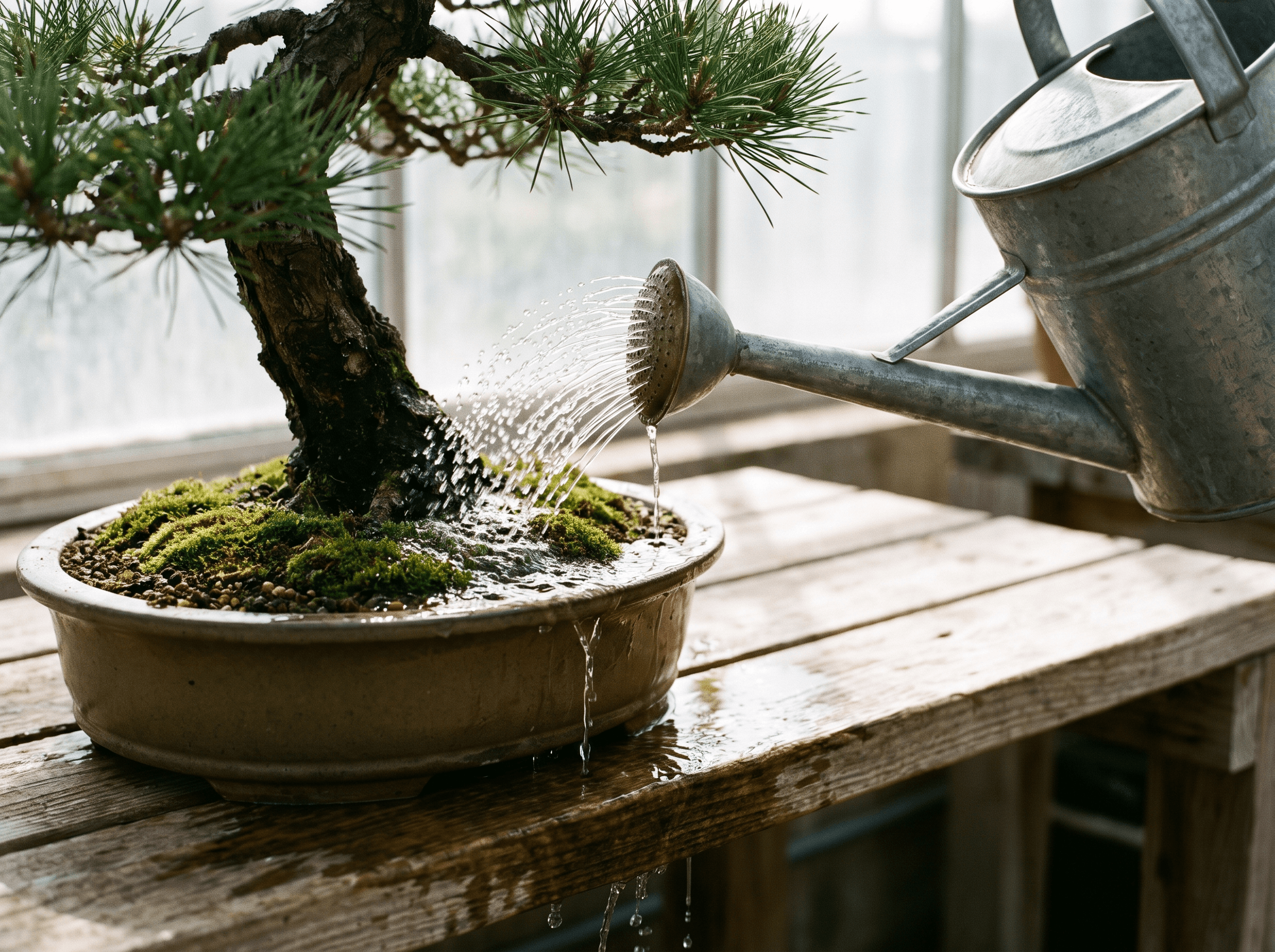
When you do water, water properly. Pour slowly over the whole soil surface until water runs freely out of the drainage holes, then, if the substrate is very dry, let it sit a minute and water again to make sure it's actually penetrated rather than channelled straight through the driest cracks. A quick splash on top that wets only the surface does almost nothing for the roots further down and trains you to think the tree is fine when it isn't. I'd rather see someone water less often but properly than water a little bit every day.
Check before you water, don't guess
Stick a finger into the top centimetre or so of soil, or lift the pot and get a feel for its weight when dry versus freshly watered. Some growers use a wooden skewer pushed into the soil and pulled out to check for dampness lower down. Whatever method you use, the point is the same: water when the soil actually needs it, not because it's Tuesday. In hot, dry, or windy weather that might mean daily or even twice daily for a small pot. In cool, overcast weather or during winter dormancy it might mean every few days or longer.
Match your watering can to the job
A watering can with a fine rose head spreads water gently across the whole surface without blasting soil out of the pot or exposing roots, and it's slow enough that you actually see when water starts running from the drainage holes. A hose on full blast or a cup poured straight down the middle of the pot tends to carve a channel straight through the substrate and out the bottom, leaving large parts of the root ball dry even though water clearly went in and came out.
Time of day matters more in some climates than others
Morning is generally the preferred time to water, since it gives the tree a full day of good moisture before the heat of the day sets in rather than sending it into the night already stressed. In hot, dry climates, an additional check in the evening is often worth doing too, mainly to stop the tree from going into darkness bone dry rather than for any disease-related reason. Neither rule is absolute; the underlying goal is just to avoid the tree sitting bone dry for long stretches.
Adjust for season and species
A tree in full leaf during the growing season is transpiring heavily and drinking a lot, so it needs checking often, sometimes daily in summer. The same tree in winter dormancy, especially a deciduous species that's dropped its leaves, needs dramatically less water since it isn't actively drawing moisture up through the canopy. Evergreens still need occasional watering through winter since they keep some foliage, just far less frequently than in summer. Species also vary: something naturally adapted to wet ground, like a bald cypress, tolerates far more consistent moisture than a Mediterranean species like olive, which actively prefers to dry out somewhat between waterings.
Common questions
How do I know if I'm overwatering my bonsai?
The soil stays wet for days without drying at the surface, you might notice a sour or stagnant smell from the pot, and in serious cases the tree wilts or drops leaves even though the soil is wet, a sign the roots themselves are struggling. The usual cause isn't watering too often on its own, it's watering on a fixed schedule regardless of whether the soil actually needs it, combined with a substrate that doesn't drain well enough.
Should I mist my bonsai instead of watering the soil?
Misting the foliage can help with humidity for some tropical species but it does almost nothing for the root system, which is what actually needs the water. Think of misting as an optional extra for certain species, not a substitute for properly soaking the soil.
Can I water my bonsai with tap water?
For most species and most tap water, yes, it's perfectly fine. The main exception is very hard or alkaline tap water combined with an acid-loving species like azalea or camellia, where mineral buildup over time can cause problems. If your tap water is notably hard and you're growing a sensitive species, rainwater is a reasonable alternative.
How long can a bonsai go without water?
It depends heavily on pot size, weather, and species, so there's no single safe number. A small pot in full summer sun can suffer real damage within a day of drying out completely. The safest approach for any absence longer than a couple of days is a plan, whether that's a neighbour checking in, a drip irrigation timer, or grouping pots in a sheltered, shaded spot to slow drying.
Is it bad to water a bonsai every day?
Not inherently, if the tree actually needs it. Small pots in hot, dry, or windy conditions during the growing season often do need daily watering. The problem is watering daily out of habit regardless of what the soil is doing, which is how overwatering happens even in a fast-draining mix.
Why does water run straight through my bonsai pot without wetting the soil?
This usually means the substrate has dried out enough to pull away slightly from the sides of the pot or has compacted, creating channels that water follows instead of soaking in evenly. Watering slowly, in two passes a minute or so apart, usually rehydrates the mix properly. If it happens constantly even with careful watering, the substrate itself may need replacing at the next repot.
Do I need to water differently right after repotting?
Yes. Water thoroughly right after repotting to settle the substrate around the roots, then keep the tree in a sheltered, shaded spot and monitor moisture closely rather than on your usual routine, since the disturbed root system is less able to take up water efficiently until new roots re-establish.
You might also like
General guidance based on 20+ years of practice. Every tree and every climate is different — when in doubt, ask us.