
Zelkova Bonsai
Zelkova serrata (Japanese zelkova)
Zelkova bonsai care is mostly about persistence: it's the tree behind the classic broom-shaped silhouette you've probably seen in every beginner's guide, and building that fine, symmetrical canopy is more about consistency than any single difficult technique.
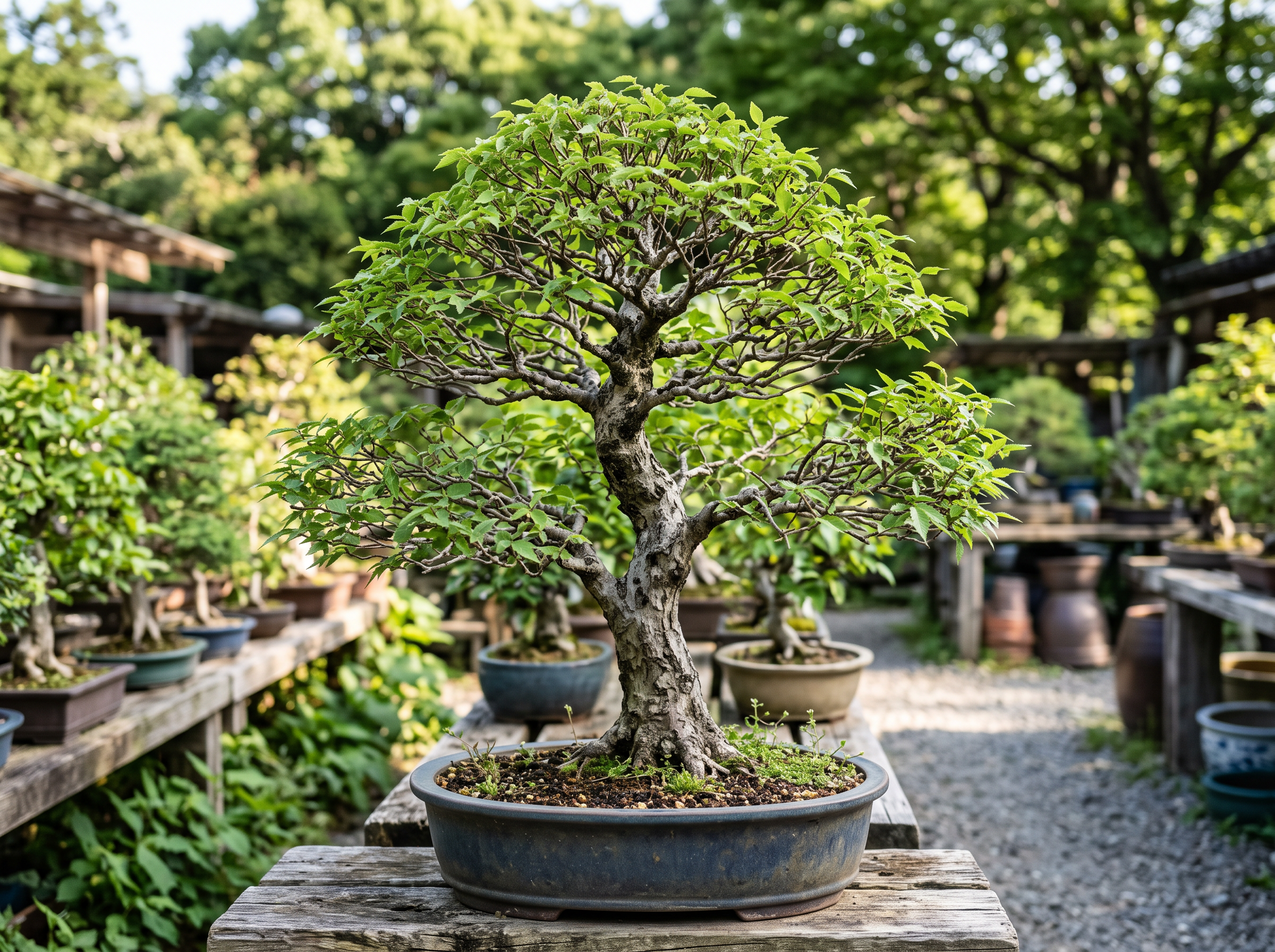
If you picture a stereotypical bonsai tree, straight trunk, flared roots, a perfectly symmetrical dome of fine twiggy branches, there's a good chance you're picturing zelkova, or at least a tree styled the way zelkova is typically styled. The broom form, hokidachi, is practically synonymous with this species, and it's not an accident: zelkova naturally wants to branch out fairly evenly from a single trunk in a way that lends itself to that shape better than most other deciduous trees. One practical note before we get into care: zelkova and Chinese elm (Ulmus parvifolia) get confused with each other constantly in the nursery trade, and trees sold under one name sometimes turn out to be the other, so if your tree's behaviour doesn't quite match what's described here, it's worth double-checking which species you actually have.
It's a vigorous grower, more so than people expect from a tree associated with such a refined, controlled silhouette, and that vigor is exactly why the classic broom canopy is achievable at all. Frequent pinching through the growing season is what keeps that vigorous growth channeled into tight, fine ramification rather than a few thick, unruly shoots. Skip a season of regular pinching and the canopy gets coarse and uneven fast, which is really the main technical challenge with zelkova: not any single difficult skill, just consistency.
It's a hardy, outdoor deciduous tree overall, though like any bonsai in a shallow pot it still needs its roots protected from serious frost rather than being left completely unguarded through a hard winter. It rewards outdoor exposure with genuinely good autumn colour on top of the summer canopy work, shifting to yellow-orange-bronze tones before the leaves drop, though the intensity varies from tree to tree. Between the classical silhouette, the manageable hardiness, and a second seasonal show in autumn, it's a species I'd recommend to almost anyone who wants a proper deciduous bonsai and is willing to put in regular, ongoing maintenance rather than the occasional big prune.
Care
Light
Full sun to light partial shade suits zelkova well, and it generally handles more direct sun without complaint than a Japanese maple does, thanks to its tougher leaves. Strong light supports the tight, fine ramification you're aiming for with a broom-style canopy, since shaded growth tends to stretch and get leggier, working against the dense, even silhouette that's the whole point of the style. Some relief from the harshest midday sun in a hot climate is sensible, but zelkova doesn't need the same careful afternoon shade planning that maple demands.
Watering
Keep the soil consistently moist through the growing season without letting it become waterlogged, watering thoroughly once the surface starts to dry. Zelkova has a fairly fine, fibrous root system and doesn't appreciate extended dry spells any more than a maple does, particularly during the vigorous summer growth period when it's using a lot of water to fuel all that new shoot production. In hot weather, small pots can dry out quickly, so check regularly rather than assuming yesterday's watering will carry through today.
Temperature & hardiness
Zelkova is a hardy outdoor deciduous tree and needs a real winter dormancy period the same as maple, but that hardiness applies more to the tree in open ground than to fine roots and branches confined to a shallow bonsai pot. Sustained, significant frost can damage fine roots and branch tips in a container even though the same tree would shrug off that cold in the garden, so protect the pot from prolonged hard freezes rather than leaving it completely unguarded. Left outdoors year-round for the dormancy it needs, with that root protection during hard freezes, is the right approach; there's no reason to bring it fully indoors or give it any special treatment beyond what you'd do for other hardy deciduous bonsai. This is still a comparatively low-stress tree to own, especially next to something like pomegranate with its more frost-sensitive roots, but fully hardy shouldn't be read as needing no winter protection at all.
Soil & potting
A standard, free-draining bonsai mix works well, akadama, pumice, and lava in typical proportions, similar to what you'd use for maple, since both species want good drainage combined with reasonable moisture retention rather than the more aggressively fast-draining mix a conifer prefers. Avoid anything that dries out within hours during summer heat, since the fine root system doesn't tolerate repeated drought stress well during the active growing season.
Fertilizing
Feed through the growing season with a balanced fertilizer, and given how vigorous zelkova's growth is, it generally tolerates and benefits from steady feeding rather than a particularly light touch, similar to how you'd feed elm. Ease off as autumn approaches and stop through winter dormancy. Consistent feeding through spring and summer supports the frequent pinching regime the broom style demands, since a tree that's being cut back constantly needs the resources to keep pushing new growth.
Pruning & wiring
This is the defining maintenance task with zelkova. Frequent pinching of new shoots throughout the growing season, letting each shoot extend to roughly three to six leaves or nodes before cutting back to one or two, is what keeps the canopy fine and tight rather than coarse and open, and it needs to happen repeatedly across the whole season rather than in one or two sessions. Zelkova is a vigorous grower and will happily get away from you if left unpinched for even a few weeks during peak growing season, so this is more about consistency than any technically difficult cut. Structural pruning to establish the main branch framework of a broom is generally done while the tree is dormant, in late winter, cutting the trunk to the desired height to encourage an even flush of branches radiating outward. Wiring is used sparingly on zelkova compared to more sculptural species, since the broom style relies more on selective pruning and branch density than on dramatic wired movement, though it's still useful for correcting individual branch angles early on.
Repotting
Young, vigorously growing trees are often repotted every one to two years, extending to two or three years as the tree matures, timed for early spring before new growth begins. Zelkova's fine, fibrous roots respond well to fairly regular repotting, and because the broom style depends so much on an even, radiating root flare (nebari) at the base, repotting is also a good opportunity to check and encourage even root development around the trunk. Comb out the roots reasonably thoroughly rather than doing minimal disturbance, since building a strong, even nebari is as much a part of the classic zelkova look as the canopy above it.
Common problems
A coarse, uneven canopy with a few thick, dominant shoots is the most common issue, and it's almost always a maintenance problem rather than a health one: not enough regular pinching through the growing season lets zelkova's natural vigor run unchecked in a few directions rather than spreading evenly. Leaf scorch can happen in extreme heat without any shade relief at all, though zelkova tolerates sun considerably better than maple does, so this is less of a concern than with that species. Aphids occasionally cluster on the new, tender shoots that this species produces so readily, worth checking for during the peak of the growing season when new growth is most abundant. Dieback on individual branches, distinct from the normal, even leaf drop of autumn, is worth investigating for root health or a fungal issue, since it's not typical for an otherwise healthy zelkova.
Styling
Zelkova is essentially the textbook species for broom style, hokidachi, where a straight, tapering trunk supports an evenly radiating dome of fine branches, and it's hard to think of another deciduous species that pulls off that silhouette as naturally or as often. Formal upright work suits it for the same reasons. Group and forest plantings are another classic use for zelkova, since several trees of slightly varying height, each developed with the same fine ramification, recreate the look of a mature deciduous woodland convincingly and relatively quickly given the species' vigor. Because the nebari and trunk base are so visible in a broom-style tree once the leaves drop in winter, root development at the base deserves just as much attention as the branch structure above it.
Common questions
What is the broom style and why is zelkova used for it?
Broom style, hokidachi, is a straight trunk topped with an evenly radiating dome of fine branches, and zelkova naturally branches in a way that suits this shape better than most deciduous species. Its vigorous growth also makes it possible to build the dense, fine ramification the style needs in a reasonable timeframe.
How often do I need to prune a zelkova bonsai?
Frequently, throughout the whole growing season, not just once or twice a year. Zelkova is a vigorous grower, and regular pinching, letting new shoots extend to about three to six leaves before cutting back to one or two, is what keeps the canopy fine and even rather than coarse and unruly.
Is zelkova bonsai cold-hardy?
Yes, it's a hardy outdoor deciduous tree and needs a genuine winter dormancy period, but hardy in the ground isn't quite the same as hardy in a shallow pot. Protect the container from significant, prolonged frost, since fine roots and branch tips confined to a small pot are more exposed to cold damage than the same tree would be planted out.
Why is my zelkova's canopy uneven and coarse?
This almost always comes down to missed pinching. Zelkova grows vigorously, and if new shoots aren't cut back regularly through the growing season, a few will dominate and thicken while others lag behind, breaking the even, dense look the broom style depends on.
Does zelkova bonsai have good autumn colour?
Yes, it shifts through yellow, orange, and bronze tones before the leaves drop, giving it a genuine second seasonal display beyond the summer canopy work, similar in spirit to maple's autumn show though generally less intensely red and variable from tree to tree.
Is zelkova a good beginner bonsai?
Reasonably good, provided you're willing to commit to frequent pruning through the growing season. It's hardy and not particularly fussy about watering or soil, but the classic broom look depends on consistent maintenance rather than occasional attention.
How do I build a strong nebari on my zelkova?
Fairly regular repotting with a thorough combing-out of the roots, rather than minimal disturbance, encourages an even, radiating root flare at the base. Since the nebari is so visible in a classic broom-style tree, it's worth giving it the same attention as the canopy above.
Is my "zelkova" bonsai actually a zelkova?
Not always. Zelkova and Chinese elm are frequently confused and mislabeled in the nursery and mall-bonsai trade, since young trees of both species can look similar. If your tree behaves differently than described here, tolerating more indoor time or growing faster than expected, it's worth checking whether you actually have a Chinese elm instead.
You might also like
General guidance based on 20+ years of practice. Every tree and every climate is different — when in doubt, ask us.