
Oak Bonsai Care
Quercus spp. (commonly Q. ilex and Q. robur)
Oak is a bonsai for growers who don't mind waiting years for a branch to do what a maple does in one season, and here in the south the evergreen holm oak barely blinks at our summers.
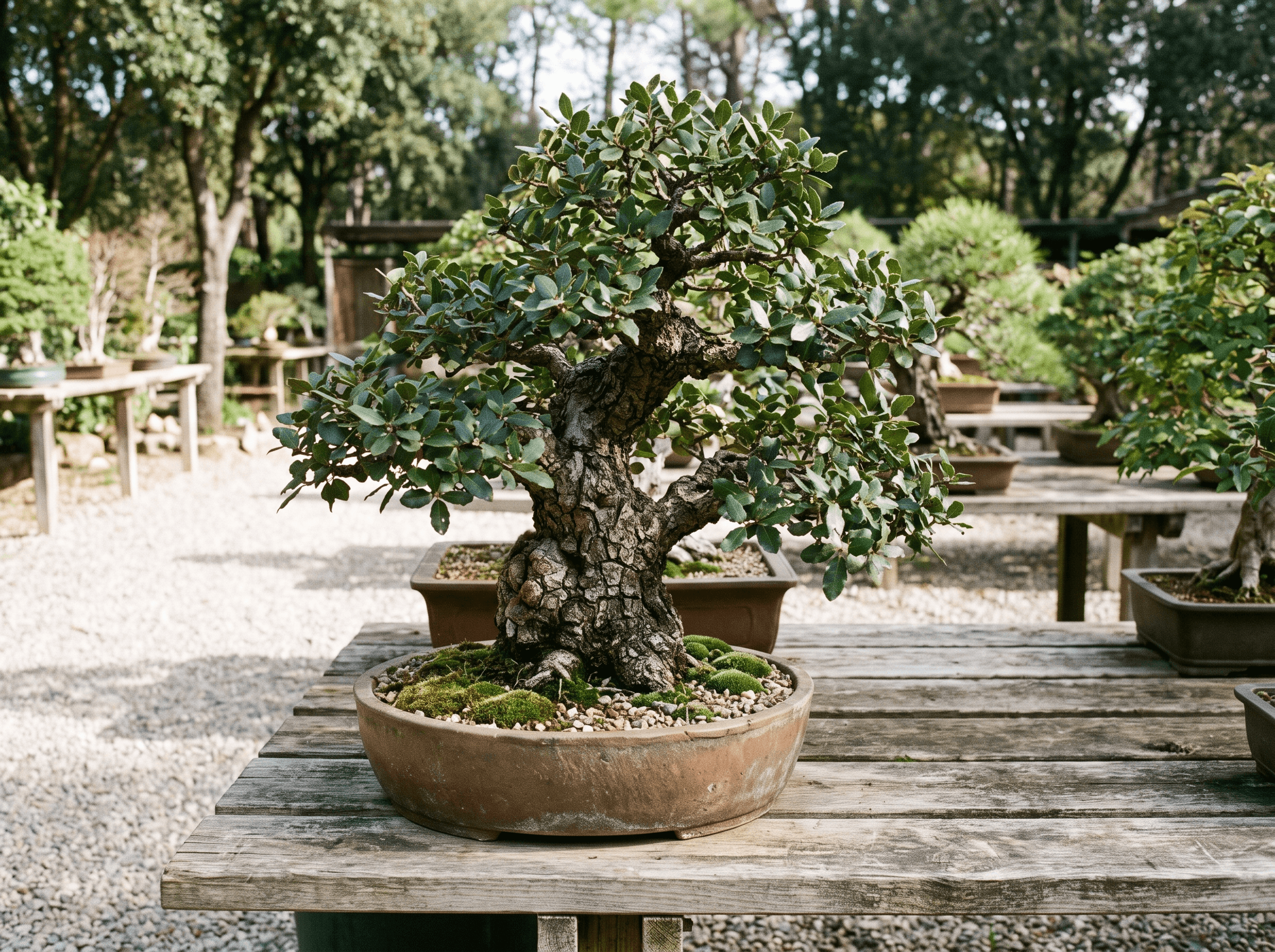
Oak isn't a species I recommend to someone who wants quick results. It's slow to ramify, meaning the fine branch structure that makes a bonsai look convincingly like a small tree takes a long time to build, season after season of grow-and-clip before you get real density. I keep a few holm oaks (Quercus ilex) on the nursery benches partly because they're native to this part of Italy and shrug off our summer heat and poor rocky soil the way almost nothing else does, and partly because clients ask for them specifically once they've tried and failed with something faster and flashier. If you want instant gratification, oak isn't your tree. If you want something that looks genuinely ancient in twenty years, it's hard to beat.
There are two oaks worth knowing for bonsai purposes and they behave differently. Holm oak, Quercus ilex, is evergreen, Mediterranean by nature, and tolerant of drought and heat once established, which makes it a solid outdoor tree across most of Italy without much winter fuss. Deciduous oaks like Quercus robur (English oak) or Quercus petraea want a proper cold winter and drop their leaves, or rather, mostly drop their leaves, which I'll get to. Both share the same core challenge: the natural leaf size on an oak is large relative to the compact silhouette bonsai aims for, so leaf reduction through partial defoliation is a technique worth having available, though it's best used as an occasional refinement on strong, established trees rather than a routine requirement every season.
The other thing that trips people up is marcescence, the tendency of young oaks and the lower branches of older ones to hold onto dead, browned leaves through winter instead of dropping them cleanly like a maple would. I get emails every autumn from people convinced their oak is dying because it's covered in crisp brown leaves in December. It isn't. Marcescence is a completely normal trait in oaks and beech, more pronounced on juvenile growth, and the leaves will get pushed off by new buds in spring. Don't strip them by hand out of anxiety. Let the tree do it on its own schedule.
Care
Light
Full sun for both types, though holm oak handles it with far more indifference than a deciduous oak with young, thin leaves. Q. ilex is essentially a Mediterranean plant and will sit in full baking sun all day without complaint once its roots are established in a pot. Deciduous oaks appreciate a bit of relief from the harshest afternoon sun in a hot climate like ours, since their leaves can scorch at the edges in prolonged heat, especially right after repotting or a hard defoliation when the tree has less canopy to shade its own trunk. In milder or northern climates, full sun all day is fine for either.
Watering
Oaks don't like sitting wet, and a compacted or poorly draining mix will cause root problems faster than drought will on an established tree. Water thoroughly when the top of the soil starts to dry, then let it approach dryness again before the next watering rather than keeping it constantly damp. Holm oak in particular has decent drought tolerance once it's been in a stable pot and soil mix for a season or two, which is useful during our August heatwaves when I sometimes can't get to every tree twice a day. Young oaks freshly potted from nursery stock are far less forgiving and need closer attention until the root system is established in bonsai soil.
Temperature & hardiness
This is where the two oak types genuinely diverge. Holm oak is evergreen and Mediterranean-tolerant, comfortable through mild Southern Italian winters outdoors with no special protection beyond keeping the pot from freezing solid in a hard cold snap. Deciduous oaks need an actual winter, real cold and a proper dormancy period, and if you're growing one in a climate that barely dips below freezing you may find it doesn't drop leaves cleanly or grow as vigorously the following spring. Being frost hardy in open ground doesn't automatically mean unprotected in a shallow bonsai pot, though, container roots are more exposed than a root system in open soil, so a deciduous oak in a pot still benefits from a cold but sheltered, frost-free spot during the harshest part of winter rather than being left fully exposed. The marcescent leaves I mentioned earlier are, in part, a cold-climate adaptation, so a deciduous oak grown somewhere too mild for it can behave oddly. Match the species to your actual climate rather than forcing a robur to live like an ilex.
Soil & potting
A free-draining, mineral mix is essential, the standard akadama, pumice, and lava combination or a comparable coarse, inorganic local equivalent. Oak roots that sit in compacted, water-retentive soil rot quickly, and a rotted root system on an oak is genuinely hard to recover from given how slowly the tree replaces growth. In the ground, oaks throw a strong taproot, and if you're developing one from a young nursery tree or a collected sapling, expect the first couple of repottings to focus on gradually reducing that taproot and encouraging a flatter, more radial root spread, since nebari on an oak, once it fills in, is genuinely spectacular and worth the early investment of effort.
Fertilizing
Feed through the growing season from spring into early autumn with a balanced fertiliser, then stop as the tree slows down. Oaks are slow to ramify but they're not weak growers, an established tree in the ground or a large training pot puts on real vigour each spring, so don't mistake slow branch development for a plant that needs less feeding. I lean slightly nitrogen-forward in spring to support that first flush, then even it out through summer.
Pruning & wiring
Partial defoliation, removing a portion of the leaves, commonly cited as around half on a healthy, established tree, during the growing season, is a useful tool for keeping oak leaves in scale and encouraging a second, finer flush of growth with shorter internodes, though treat it as an occasional refinement for strong trees rather than something every oak needs every year. Do this only on strong, healthy trees, never on something recovering from repotting or stress. Prune back new shoots once the first flush has hardened off, usually early summer. Oak can often be cut back hard on a vigorous, healthy tree and respond with fresh growth, but back-budding on genuinely old wood is less predictable than on many other broadleaf species, so treat a hard cutback into old wood as a considered risk rather than a guaranteed recovery. Wire young, still-flexible shoots early in the season since oak wood stiffens and becomes brittle as it ages, and older branches can snap rather than bend if you're not careful, so structural wiring is best done on younger growth or approached gradually with guy wires on thicker branches.
Repotting
Young, actively growing oaks benefit from repotting every two years; older, more developed trees can go three to five years between repots as growth slows. Early spring, before the buds swell, is the usual window for most oaks, though some growers find English oak (Quercus robur) responds better repotted just after the first leaves open, or in early autumn, so it's worth adjusting the timing to your particular tree and climate if early spring hasn't gone well. Go easier on root pruning than you would with a more vigorous species like trident maple, and avoid removing more than about a third of the root mass in any one session, oak's recovery pace matches everything else about the tree, unhurried. If you're still working on reducing a taproot toward better nebari, that's a multi-repot project, take a portion each time rather than trying to solve it in one session.
Common problems
Powdery mildew is the complaint I hear about most with oak, a grey-white dusty coating on leaves that shows up in humid, still conditions, especially late summer, and it's more of a cosmetic nuisance than a killer if you improve airflow around the tree and remove badly affected leaves. Oak leaf miner and scale insects turn up occasionally, the former leaving pale winding trails inside the leaf tissue, the latter showing up as small brown bumps along stems that secrete a sticky residue. Yellowing between the leaf veins while the veins themselves stay green usually points to iron chlorosis, common when an oak is watered with hard, alkaline tap water over time or potted in the wrong soil pH, and it's worth correcting since oak doesn't recover its color quickly once it sets in. And to repeat the point from the intro, dry brown leaves clinging on through winter are marcescence, not a disease and not a sign your tree is struggling.
Styling
Oak's natural silhouette, broad, rounded, substantial, suits formal and informal upright styles better than anything dramatic or twisted. The trunk character and eventual nebari carry a lot of the visual weight, so I generally style toward a strong, believable branch structure rather than forcing unusual movement into the trunk line. Group or forest plantings work particularly well with oak too, since a cluster of trunks reads as a small woodland scene almost immediately, and oak's slow ramification is less of a drawback in a forest planting where individual branch refinement matters less than the overall silhouette. Holm oak, given its Mediterranean, windswept origins along our coastline, also takes well to informal upright or slight windswept styling that echoes how it actually grows on exposed hillsides here.
Common questions
Is oak a good species for a beginner?
It's a reasonable choice if you're patient, but it's not the fastest way to see results. Oak is slow to ramify compared to maple or elm, so a beginner expecting quick, visible progress each season may get frustrated. If you enjoy the long game and want a tree that looks genuinely aged in a decade or two, oak rewards that patience well.
Why does my oak hold onto dead leaves in winter?
That's marcescence, a normal trait in oaks (and beech) where dead leaves stay attached through winter instead of dropping cleanly, more pronounced on young trees and lower branches. It isn't disease or stress. New spring growth pushes the old leaves off on its own, so there's no need to strip them by hand.
How do I get my oak's leaves smaller?
Partial defoliation on a strong, well-established tree during the growing season is a useful method, removing a portion of the leaves, commonly around half, to encourage a second, finer flush with shorter internodes and smaller leaves. Treat it as an occasional refinement rather than something to do every season, and only on strong trees, giving the tree a season or so to recover afterward before repeating it.
Can holm oak survive outdoors year-round in Italy?
Yes, easily, in most of the country. Quercus ilex is native to the Mediterranean and handles Southern Italian winters outdoors without special protection. Further north or in genuinely harsh winter climates, some pot protection during hard freezes is sensible, but it doesn't need the indoor coddling people sometimes assume.
What's the difference between holm oak and deciduous oak for bonsai?
Holm oak (Q. ilex) is evergreen, drought and heat tolerant, and suited to milder Mediterranean-style climates. Deciduous oaks like Q. robur need a real, cold winter dormancy and drop most of their leaves each autumn, holding onto some through marcescence. Even though they're frost hardy in open ground, container-grown deciduous oaks still appreciate a sheltered, frost-free spot during the harshest cold. Choose based on your actual climate rather than aesthetic preference alone.
Why is my oak developing weak, uneven nebari?
Oak throws a strong taproot in the ground, and without deliberate root work over several repottings that taproot dominates instead of a flat, radial root spread. Nebari development on oak is a multi-year project done gradually across repots, taking a portion of the taproot each time and avoiding removing more than about a third of the roots in any single session.
How do I treat powdery mildew on my oak bonsai?
Improve airflow around the tree first, since mildew thrives in still, humid conditions, and remove the worst affected leaves. A sulfur-based fungicide can help in persistent cases, but most mild outbreaks clear up once the tree gets better spacing and light.
You might also like
General guidance based on 20+ years of practice. Every tree and every climate is different — when in doubt, ask us.