
Bonsai Defoliation Technique Explained: When, Why, and Which Trees
The bonsai defoliation technique can shrink leaf size and thicken ramification fast, but it's a technique for a healthy, vigorous tree, not a tool for fixing a struggling one.
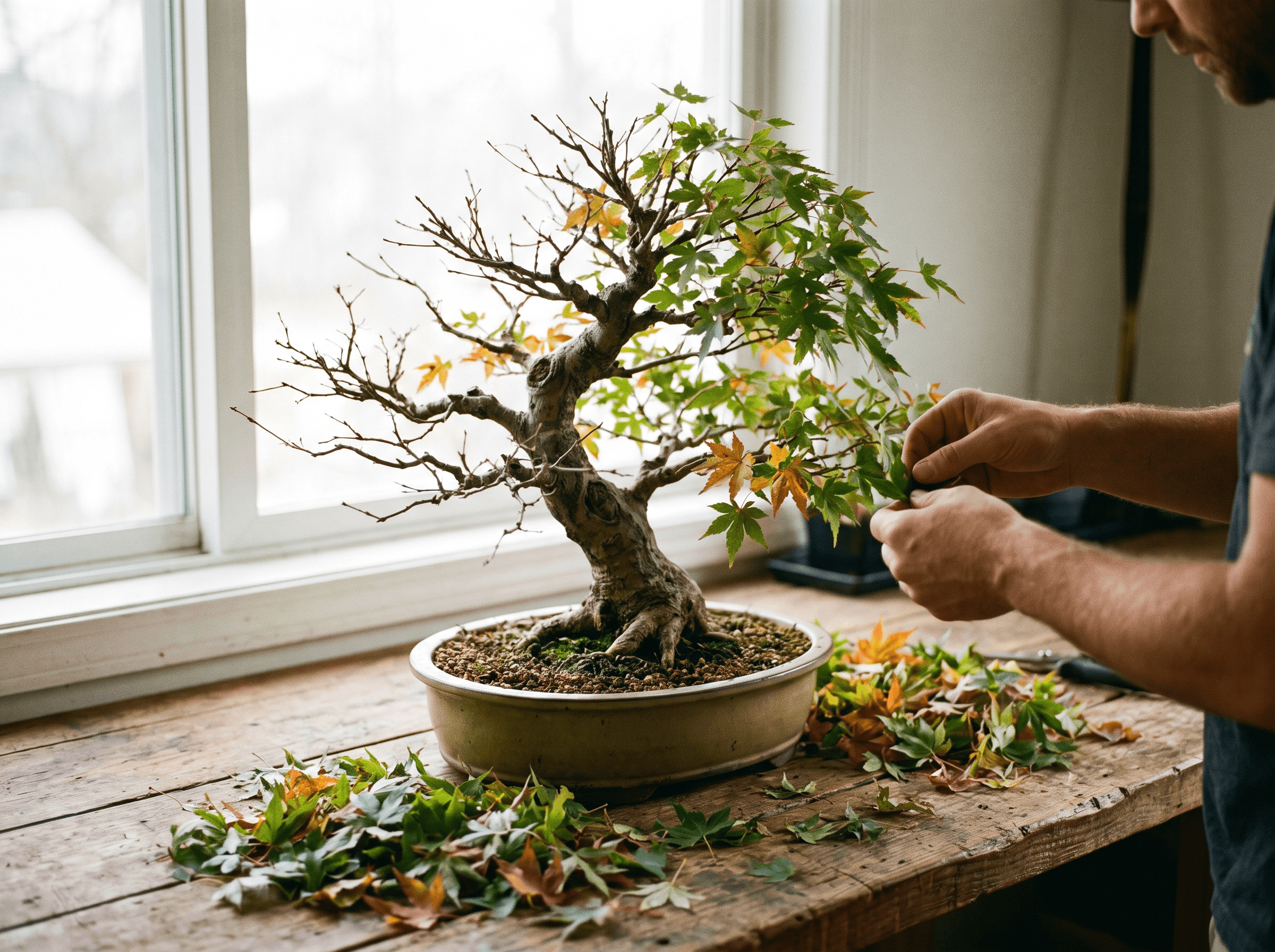
Defoliation looks alarming the first time you see it done. A grower strips a perfectly green, healthy-looking tree of most or all of its leaves in the middle of the growing season, on purpose. New growers usually assume something's gone wrong. Actually it's a deliberate technique, and a genuinely useful one, but it only works because the tree in question has the reserves to recover quickly.
The idea is straightforward: removing leaves during active growth on a vigorous deciduous species forces the tree to push a fresh flush of foliage, and that new growth tends to come back with smaller leaves and finer ramification, more numerous, smaller branch divisions in the canopy. It also opens the interior of the tree up to more light for a while, which helps back-budding and overall canopy density.
The technique has real limits though, and misapplying it, on the wrong tree or at the wrong point in the season, causes actual harm rather than the improvement you're after. So it's worth understanding not just how to do it but when it's appropriate at all.
How the bonsai defoliation technique works
The main reasons are leaf reduction, ramification, and light penetration. A second flush of leaves grown after defoliation is typically smaller than the first, which matters a lot for keeping foliage in scale with a small tree. The process of pushing new growth from multiple points also tends to increase branching density over time, giving you a fuller, more refined canopy. And with the leaves temporarily gone, more light reaches the interior branches, which can encourage weaker interior growth to strengthen rather than get shaded out and die back. In practice, the technique itself is simple: leaves are usually cut off individually with scissors rather than stripped by hand, and on many species it's common to leave the petiole, the small leaf stalk, attached rather than tearing it away, since that reduces damage to the dormant bud at its base.
Only for healthy, vigorous, well-established trees
This is the single most important condition, and it's the one people skip when they're excited to try the technique. Defoliation is a legitimate demand on a tree's energy reserves, and only a tree that's genuinely healthy, vigorous, and well-established has the reserves to recover and push a strong second flush. A stressed, weak, recently repotted, or otherwise struggling tree doesn't have that buffer, and defoliating it can set the tree back seriously or in bad cases kill it outright. If there's any doubt about a tree's vigour, skip defoliation for that season.
Partial versus full defoliation
Full defoliation, removing essentially all the leaves, produces the strongest effect but also carries the most risk, and it's generally something to reserve for experienced growers working with trees they know well. Partial defoliation, removing roughly half the leaves, usually the larger or coarser ones while leaving smaller leaves in place, gets you much of the benefit with meaningfully less stress on the tree. For anyone newer to the technique, or working on a tree that's healthy but not exceptionally vigorous, partial defoliation is the safer starting point. Species matters here too. Trident maple, Chinese elm, and hornbeam generally tolerate defoliation well and respond with the kind of vigorous, fine regrowth the technique is meant to produce. Japanese maple is a notable exception: it often responds poorly to full defoliation, and many growers get better results thinning or cutting back individual leaves rather than stripping the tree entirely.
Timing and frequency matter as much as technique
For most growers and most species, once per growing season is the sensible limit, and it needs to happen early enough that there's still meaningful growing season left afterward for the tree to push new leaves and harden them off before the season ends. Some highly vigorous species, trident maple is the usual example, can tolerate a second partial defoliation in a single season under the right conditions, but that's advanced, species-specific work rather than a general rule to follow by default. Defoliating too late in the season leaves the tree without enough time to recover fully before dormancy, going into winter under-resourced. I generally do it not long after the first flush of spring growth has hardened, commonly early summer in many temperate climates, though the exact window shifts with species and local conditions, which leaves the rest of the season for the tree to recover and settle.
Common questions
How do I know if my bonsai is healthy enough to defoliate?
Look for strong, consistent growth throughout the current season, good leaf colour and size, and no recent stress events like a repot, pest problem, or relocation. If you have any doubt about the tree's vigour, it's safer to wait a season.
Can I defoliate a conifer or evergreen bonsai?
Defoliation as commonly practiced is mainly a deciduous technique, since these species regrow leaves readily within a season. Some broadleaf evergreens can tolerate a similar approach in experienced hands, but true conifers and needle evergreens don't respond the same way and aren't candidates for the technique in the way maples or elms are.
How many times per year can I defoliate the same tree?
Once per growing season is the sensible limit for most species and most growers. A few especially vigorous species, like trident maple, can sometimes take a second partial defoliation under ideal conditions, but that's advanced work rather than a default plan. Repeating it too often within a season or year after year without rest weakens the tree over time.
Should I do full or partial defoliation as a beginner?
Partial defoliation is the safer choice for anyone newer to the technique. It produces meaningful leaf reduction and ramification benefits with less stress than removing every leaf, which is better reserved for experienced growers on trees they know well.
What happens if I defoliate too late in the growing season?
The tree may not have enough time left to push a full new flush of leaves and harden them off before dormancy, which leaves it heading into winter under-resourced. Timing defoliation early enough in the season to allow full recovery is important.
Will defoliation permanently reduce my bonsai's leaf size?
The second flush after defoliation typically comes in smaller, but the effect isn't necessarily permanent on its own. Leaf size reduction is usually maintained through a combination of techniques over time, including repeated defoliation on suitable species, rather than a single treatment.
Can defoliation kill my bonsai?
Yes, if it's done on a tree that isn't healthy and vigorous enough to recover, or if it's done too late in the season, too frequently, or as a full defoliation on a tree that would have been better suited to a partial one.
You might also like
General guidance based on 20+ years of practice. Every tree and every climate is different — when in doubt, ask us.