
White powdery film on bonsai leaves
A dusty, flour-like coating on bonsai leaves and stems, usually appearing in still, humid air, is the classic sign of powdery mildew on bonsai.
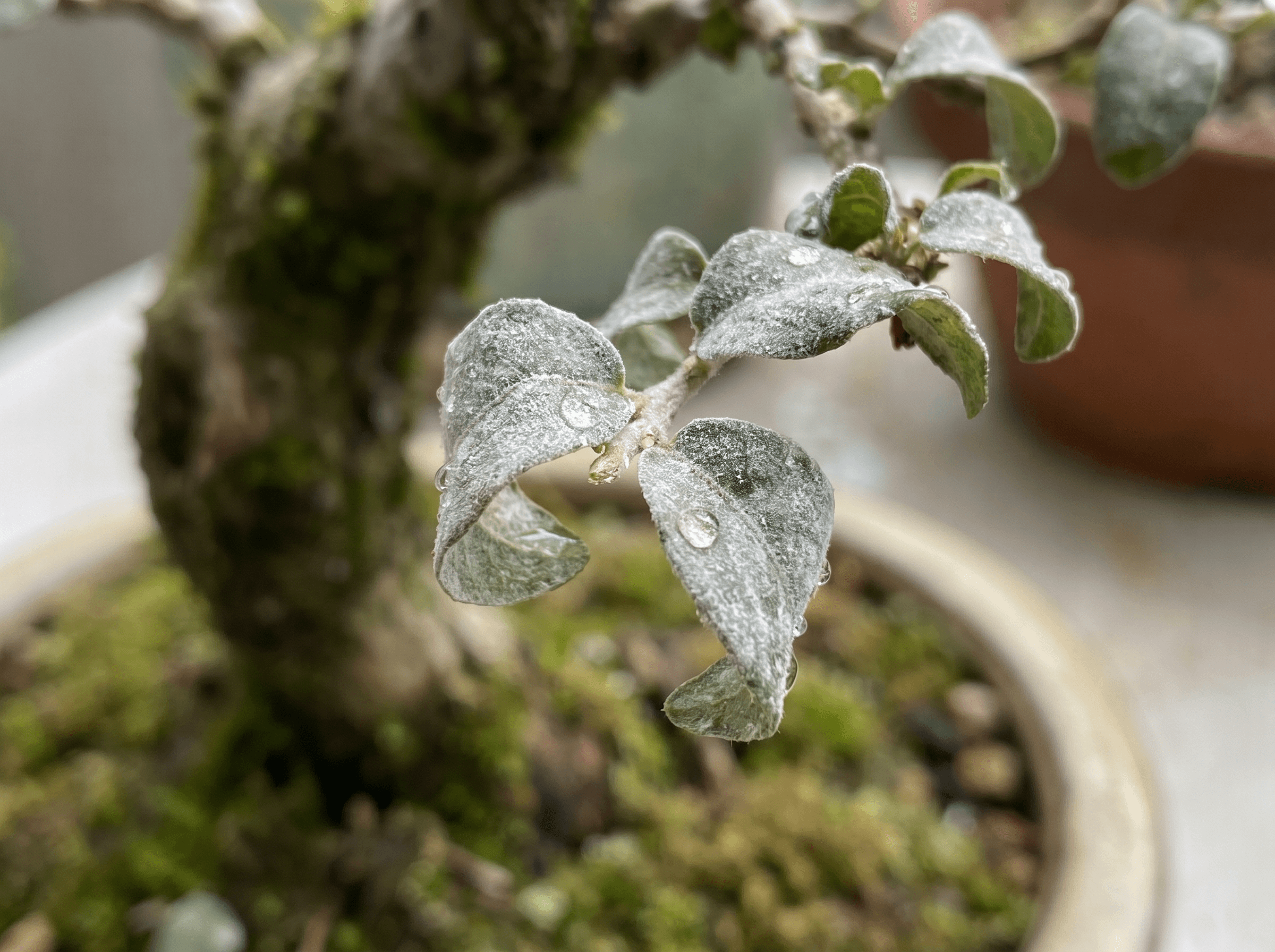
Powdery mildew on bonsai is caused by a group of fungi that behave a bit differently from most of the leaf diseases I deal with. Most fungal problems on bonsai need standing water on the leaf to get started, which is why we're always told to water at the base and avoid wetting the foliage. Powdery mildew doesn't play by that rule. Its spores can germinate in high humidity alone, without a film of water on the leaf surface, which is exactly why it turns up on trees kept in still, muggy air even when you've been careful about how you water.
On its own, a mild case rarely kills a tree. What it does is chip away at vigour over the course of a season. The white coating blocks light from reaching the leaf tissue underneath, so the affected leaves photosynthesise less efficiently, new growth can come in stunted or slightly twisted, and on a tree that's already recovering from a repot or a hard prune, that extra drain matters more than it would on a strong, established specimen. I've seen it get genuinely serious on young or weak trees left untreated over a whole growing season, with dieback on the worst-hit shoots.
You'll see it most in the shoulder seasons, spring and early autumn, when days are warm but nights cool down enough to push humidity up overnight. It also shows up a lot on trees that have just come indoors, or that sit crowded together on a bench with no breeze moving between them. Certain species bring their own risk on top of that, which I'll get to below, so where you place a susceptible tree matters as much as the weather does.
Likely causes
Powdery mildew infection
How to tell: A white or grey, powdery coating sitting on top of leaf surfaces and sometimes on young, still-soft stems. Unlike a lot of other fungal marks, it wipes off on a finger if you touch it lightly, which is a decent field test if you're not sure whether you're looking at mildew or something else like dust or scale residue. It tends to start on a handful of leaves, usually lower down or on the shadier side of the canopy, then spreads outward from there.
The fix: Improve air circulation around the tree first, since that's what actually stops the spread, not just the spray. Bin the worst-affected leaves, send them to municipal composting, or hot-compost them yourself if your setup reliably reaches the temperatures needed to kill fungal spores; skip casual cold home composting of infected debris if you want to be cautious, since spores can survive on material that never heats up enough. Then treat the rest of the tree with a fungicide labelled for powdery mildew, or for a mild case a diluted milk spray (roughly one part milk to nine parts water) works surprisingly well as a lower-intervention option, applied weekly for two or three weeks. Whatever you use, get good coverage on the undersides of leaves too, not just the tops. Follow the label directions on any fungicide or milk spray, test it on a small area first if you're working with a species you're unsure about, avoid spraying oils or sulfur-based products in strong sun or heat since that combination can scorch foliage, and repeat according to the label's schedule rather than treating it as a one-off.
Overcrowded placement
How to tell: The tree sits close to other plants with almost no gap or airflow between the foliage masses. Walk up to the bench on a still day and you can often feel the difference: air moves freely around trees spaced apart, and sits stagnant in the gaps of a crowded row. That stagnant pocket of humid air right against the leaves is exactly the microclimate powdery mildew spores need to establish.
The fix: Increase spacing so foliage doesn't touch and air can move through the canopy. Avoid overhead watering that wets the whole canopy, especially late in the day when the foliage stays damp overnight, and water the soil directly instead. If your bench is genuinely tight on space, a small oscillating fan running a few hours a day through the humid part of the season is a helpful airflow aid, especially for trees kept indoors or crowded on a bench.
A susceptible species in a shaded spot
How to tell: Some species are simply more prone to this than others, in my experience maples, particularly Japanese and trident maple, along with elms and oaks, are the ones I see mildew on most often. If one of these is also sitting in a shadier position than it would get growing naturally in the open, with less direct sun to dry the leaf surface off after a humid night, the risk goes up further.
The fix: Where the species and the season allow it, shift the tree to a spot with a bit more morning sun and better exposure, sun and dry leaves are one of the simplest deterrents there is. If moving it isn't practical, at minimum thin the canopy a little during your regular pruning so light and air can actually reach the inner branches rather than staying trapped under a dense outer layer of foliage.
How to prevent it
Good airflow is the single biggest factor in keeping powdery mildew off your trees, more than any spray or fungicide schedule. Space trees out on the bench so foliage doesn't touch its neighbours, and if your growing area is naturally still, a small fan through the humid months earns its keep. Water the soil rather than the leaves, and if you do need to mist or hose the foliage for any reason, do it early in the day so everything has hours of daylight to dry off before evening. Keep an eye on maples, elms and oaks in particular, since they're the species I flag first when I'm doing my rounds, and give them slightly more sun exposure than you might a less susceptible tree. A quick thinning prune once or twice a season, just enough to open up dense inner growth, does more for long-term prevention than most people expect from something so simple.
Common questions
Is powdery mildew the same as spider mite damage?
No, and they're worth telling apart because the fixes are different. Powdery mildew sits on top of the leaf as a wipeable, dusty coating, while spider mite damage shows up as fine stippling or a bronze, dry look to the leaf itself, often with faint webbing between leaves or at branch forks rather than any powder. If you're unsure, wipe the mark with a finger; mildew comes off, stippled mite damage doesn't.
Will powdery mildew kill my bonsai?
On a healthy, established tree, a mild case is rarely fatal on its own. It becomes a real problem when it's left untreated for a full growing season, especially on a young or already-stressed tree, where the ongoing loss of photosynthesis can lead to weak growth and dieback on the worst-affected shoots. Treat it early and most trees shrug it off completely.
Does a homemade milk spray actually work against powdery mildew?
Yes, for mild to moderate cases it's a genuinely useful option, not just an old wives' tale. Diluted roughly one part milk to nine parts water and applied weekly, the compounds in milk have a mild fungicidal effect and also seem to boost the leaf's own resistance. For a heavy, established infestation I'd still reach for a proper labelled fungicide, but milk spray is a reasonable first step on a light case.
Does powdery mildew spread through the soil or roots?
Not really. Powdery mildew spreads by airborne spores landing on leaf and stem surfaces rather than anything happening in the root zone, so you don't need to drench the soil or treat it alongside root rot. That said, spores can persist on infected plant debris, which is why it's still worth binning badly affected fallen leaves rather than leaving them in the pot, and clearing debris from around the base matters even though the roots themselves were never at risk.
Should I destroy affected leaves or can I compost them?
Bin them, send them to municipal composting, or hot-compost them yourself if your setup reliably gets hot enough to kill fungal spores. Most home compost bins run cooler than that, so if you're not confident yours reaches the temperature, it's simplest to avoid casual cold composting of infected leaves and bin them instead, since surviving spores can end up right back near your trees when you use the finished compost.
Will it come back on the same tree every year?
It can, particularly if the underlying conditions that caused it in the first place haven't changed, the same crowded spot, the same still air, the same shady placement for a susceptible species. I've had a few maples that flare up every spring until I finally moved them to a more open position with better airflow, after which it stopped being a recurring issue. Fixing the placement usually matters more than any single treatment.
You might also like
General guidance based on 20+ years of practice. Every tree is different — when in doubt, ask us.