
Mikawa Yatsubusa Maple Bonsai
Acer palmatum 'Mikawa Yatsubusa'
Mikawa Yatsubusa is one of the classic dwarf Japanese maple cultivars, grown less for a single showy trait like leaf colour and more for the way its foliage naturally stacks into tight, layered pads as it grows. That pad-forming habit is what growers reach for it specifically to exploit, and it's also why the pruning approach here ends up a bit different from a standard Japanese maple, less about building ramification from nothing and more about keeping naturally dense growth from crowding itself out.
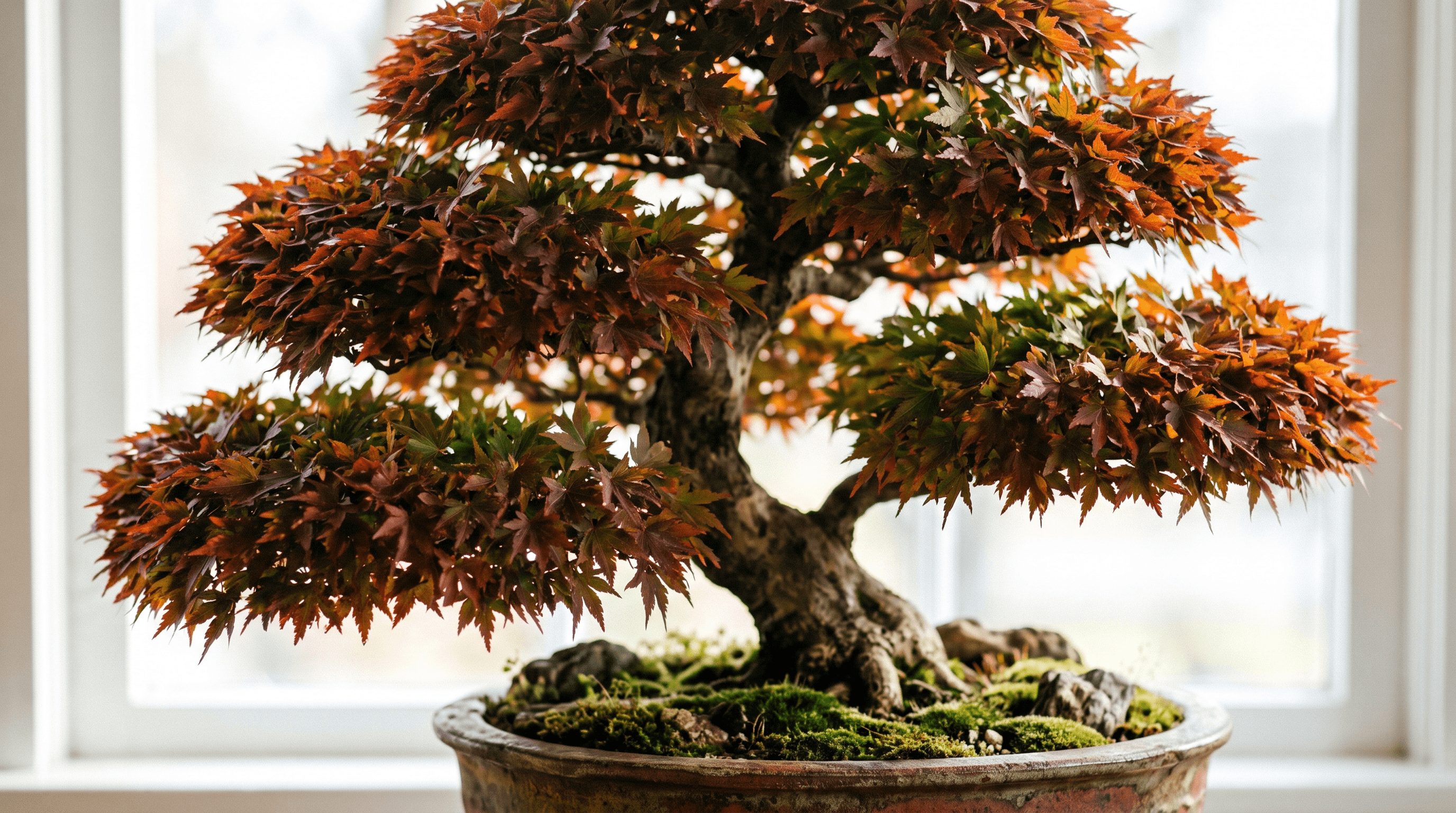
Acer palmatum 'Mikawa Yatsubusa' is an old, well-established dwarf cultivar. Sources vary on the exact literal translation of the name, but yatsubusa is horticulturally associated with maples that grow as dense, clustered, many-branched dwarfs rather than as a single extending leader. In practice that means extremely short internodes, the gaps between leaf nodes along a shoot, and small leaves packed closely together, which on its own would just describe a compact tree. What sets Mikawa Yatsubusa apart even among other compact cultivars is that this dense branching tends to organise itself into distinct, layered pads of foliage as the tree matures, tiers of tightly packed leaves stacked one above another along the branch structure, rather than growing as one even, undifferentiated mass the way a lot of maples do.
That's the trait growers specifically exploit with this cultivar. Where building a pad-like canopy on most trees takes years of selective wiring and pruning to coax branches into distinct layers, Mikawa Yatsubusa does a good deal of that work on its own simply by how it wants to grow, so the grower's job shifts toward guiding and thinning naturally forming pads rather than constructing them from scratch. It sits in similar territory to Kotohime; both are dwarf Japanese maple cultivars suited to small bonsai, but Kotohime is the stronger choice when minimum leaf size is the priority, since its leaves and internodes are genuinely tiny. Mikawa Yatsubusa's compact look comes at least as much from very short shoots and petioles and tightly overlapping placement as from small leaf blades themselves, and its defining feature is specifically that layered pad structure. It also tends to grow more slowly than Kotohime, which means patience is even more central to developing one well.
Care
Light
Light needs follow the standard Japanese maple pattern, morning sun with protection from harsh, direct afternoon sun once summer heat sets in, since the small leaves scorch under intense afternoon light much the way any maple's would. New growth on Mikawa Yatsubusa often comes in with a reddish or bronze tinge in spring before greening up over the following weeks, and good light through that period seems to help keep growth dense rather than drawn out, though the tree isn't grown primarily for that spring colour the way a cultivar like Deshojo is. Because the foliage pads are dense by nature, keeping light reaching the interior of each pad, not just the outer surface, matters more here than it does on a maple with a more open, even canopy.
Watering
Keep the soil evenly moist through the growing season, the same baseline as Japanese maple generally, and check more often than you would with a standard-size tree since Mikawa Yatsubusa is commonly grown in small shohin or mame pots to suit its scale, and a small pot dries out faster in the same weather regardless of the cultivar. The dense, layered foliage can also make it a little harder to judge soil moisture at a glance, since the packed pads shade the pot surface and can make the top of the soil look and feel different from what's happening lower down, so I'd rather check by feel or weight than rely purely on how the surface looks.
Temperature & hardiness
Mikawa Yatsubusa needs the same genuine outdoor winter dormancy as Japanese maple generally and is reasonably cold-hardy as a tree, but as with most dwarf cultivars grown in small pots, the container itself is the more exposed part of the system during a hard freeze, since a shallow mame or shohin pot offers roots less insulation than a larger container would. Late frost after the spring flush carries the same risk as with any Japanese maple, tender new growth can blacken even if the rest of the tree is unaffected, so it's worth watching the forecast through early spring rather than treating budbreak as a signal that the cold season is fully done.
Soil & potting
A free-draining but moisture-retentive mix, the same akadama-based approach that suits Japanese maple in general, works well here too. Because Mikawa Yatsubusa is usually grown small to suit its dwarf, pad-forming habit, it's commonly potted in shallow mame or shohin containers, and a smaller soil volume gives less buffer against drying out or sitting too wet, so the margin for error on timing is narrower than with a maple in a larger pot. I'd favour a mix on the more moisture-retentive side of the usual range rather than the driest one that would still technically work.
Fertilizing
Feed through the growing season on roughly the same schedule as Japanese maple generally, tapering off as autumn approaches. Given the smaller root volume that comes with the small pots this cultivar is usually grown in, I favour light, frequent feeding over infrequent heavy doses, the same logic as with other dwarf maple cultivars. It's also worth watching feeding a bit more carefully here than on a plainer cultivar, since pushing too much nitrogen tends to encourage longer internodes and looser growth, which works against the tight, layered pad structure that's the whole reason to grow Mikawa Yatsubusa in the first place.
Pruning & wiring
This is where Mikawa Yatsubusa genuinely departs from standard Japanese maple technique. Rather than pinching and trimming mainly to build ramification from an open structure, as you would on a regular maple, a good part of the ongoing work here is thinning growth inside pads that are already forming naturally, since the dense, layered habit that makes this cultivar distinctive can also shade out its own interior growth if left unthinned, and interior shoots that lose light for too long tend to weaken and die back. I go through periodically and remove some of the weaker interior shoots to keep light reaching each layer, rather than just cutting back the outer perimeter the way I would on a more open canopy. Since Mikawa Yatsubusa, like most named Japanese maples, is usually a grafted tree, also watch for vigorous shoots emerging from below the graft line; those belong to the rootstock rather than the cultivar and should be removed. A strong shoot from above the graft is usually just healthy growth, not a problem on its own, unless it persistently shows noticeably larger leaves and longer internodes than the rest of the tree, in which case removing it keeps the tight pad look intact. Wiring calls for fine gauge given how thin the branches stay at this scale, and structural cuts are best saved for summer or early autumn rather than late winter, the same sap-bleeding logic as Japanese maple generally.
Repotting
Repot on a similar cycle to Japanese maple generally, roughly every one to two years while young, though a small mame or shohin pot can need attention sooner than that if growth slows or roots fill the container faster than expected, which is worth checking for rather than assuming on a fixed schedule. Handle the fine root system gently, combing rather than raking hard, and lean conservative with how much you remove at once, especially on younger trees you don't yet know well, letting how the roots actually look, dense and full versus still sparse, guide how hard you go rather than assuming any fixed recovery timeline.
Common problems
Most issues on Mikawa Yatsubusa are the standard Japanese maple set, scorched leaf edges from too much direct afternoon sun, wilting or leaf drop from drying out or from waterlogged roots, aphids on tender spring shoots, and blackened new growth from late frost after budbreak. The pattern that's more particular to this cultivar is dieback inside a foliage pad that's gotten too congested, since the same dense, layered growth that makes Mikawa Yatsubusa distinctive can also shade out its own interior if it isn't thinned occasionally, and a pad that's died back in the centre while still looking full from outside is easy to miss until it's fairly advanced. Because Mikawa Yatsubusa, like most named Japanese maples, is normally grafted, it's also worth watching for vigorous shoots from below the graft line, which belong to the rootstock rather than the cultivar and are worth removing promptly. A strong shoot from above the graft is usually just healthy growth, though if it persistently shows distinctly larger leaves and longer internodes than the rest of the tree, removing it helps the pad-formed canopy keep its character.
Styling
Mikawa Yatsubusa is prized above all for the layered, pad-like foliage structure it forms more or less on its own, and styling work leans into that rather than fighting it, informal upright and clump or multi-trunk forms all suit it well, and it's a common choice for growers who want a tiered, cloud-like canopy without years of wiring to build distinct foliage layers from an otherwise even branch structure. Because the pads form naturally, the main styling discipline is restraint, thinning congested growth and removing reversion shoots to keep each layer distinct and healthy, rather than aggressive cutting to force branches into a shape they don't want to hold. Compared with Kotohime, which suits an even, all-over network of fine twigs more in line with standard Japanese maple ramification, Mikawa Yatsubusa reads as a tree built around a handful of distinct foliage masses, and it's slower growing besides, so a well-developed specimen generally represents a longer stretch of patient, incremental work than a Kotohime of similar size would.
Common questions
What makes Mikawa Yatsubusa different from other dwarf Japanese maples?
Its defining trait is the way foliage naturally organises into tight, layered pads as the tree matures, rather than growing as one even mass. That compact look comes at least as much from very short shoots and petioles as from tiny leaf blades. Other dwarf cultivars like Kotohime are chosen mainly for genuinely small leaf size and short internodes, without that same natural pad-forming habit.
Why are there gaps or dieback inside my Mikawa Yatsubusa's foliage pads?
That's usually congestion. The dense growth that forms the pads can shade out its own interior if it isn't thinned occasionally, and interior shoots that lose light for too long tend to weaken and die back. Periodically removing some of the weaker interior shoots helps prevent it.
Is Mikawa Yatsubusa good for shohin or mame bonsai?
Yes, it's a common choice for small-scale bonsai thanks to its small leaves and dwarf, clustered habit, though it grows slowly, so a well-developed shohin-size specimen with distinct pads typically represents a good number of years of patient work.
Should I worry about an unusually vigorous shoot on my Mikawa Yatsubusa?
Check where it's coming from. Like most named Japanese maples, Mikawa Yatsubusa is usually grafted, and a vigorous shoot from below the graft line belongs to the rootstock rather than the cultivar and should be removed. A strong shoot from above the graft is usually just healthy growth, though if it persistently shows distinctly larger leaves and longer internodes than the rest of the tree, pruning it out keeps the layered pad look consistent.
How does Mikawa Yatsubusa compare to Kotohime?
Both are dwarf Japanese maple cultivars suited to small bonsai, but Kotohime is the stronger choice when minimum leaf size is the priority, since its leaves and internodes are genuinely tiny. Mikawa Yatsubusa's compact look comes more from short shoots, short petioles and tightly overlapping foliage than from small leaf blades, and it's specifically known for forming layered pads on its own. It also tends to grow more slowly than Kotohime.
Does Mikawa Yatsubusa need different pruning from a standard Japanese maple?
Pinching still has a place, especially on a more refined tree where spring shoots can be pinched back as the first leaf pair opens, but a tree still in development is usually better allowed to extend before being cut back. Beyond that general timing question, a good part of the ongoing work on Mikawa Yatsubusa shifts toward thinning growth inside naturally forming pads to keep them from getting congested, rather than mainly building branch structure from an open canopy the way you would on a standard maple.
General guidance based on 20+ years of practice. Every tree and every climate is different — when in doubt, ask us.