
Jade Plant Bonsai Care
Crassula ovata
Jade plant is a succulent, not a true tree, and that single fact explains almost everything about why it's one of the most forgiving and widely recommended species for anyone growing bonsai indoors.
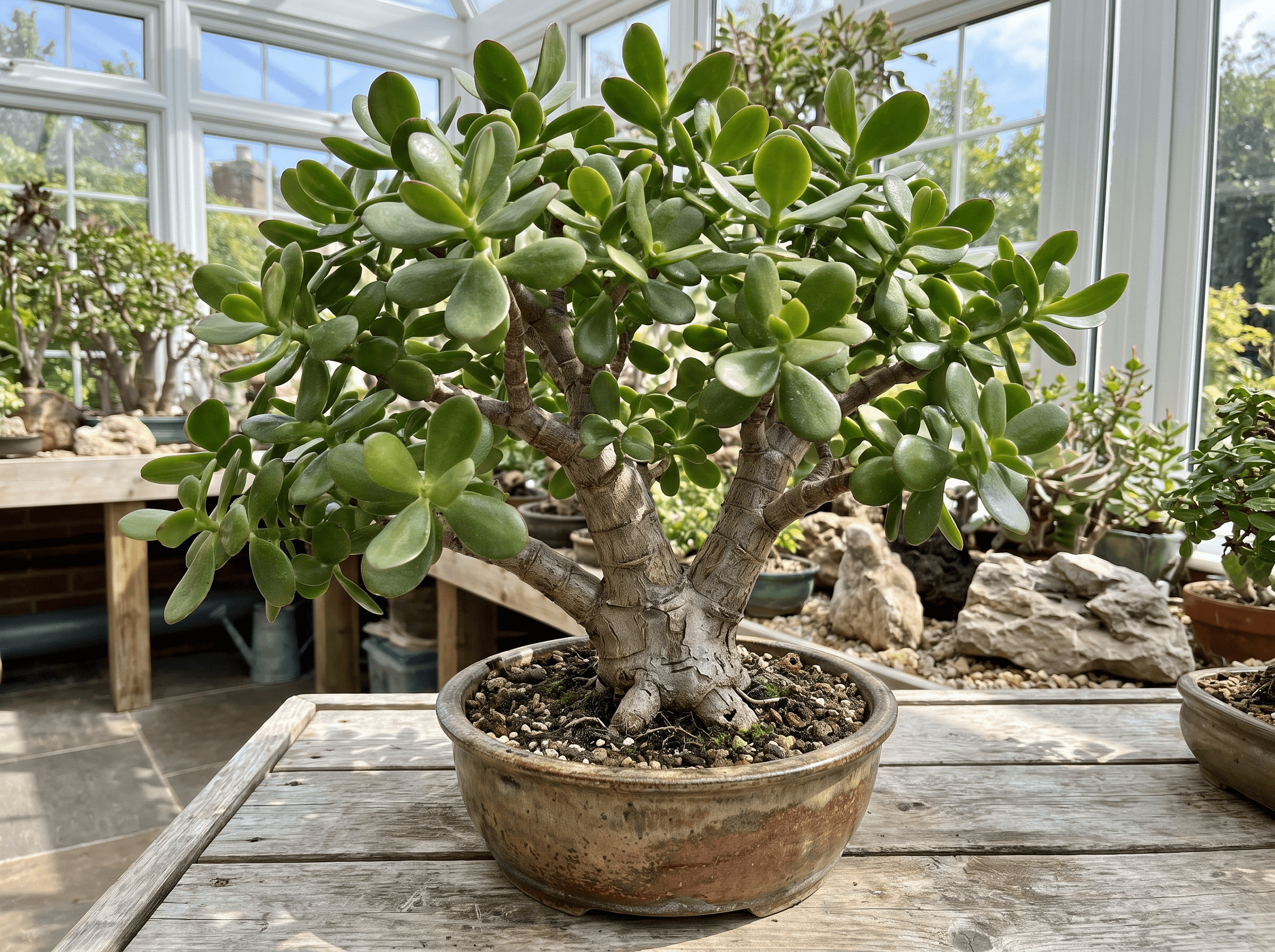
I want to be upfront about something before anything else: jade plant isn't a tree in the botanical sense the way a juniper or a maple is. It's a succulent shrub that stores water in its thick, fleshy leaves and in the trunk itself, and that storage capacity is what makes it behave so differently from every other species I cover here. People sometimes feel like that makes it a lesser bonsai subject, but I don't see it that way. It develops real trunk character, real bark texture, and a genuinely convincing tree-like silhouette over time, it just gets there through a different physiology. Worth flagging early too: this guide covers true jade, Crassula ovata. If your plant was sold as dwarf jade or elephant bush, that's Portulacaria afra, an unrelated South African succulent with a somewhat different growth habit and, notably, more tolerance for wiring than Crassula has.
The practical upshot of that water storage is drastically reduced watering frequency compared to any other indoor bonsai. Where a ficus or Chinese elm wants attention every day or two, a jade plant can typically go a week or more between waterings without any distress, and it's a species where overwatering causes far more damage than underwatering does. That makes jade plant genuinely well suited to a beginner, a forgetful waterer, or anyone easing into bonsai without wanting to commit to a daily routine.
It's happy as an indoor plant given a genuinely bright spot, which is unusual among the species on this site, most of which insist on being outdoors. It also propagates readily from cuttings, a broken branch stuck in soil will often root on its own, which is both a handy way to start new material and a small mercy when you inevitably knock a branch loose, since the wood is more brittle than most people expect.
Care
Light
Bright light is essential, ideally several hours of direct sun, whether that's an outdoor spot in warmer months or the brightest window you have indoors. Insufficient light produces weak, stretched, leggy growth with wide gaps between leaves, quite different from the compact, tight growth you want for a convincing bonsai silhouette. I move mine outdoors into a sunny spot through the warm months and bring it back to the brightest indoor window once temperatures drop, and the difference in growth density between the two settings is obvious.
Watering
This is where jade plant really breaks from every other species I cover: let the soil dry out substantially between waterings, then water thoroughly, checking soil dryness rather than following a fixed calendar, since the right interval shifts with light, temperature, and pot size. Because the leaves and trunk store water, this plant is built to handle drought and tolerates it far better than it tolerates being kept constantly damp, though letting it go too long without any water at all can still shrivel and stress the leaves. Overwatering is the more common killer of jade plant than underwatering, so if you're used to checking your other bonsai daily, resist that same instinct here. As a rough personal example, mine goes roughly a week to ten days between waterings depending on season, less in winter when growth slows, but treat that as an illustration rather than a schedule to follow blindly.
Temperature & hardiness
Jade plant is not cold-hardy and won't tolerate frost at all, so it needs to come indoors well before temperatures approach freezing if it spends summer outside. It's comfortable at normal indoor room temperatures year-round, which is part of why it works so well as a true indoor bonsai rather than needing the outdoor placement most other species demand. It can handle a fairly wide range of warmer temperatures without complaint, another point in its favour for beginners without a controlled growing space.
Soil & potting
Use a very fast-draining mix, either a gritty succulent or cactus blend, or a mineral-heavy bonsai substrate with extra pumice worked in. Either approach works as long as it doesn't hold water around the roots for long, and that's what matters most for preventing the overwatering-related root rot that's the biggest real threat to this species. A shallow, wide bonsai pot works well aesthetically once the plant is established and the roots have filled out, though I still give a young or newly rooted specimen a bit more depth while it establishes.
Fertilizing
Feed lightly through the growing season with a balanced fertiliser at a reduced strength compared to what you'd use on a fast-growing broadleaf tree, since jade plant doesn't need or want heavy feeding to stay healthy. I feed roughly once a month through spring and summer and stop almost entirely through the cooler months when growth slows right down. Overfeeding is more of a risk than underfeeding with this species.
Pruning & wiring
Prune to shape the silhouette and encourage a thicker, more tree-like trunk, cutting back leggy growth to a pair of leaves to push branching. Crassula ovata is generally shaped mainly through this kind of pruning and clip-and-grow work rather than wiring, since its branches are brittle rather than flexible and tend to snap cleanly rather than bend, more so than the softer-wooded Portulacaria afra that some growers wire with reasonable success. If you do try light wiring on young, still-soft shoots, test a small amount of gentle pressure before committing to any bend, and don't try to move mature, thickened branches at all. On the upside, if you do snap a branch, it will often root readily as a cutting, so a mistake isn't necessarily wasted material.
Repotting
Repot about every two years, done in spring, adjusting a season earlier or later depending on vigour and how full the roots have grown, using a fresh, fast-draining succulent mix each time. The roots are fairly resilient and tolerate root work well as long as you let the plant settle in a dry, sheltered spot for a week or two afterward before resuming normal watering, since freshly cut roots are more vulnerable to rot in wet soil than established ones.
Common problems
Overwatering is the dominant issue with jade plant, by a wide margin, showing up as soft, mushy, translucent leaves that drop easily, or a soft, blackened trunk base in more advanced cases, all pointing to root rot from soil that never gets the chance to dry out. Wrinkled, slightly shrivelled leaves are the sign of underwatering, easily fixed with a thorough watering and generally far less dangerous than the overwatering symptoms, though it's still worth avoiding rather than treating as harmless. Mealybugs are the pest I see most often on this species, small cottony clusters that tend to hide in leaf joints and along the stem, and they're worth checking for periodically since they can be easy to miss early on. Legginess, wide gaps between leaves and a generally stretched appearance, points to insufficient light rather than any disease, and is fixed by moving the plant somewhere brighter rather than by pruning alone.
Styling
Jade plant takes well to informal upright and even fairly compact, stout, trunk-forward styles that emphasise its naturally thick, tree-like trunk and branch structure, since it develops real bark texture and taper with age despite being a succulent rather than woody through and through. Because the wood is brittle, growers tend to build shape more through selective pruning and directional growth over time than through aggressive wiring, letting the plant's own branching habit do more of the work. It's a popular choice for smaller, shohin-sized indoor bonsai given how readily it can be propagated and shaped from modest cuttings, and it makes a genuinely satisfying long-term indoor project for someone without outdoor growing space.
Common questions
Is jade plant a real bonsai or just a succulent trained to look like one?
It's a succulent shrub, not a true tree, but it's widely and legitimately grown as bonsai because it develops real trunk thickness, bark texture, and a convincing tree-like structure over time. Plenty of experienced growers keep jade plant alongside more traditional species without treating it as lesser.
How often should I water a jade plant bonsai?
Much less often than other indoor bonsai. As a rough guide, expect somewhere around once a week to ten days, but let soil dryness guide you rather than the calendar, since light, temperature, and pot size all shift the right interval. Because the leaves and trunk store water, this plant handles drought far better than it handles staying constantly damp.
Can jade plant bonsai be kept indoors year-round?
Yes, it's one of the few species genuinely suited to permanent indoor placement, as long as it gets a bright spot with several hours of light. It also does well moved outdoors in warm months if you have the option, but indoor-only care works fine too.
Why are my jade plant's leaves falling off and mushy?
That's a classic sign of overwatering and early root rot, by far the most common way this species runs into trouble. Let the soil dry out fully and cut back on watering frequency, and check the roots if the problem continues.
Why did a branch on my jade plant bonsai snap while I was wiring it?
Jade plant branches are more brittle than flexible and tend to snap cleanly rather than bend gradually the way a juniper or elm branch would. Crassula ovata in particular is usually better shaped by pruning than by wiring for this reason. Wire only young, soft growth with light pressure and small, gradual movements, and don't be surprised if occasional breakage happens even with care.
Can I grow a new jade plant bonsai from a broken branch?
Yes, quite easily. Jade plant propagates readily from cuttings, so a snapped or pruned branch left to callus for a short while and then placed in dry, fast-draining soil will often root on its own within a few weeks.
Is jade plant a good beginner bonsai?
Yes, genuinely one of the best choices for a beginner, especially someone growing indoors without a controlled outdoor space. It's forgiving of infrequent watering, tolerant of typical room conditions, and hard to kill through neglect, though it does need a genuinely bright spot to grow well.
You might also like
General guidance based on 20+ years of practice. Every tree and every climate is different — when in doubt, ask us.