
California Juniper Bonsai
Juniperus californica
California juniper is the species people mean when they talk about a bonsai trunk that looks like it's frozen mid-twist, and unlike a lot of what's sold as bonsai stock, that movement almost never comes from wire, it comes from decades of surviving on a dry, wind-scoured hillside before anyone dug it up.
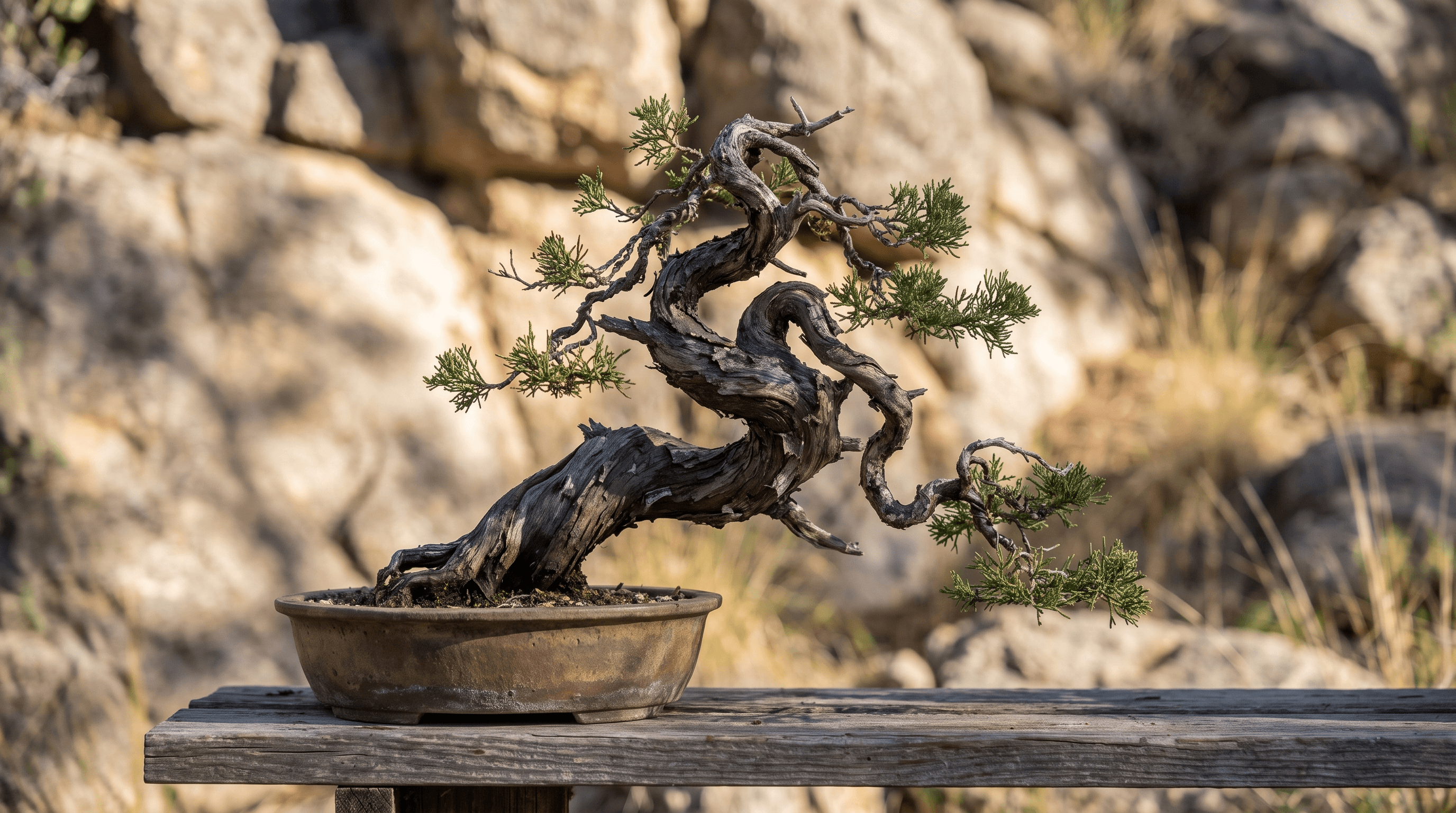
This species grows natively across the dry slopes and desert margins of California and into parts of the Southwest, in conditions that are genuinely hostile: thin rocky soil, long stretches without rain, and constant wind. Part of why the trunks end up so dramatically twisted and contorted is that the species itself naturally grows crooked, forked, and multistemmed even in easier conditions, and harsh, exposed sites then exaggerate that tendency into extreme weathering and deadwood, movement no amount of wiring on a straight nursery trunk can convincingly fake. Many of the famous old California juniper bonsai in collections started as collected material, dug from that harsh native terrain rather than grown from a cutting in a pot.
The foliage is a bit coarser and greyer than the finer, brighter cultivars you might know from Chinese juniper, mostly tight scale-like growth in a muted green-grey that suits the weathered character of the trunk rather than competing with it. What really sets this species apart, though, is how much of the deadwood is already present on collection. A wild California juniper can carry substantial naturally formed jin and shari, and on some individual specimens I've worked with there's been more dead wood than live, with the live vein spiralling around the trunk in a way that looks almost sculpted. Working with one of these trees is as much about reading what's already there as it is about designing something new.
Care
Light
Full sun for an established tree, without question, this species comes from some of the sunniest, most exposed growing conditions of any bonsai subject. The caveat is the same as with any recently collected juniper: a tree that's just been dug up has a reduced root system and can't necessarily support full sun exposure right away, so I bring newly collected trees into full light gradually over the first season rather than putting them straight into the harshest spot on the bench.
Watering
This is a genuinely drought-adapted species in the wild, and that shows up in cultivation as a strong dislike of sitting wet. The substrate needs to drain fast and completely, and the priority is an aerated root zone that never stays saturated rather than leaving the roots in anything damp for an extended period. That said, a bonsai pot dries out far faster than the deep, sprawling root system this tree would have in open desert ground, so don't assume drought tolerance means it can be left alone for long stretches once it's in a shallow container; check it regularly and water thoroughly when it does need it.
Temperature & hardiness
Cold tolerance varies more with this species than with some others, since collected trees come from a range of elevations and microclimates within its native range, so I'd rather not put a specific number on it. Keep it outdoors year-round so it experiences natural seasonal cues; it does not require severe winter cold to stay healthy, since much of its native range has fairly mild winters and a very long growing season, but collected provenance affects individual frost tolerance. What matters more day to day is that it's used to a hot, dry, sun-intense climate, and it can struggle in cultivation in consistently humid or wet regions far outside that range. Protect the pot itself only in unusually severe or prolonged freezes.
Soil & potting
Even by juniper standards, this species wants an aggressively free-draining, mineral-heavy mix, closer to what it would find growing out of decomposed granite or rocky scree than a typical organic-rich potting substrate. I lean coarser and more mineral than I would for a Chinese juniper cultivar, especially in the years right after collection, since the small, sparse root system on a newly dug tree is particularly unforgiving of a mix that holds moisture too long.
Fertilizing
Once a tree is established and growing steadily, a normal balanced feeding programme through the growing season works fine. For a recently collected tree I feed conservatively while it's still in recovery, since it needs time to rebuild its root system before it can make good use of extra fertiliser, and I wait for clear, consistent new growth before feeding a newly collected specimen at all. Feeding should follow the tree's actual vigour and recovery stage rather than a fixed species-wide rule.
Pruning & wiring
A lot of the trunk movement and deadwood on this species already exists before you touch it, so styling is often more about selection than creation, deciding which live vein to follow, how much foliage to keep, and how to frame the natural twist rather than inventing new lines. The live vein itself can be narrow and vulnerable where it winds close to large sections of deadwood, so wiring needs a careful touch in those transition zones. As with any recently collected juniper, I avoid major structural work until the tree shows clear signs of recovery, strong extension growth, stable foliage, and firm anchorage, rather than working to a fixed timeline, giving the tree the time it individually needs to rebuild energy before asking it to recover from significant cuts as well.
Repotting
Recovery after collection can genuinely take several years with this species before the tree is stable enough to move into a proper bonsai pot, and I've seen good growers keep a newly collected specimen in a grow box far longer than impatience would suggest. Root disturbance should be minimal at each stage, working around the outer part of the root mass rather than aggressively reducing it, and always into a fast-draining, mostly mineral mix. Once a tree is established and vigorous, it settles into a fairly typical, unhurried juniper repotting rhythm.
Common problems
The main risk with this species is a collected tree that simply never fully recovers, showing a slow decline over a year or two that's easy to miss until it's advanced. Watch for weak or absent new growth through a full season rather than waiting for the foliage to visibly brown. Because it's so strongly adapted to dry conditions, growers in humid climates need to be especially careful about overwatering and poor air movement around the foliage, and maximising drainage and airflow matters more here than it would for a juniper used to wetter native conditions. Spider mites are still a possibility in hot, still conditions, and a soft or discoloured trunk base near the soil line points to root problems that need attention right away.
Styling
This is a species where the trunk does most of the talking. Literati and dramatic driftwood-style compositions are the natural fit, since the twisting, deadwood-heavy trunks these trees develop in the wild already look like an advanced styling exercise before any work begins. Foliage is usually kept sparse and restrained, arranged in a few clear pads that let the trunk line and the transitions between live vein and deadwood stay visible rather than getting hidden behind mass. Straightforward upright styles exist for younger or less dramatic material, but they're not really why this species has the reputation it does.
Common questions
Is California juniper bonsai stock collected from the wild?
Most, at least among the specimens known for dramatic trunk movement. This species is native to dry, rocky terrain in California and parts of the Southwest, and the twisted trunks and heavy natural deadwood that make it so prized come from a naturally crooked, multistemmed growth habit that harsh, exposed sites then exaggerate over years, not from cultivation.
Can I grow California juniper bonsai outside a dry climate?
You can, but it takes more care around watering and airflow. This species is strongly adapted to arid conditions, and in humid climates it's more prone to rot and fungal problems than a lot of other junipers if the substrate or watering routine holds too much moisture.
Why is the trunk on my California juniper so twisted?
This species naturally grows crooked, forked, and multistemmed even in easy conditions, and a life spent in harsh, exposed native terrain exaggerates that into the dramatic twisting and weathering collectors look for; it's not something added afterward. It's the main reason this species is so sought after for bonsai, and it's part of why collected specimens are valued far more than young nursery-grown plants.
How long does a collected California juniper take to establish?
It can take several years before a freshly collected tree is stable enough for a real bonsai pot and significant styling work. Growth is slow to resume after collection, and pushing the process too fast with heavy pruning, wiring, or fertiliser is one of the more common ways these trees are lost.
Why does my California juniper already have so much deadwood?
Wild trees of this species often develop large amounts of natural jin and shari on their own, and on some individual specimens there's more dead wood than live, as a result of the harsh conditions they grow in. On collected material, that deadwood is usually worth preserving as it is rather than treating as a blank canvas.
General guidance based on 20+ years of practice. Every tree and every climate is different — when in doubt, ask us.