
Spring Repotting Timing by Species
There is no single repotting date for spring, only a set of windows that shift depending on whether you're holding a maple, a pine, or a flowering tree.
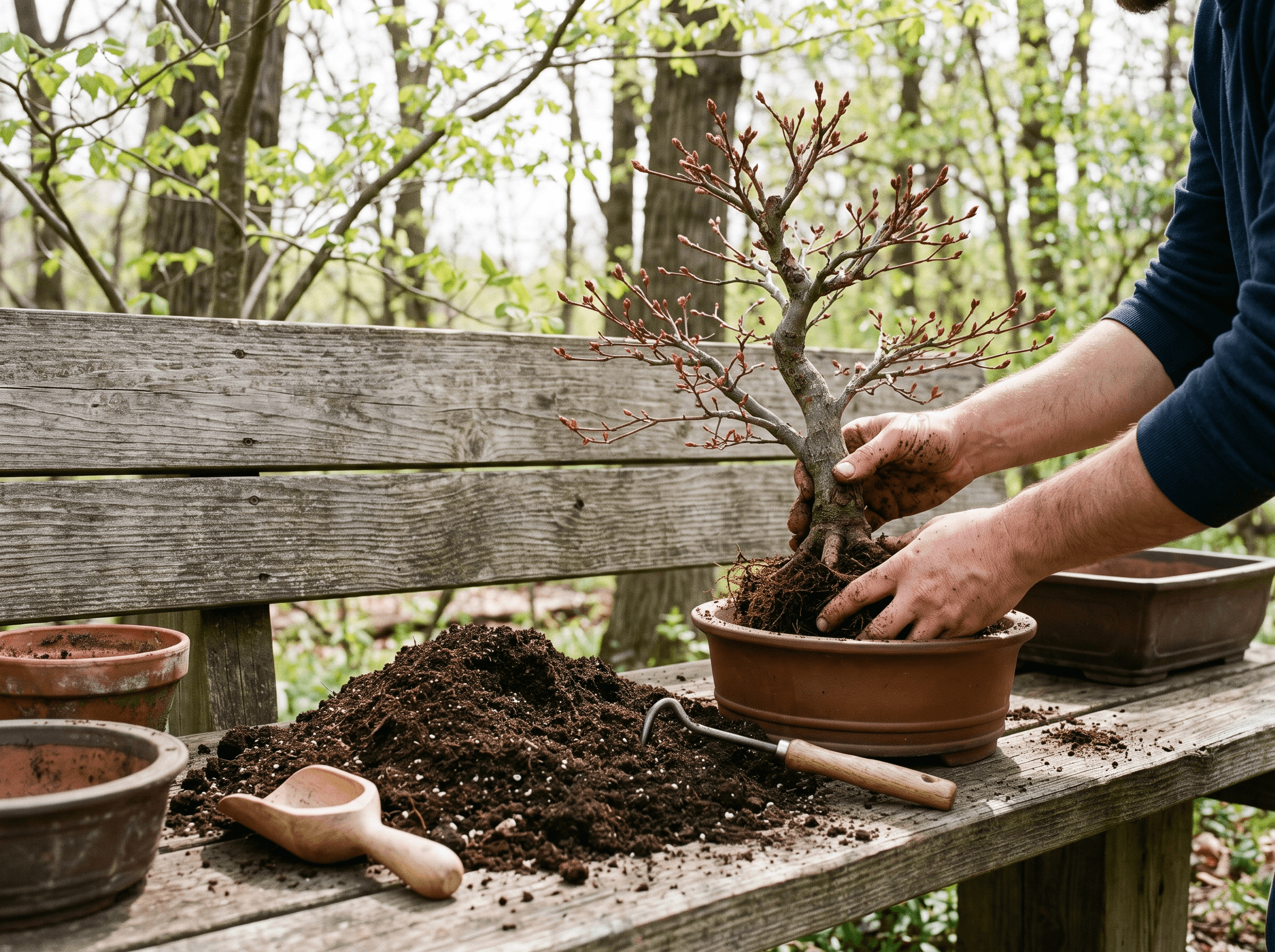
People ask me for a repotting date every February, and I understand why, a date is easy to plan around. But the truth is I don't repot my whole collection on the same weekend, and I never have. My maples and my black pines come out of their pots around the same time each spring, close to bud swell, while my junipers and spruces often trail behind by a few weeks, and my flowering trees follow their own separate logic entirely.
What actually drives the timing is what the roots and buds are doing on that specific tree, not the number on the calendar. That's genuinely more useful information than a date, because it adjusts automatically for whatever kind of spring you're having, early and warm or late and cold.
So instead of one rule, think of spring repotting as three or four overlapping windows that you match to what's sitting on your bench. I'll walk through how I sequence mine.
Temperate deciduous species: as buds swell, before leaves open
Maples, elms, hornbeams and most other temperate deciduous trees get repotted right as their buds are swelling but before the leaves have actually opened. This is the window where the tree is about to commit a burst of energy into new roots, which is exactly what you want after root pruning, but hasn't yet spent that energy on leaves. Waiting until leaves are fully out asks the tree to support new foliage on a disturbed root system at the same time, which is a bigger ask for most species, though a few, trident maple among them, tolerate repotting a bit later, even with the first leaves still reddish and unfurling. This tends to be my earliest repotting round each year.
Conifers: pines and junipers don't follow the same clock
Conifers don't all follow one simple rule, and I've learned to treat pines separately from junipers and spruces rather than lumping them together as a single later window. Pines, in my experience, actually want timing close to my deciduous schedule, right as buds begin to swell or just as roots are starting to grow but before candles have really extended, rather than waiting until candle movement is well underway, which tends to slow recovery rather than help it. Junipers and spruces are more forgiving on exact timing since they don't push out leaves the way a maple does, so the urgency to finish before foliage development isn't as sharp, but I still want to see the tree clearly moving into active growth before I disturb the roots. None of this is a fixed later window across all conifers, it depends on the specific species in front of me.
Flowering species: around or after bloom, depending on the tree
Flowering bonsai add a wrinkle because you often don't want to disrupt a bloom you've been waiting all year to see, and heavy root disturbance right before or during flowering adds stress at a demanding moment. Satsuki azalea is the clearest example of a species with two workable windows, late winter before spring growth gets going, or right after the flowers fade, and I pick whichever fits my schedule that year. Some flowering prunus, crabapple, and quince are more often repotted in early spring like a typical deciduous tree rather than automatically waiting for bloom to finish, so it's worth checking the specific species rather than assuming every flowering tree follows the same after-bloom rule. The point isn't a fixed rule so much as knowing your specific species' bloom habit and working around it rather than through it.
Why one date for everything gets it wrong
If you repot everything on a single weekend because that's when you have time, you'll almost always be too early for something and too late for something else. I learned this the hard way early on, catching a couple of conifers before they were really ready and losing more vigor that year than I should have. Now I stagger the work across several weeks each spring, checking each tree's buds and roots before deciding it's its turn.
Reading the roots, not just the buds
Buds are the visible signal, but if you're unsure, a quick look at the root ball can add a useful second data point, especially on pines, where root activity often starts before buds visibly move. White, actively extending root tips at the edge of the pot are one sign the tree is moving into active growth, though I treat this as a clue alongside bud movement rather than a rule on its own. A root mass that's still tight and pale with no visible new tips is more reason to wait another week or two than to force it, particularly when the bud signal is ambiguous too.
Common questions
What's the general order I should repot my collection in during spring?
In my nursery, deciduous species like maple and elm go first, as their buds swell. Pines usually land around the same time, close to bud swell or the first sign of root activity, rather than well after. Junipers and spruces are more flexible and can trail behind by a few weeks, and flowering species are timed around their individual bloom habits rather than fitting a fixed slot in between.
Can I repot a tree that's already in flower?
It's usually better to wait until the flowers fade for species that bloom on old wood, since root disturbance right before or during bloom can affect the flowers and adds stress at a moment when the tree's already busy. Check your specific species' habit first.
Do pines get repotted later than maples?
Not necessarily. In my experience pines actually want timing close to my maple schedule, right as buds begin to swell or just as roots start growing, rather than waiting for candles to extend well underway. It's junipers and spruces that tend to have more flexibility on exact timing, since they don't push into leaf growth the way deciduous trees do, so there's less urgency to finish before foliage develops.
Is it possible to repot too early in spring?
Yes. If buds haven't started swelling and there's no sign of new root tips, the tree isn't ready to recover quickly from root work yet. I've caught trees too early myself and seen slower recovery for it, so when in doubt I wait rather than rush.
How do I know if my tree's roots are ready for repotting?
Look at the edge of the root ball for white, actively extending root tips, one sign the tree is entering active growth, though I treat it as a supporting clue alongside bud movement rather than a rule on its own. A tight, pale root mass with no visible new growth is more reason to hold off a bit longer.
Does every species need repotting every spring?
No. Repotting frequency depends on species, pot size, and how root-bound the tree has become, ranging from every year for some fast-growing species in development to every few years for a mature tree in a smaller pot. Spring timing rules apply whenever repotting is due, not every single year.
What happens if I miss the ideal repotting window for a species?
It's not catastrophic, but recovery tends to be slower and more stressful the further into active leaf growth you go, for most temperate species. A few, like trident maple, tolerate a later window better than most. If you've clearly missed the window on a species that doesn't have that flexibility, I'd lean toward waiting until the following year rather than repotting into a fully leafed-out tree.
You might also like
General guidance based on 20+ years of practice. Every tree, climate, and year is different — when in doubt, ask us.