
When to Repot a Bonsai: Signs and Timing
The most reliable way to know if a tree needs repotting is to actually look, sliding it partway out of the pot to check the roots, rather than going by how many years it's been.
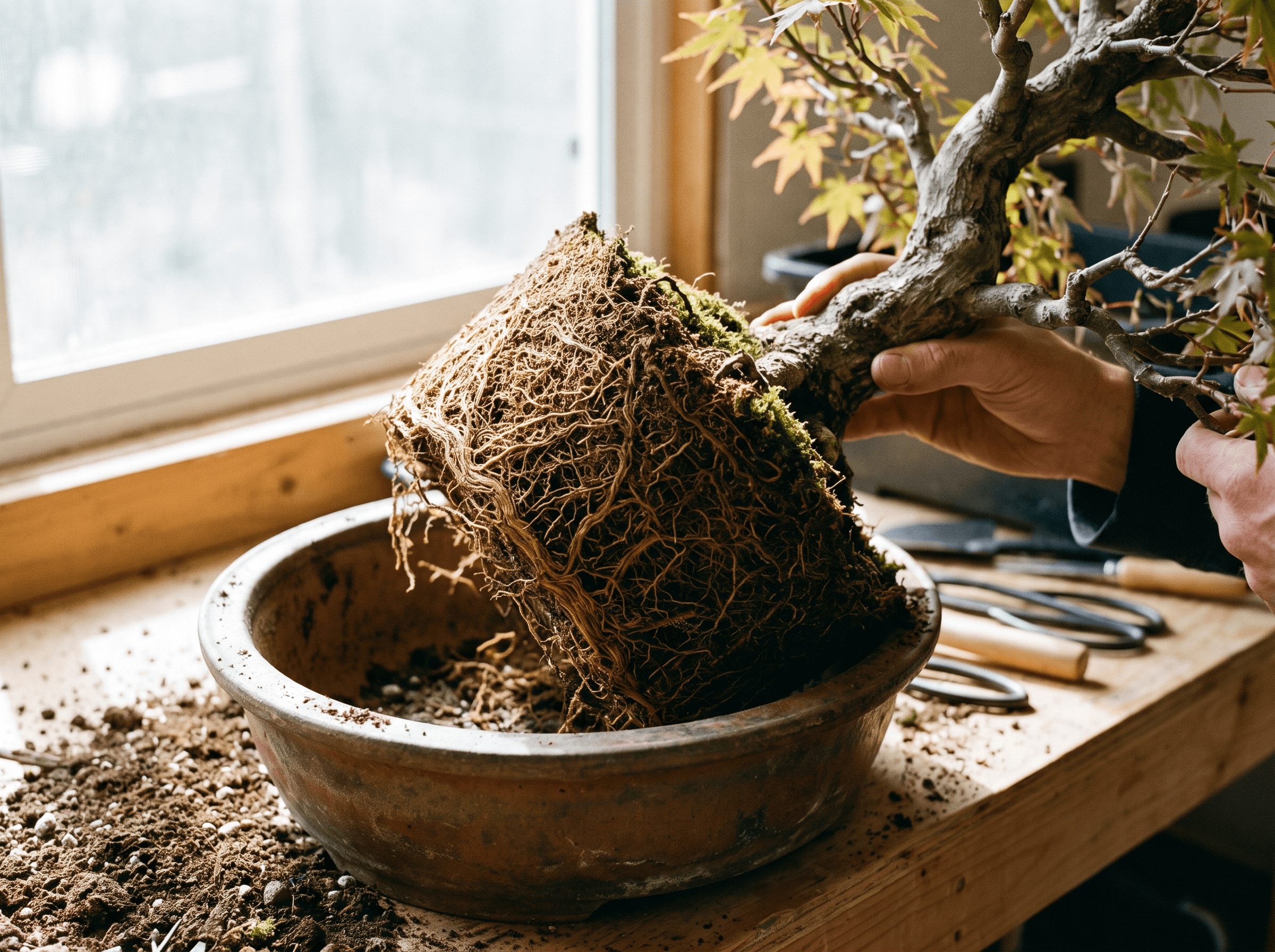
People ask me for a schedule, something like repot every two years and you'll be fine, and I understand the appeal of a simple rule. But I've got trees on the bench right now that have sat happily in the same pot for five or six years, and others that needed attention again within eighteen months. The tree tells you when it's ready, the calendar doesn't, and the most reliable way to know is to look at what's happening under the soil, alongside other cues like how quickly water is draining through the pot.
The check itself is simple. Gently slide the tree partway out of its pot, just enough to see the outer edge of the root mass, and look at what the roots are doing. That look, combined with paying attention to drainage speed, tells you more than any fixed schedule ever could, and it takes less time than most people expect once you've done it a couple of times.
Timing within the year matters too, alongside deciding whether a tree needs repotting at all. Most species have a window when repotting is far less stressful for the tree, and getting that timing roughly right matters as much as correctly identifying that the tree is ready in the first place.
The slide-out check
Carefully ease the tree partway out of its pot, tilting it or sliding it just enough to expose the sides and bottom of the root mass without fully removing it if you're not planning to repot that day. What you're looking for is how densely roots have filled the space. A healthy amount of root growth reaching the pot walls is normal and even desirable, a sign the tree is settled and vigorous. What signals it's time to act is roots circling densely around the inside wall of the pot in a tight mat, together with signs like water draining noticeably slower than it used to or soil that's turned compacted and mud-like. Roots emerging from the drainage holes underneath are worth noting too, but on their own they're a supporting clue rather than a definitive trigger, some trees push a few roots through the holes well before they're genuinely due for a repot.
Timing within the year
For most species, early spring, right around bud swell and just before the growing season really gets going, is the standard window for repotting. The tree is about to put energy into a burst of new growth, which helps it recover from root work quickly, but it hasn't yet committed that energy to leafing out or flowering, which keeps the disturbance from competing with an active growth push already underway. Conifers and some other species often run on a slightly different schedule than deciduous broadleaf trees, and a handful of species are repotted in autumn instead, so it's worth checking what's typical for the specific species rather than assuming one calendar window covers everything. Some tropical and subtropical species are more flexible about this and tolerate repotting reasonably well during other warmer months too, since they don't have the same sharply defined dormant and active seasons that temperate species do. Species-specific timing details vary, but the general principle, catching the tree just ahead of its main growth push, holds broadly across most of them.
Age and vigor change the frequency
Young, vigorously growing trees build root mass quickly and often need repotting every one to two years to keep up with that growth. Older, more mature trees, especially ones that have already been developed and are being maintained rather than pushed for growth, can often go considerably longer between repots, sometimes many years, since their root systems fill the pot more slowly and their overall growth has settled into a steadier pace. There's no single frequency that applies across a collection with trees at different stages, which is exactly why the slide-out check matters more than a fixed interval.
The cost of repotting too often
It's tempting, especially for newer growers eager to see progress, to repot more frequently than a tree actually needs, treating it almost like a way to actively participate in the tree's development. But repotting is a genuine stress event, disturbing roots that were doing their job perfectly well, and doing it more often than necessary out of impatience actually slows a tree down rather than helping it, forcing it to spend energy recovering rather than growing. That said, this cuts both ways, some growers prefer to repot a little before a tree becomes genuinely pot-bound rather than waiting for the most severe signs to show up, since recovery tends to be easier from a mild case than a serious one. If the slide-out check and drainage speed both still look normal, it's usually fine to leave the tree be for another season.
Common questions
How can I tell my bonsai needs repotting without fully removing it from the pot?
Gently slide or tilt the tree partway out of the pot to see the outer edge of the root ball. Dense roots circling the inside wall is the clearest sign, along with water draining noticeably slower than usual. Roots emerging from the drainage holes is worth noting too, but treat it as a supporting clue rather than proof on its own, since a few roots can show up there before the tree is genuinely due.
What season is best for repotting?
Early spring, around bud swell and just before the growing season starts, is the standard window for most species, since the tree can recover quickly using the energy it's about to put into new growth. Conifers and some other species can run on a slightly different schedule, and some tropical and subtropical species tolerate repotting during other warm months as well.
How often should a young bonsai be repotted?
Young, vigorously growing trees often need repotting every one to two years, since they fill their pots with root growth relatively quickly. This slows considerably as the tree matures and its growth rate settles down.
Can an older bonsai go many years without repotting?
Yes, mature, developed trees that are being maintained rather than pushed for growth often go much longer between repots than younger material, sometimes several years or more, since their root systems fill the pot more slowly.
Is it bad to repot a bonsai too often?
Yes, repotting is a genuine stress on the tree, and doing it more often than the roots actually require, out of impatience or eagerness, tends to slow growth and recovery rather than help it. That said, it's also worth not waiting for the most severe signs of being pot-bound, a tree caught a little early tends to recover more easily than one left too long.
What happens if I wait too long to repot a severely rootbound tree?
The tree's roots can become so densely packed that water and nutrients struggle to move through the root mass properly, and the tree's overall vigor can decline even while other conditions look fine. Checking periodically with the slide-out method, along with watching how fast water drains, helps catch this before it becomes severe.
Can I repot a bonsai outside of spring if it clearly needs it?
It's not ideal but sometimes necessary, and for many temperate species a full repot with root pruning outside the usual window carries more risk than waiting for spring would. In a genuine emergency, a simpler slip-pot, moving the tree into a larger container without disturbing the root ball, is usually the safer interim option rather than full root work. Tropical and subtropical species generally have more flexibility here. If a repot outside the usual window is unavoidable, extra care with aftercare and shelter afterward matters even more than usual.
You might also like
General guidance based on 20+ years of practice. Every tree and every climate is different — when in doubt, ask us.