
Signs Your Bonsai Soil Needs Replacing
Most of the time you can tell a bonsai's soil needs replacing well before the tree itself shows any real distress, if you know what to actually check at watering time.
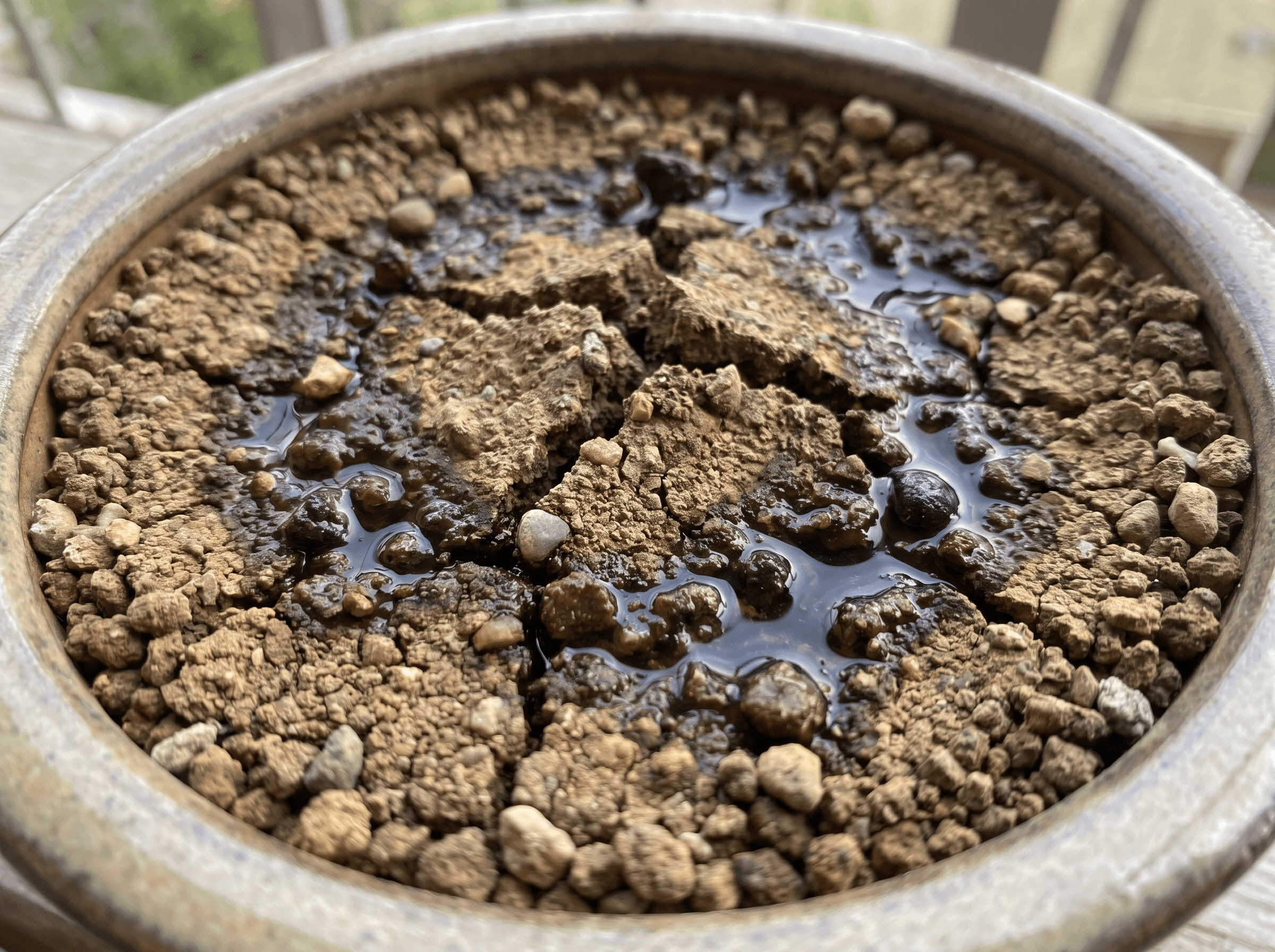
I check soil condition on every tree I water, almost without thinking about it anymore, mostly because I've been caught out before by a tree that looked perfectly healthy above the soil line while the substrate underneath had quietly turned to compacted mud. By the time foliage problems show up, the soil has usually been in bad shape for a while already, so learning to read the signs early saves you from finding out the hard way.
None of these signs mean you did anything wrong as a grower. Substrate breaking down over time is a normal, expected part of bonsai maintenance, not a symptom of neglect. The goal isn't to avoid it happening, it's to catch it at a reasonable point and address it at the next repot rather than letting it run on for another year or two past when it should have been dealt with.
Water sitting on the surface instead of running through
This is usually the first and clearest sign. Fresh, well-structured bonsai substrate lets water pass through and out the drainage holes fairly quickly when you water. As the substrate breaks down and compacts, water starts pooling on the surface for a moment before slowly working its way down, or in worse cases just sits there and drains at a noticeably slower pace than it used to for the same tree in the same pot. If you water the same trees regularly, you develop a feel for how fast water normally disappears into a given pot, and a real slowdown from that baseline is worth paying attention to rather than dismissing as a one-off.
A sour or stagnant smell from the pot
Healthy, well-draining substrate generally doesn't have much of a smell at all, maybe a faint earthy note right after watering. A sour, stagnant, or swampy smell coming from the pot can be a possible warning sign that water is sitting too long in the substrate without enough oxygen movement through it, often pointing toward compaction and poor drainage rather than anything happening at the surface. I treat it as worth investigating alongside the other checks rather than as proof on its own. This is worth checking directly by getting your nose close to the soil surface after watering, since it's easy to miss from a normal working distance, especially outdoors where airflow disperses smells quickly.
A mushy, mud-like texture instead of distinct granules
Probe the top layer of soil with a finger or a wooden skewer. Fresh bonsai substrate should feel granular and distinct, individual particles you can more or less identify by touch and sight. Broken-down substrate feels mushy and uniform instead, more like mud than like a collection of separate granules, because the particles have physically degraded into finer material that packs together. This texture check is one of the more reliable ways to confirm what slow drainage or a bad smell is already suggesting, and it's something you can do in a few seconds without any tools.
Why this happens even with good care
Components like akadama are clay-based and simply break down mechanically over time, typically over a period of a few years, though the exact interval varies quite a bit with climate, watering frequency, particle grade, and how fast the tree itself is growing, regardless of how well you've cared for the tree in a general sense. This isn't a flaw in your routine, it's the expected lifespan of that particular ingredient doing its job. Even components chosen specifically for long-term stability, like pumice or lava rock, can end up buried in fine particles shed by a breaking-down akadama fraction nearby, which affects the drainage of the whole mix even though those components themselves haven't degraded. Treating substrate breakdown as a normal maintenance item on a rough multi-year cycle that shifts with your own conditions, rather than a problem to diagnose and fix, keeps expectations realistic.
What to do once you've spotted the signs
None of these signs demand an emergency repot the moment you notice them, particularly if the tree is otherwise healthy and you're outside the normal repotting window for the species and season. What they do mean is that a repot, addressing the substrate properly rather than a quick topdressing over the surface, should be planned for the next appropriate window rather than pushed off indefinitely. The longer compacted, broken-down substrate stays in place, the more the root system suffers from reduced oxygen and slower water movement, so I'd rather schedule a repot a season earlier than strictly necessary than wait until the tree itself is showing visible stress from it.
Common questions
How many years does bonsai soil typically last before it needs replacing?
It varies by the components used, watering frequency, climate, and how vigorously the tree is growing, but a few years is a reasonable general expectation for akadama-based mixes before the clay fraction has broken down enough to affect drainage. More stable mineral components like pumice and lava rock last considerably longer on their own.
Can I tell my soil needs replacing without taking the tree out of the pot?
Mostly, yes. Watching how quickly water drains, checking for smell, and probing the top layer with a finger or skewer all work without removing the tree. A full picture of what's happening deeper in the root zone really does require an actual repot, but the surface-level checks are usually enough to flag that one is due.
Is a sour smell from the pot always a sign of bad soil?
It's a possible indicator worth taking seriously, but it's worth considering alongside the other signs rather than in isolation. A faint, brief smell right after watering in otherwise well-draining soil isn't necessarily cause for concern. A persistent sour smell combined with slow drainage is a stronger combined signal.
Does soil breaking down mean I did something wrong with watering?
No. Clay-based components like akadama break down mechanically over a normal multi-year timeframe regardless of watering technique. Overwatering or poor drainage elsewhere can accelerate the process somewhat, but the underlying breakdown happens even under good care, it's just the expected lifespan of that material.
If the soil looks fine on top but the tree seems stressed, could old soil deeper down be the cause?
It's worth considering. Substrate can break down unevenly through the profile, and surface checks don't always tell you what's happening deeper in the pot, sometimes the surface layer is actually the one that degrades faster, since it takes the most direct hit from watering. A tree showing unexplained stress with no obvious cause is a reasonable candidate for checking the substrate condition at the next repot rather than assuming the surface tells the full story.
Should I replace all the soil at once when I notice these signs, or just refresh part of it?
That depends on how extensively the substrate has broken down and how the species tolerates root disturbance. Many repots address the substrate gradually through partial root work over more than one session rather than replacing everything in a single sitting, particularly for species like many conifers that don't tolerate aggressive root work well.
Can I speed up or slow down how fast my soil breaks down?
Watering frequency and climate both affect the pace somewhat, more frequent watering and hotter conditions tend to accelerate breakdown of clay-based components like akadama. You can't stop it entirely, since it's a mechanical property of the material itself, but choosing a higher grade of akadama or leaning the mix more toward stable components like pumice and lava rock can extend the interval between needed refreshes.
You might also like
General guidance based on 20+ years of practice. Every tree and every climate is different — when in doubt, ask us.