
Bonsai soil that never seems to dry out
If the surface of your bonsai's soil still feels damp two or three days after you watered, and it stays that way no matter how you adjust your routine, the problem is almost never your watering can. It's what's underneath it. Bonsai soil not draining is one of the most common problems in container growing, though a damp surface a couple of days out isn't always diagnostic on its own, since cool weather, dormancy, low light, humidity, recent rain, and pot size can all stretch out normal drying time.
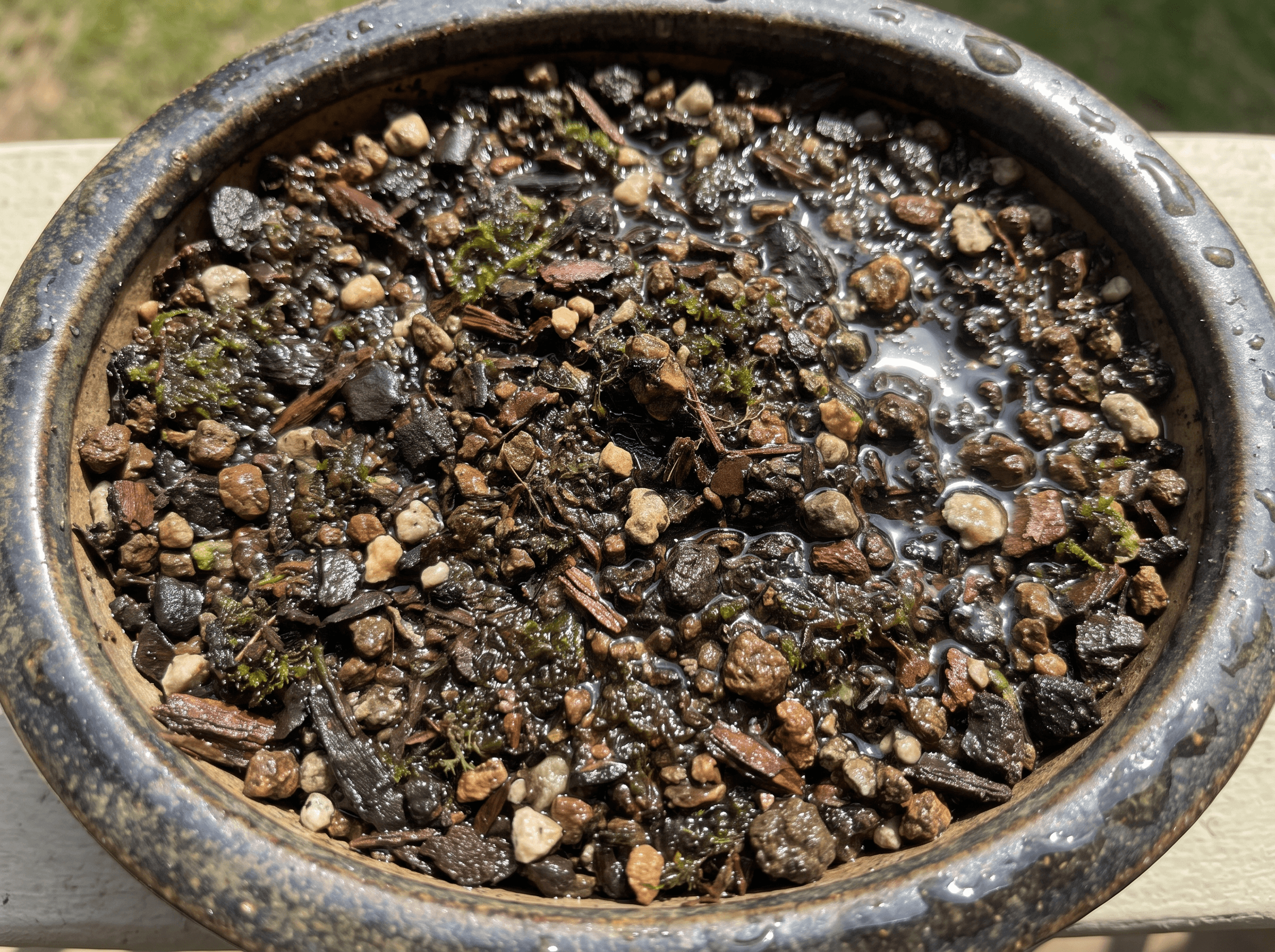
In my experience, when someone tells me their bonsai soil never dries out, the actual watering schedule usually turns out to be fine. What's wrong is the material sitting in the pot, or the pot itself isn't letting the water leave once it's done its job. Bonsai substrate is supposed to hold enough moisture to feed the roots between waterings and then get out of the way. When it can't manage the second half of that job, water just sits there, and no amount of adjusting how often you fill the watering can changes that.
I bring this up because standing water and root rot are close relatives, but they're not the same diagnosis. Roots need oxygen almost as much as they need water, and soil that stays saturated pushes air out of every gap between particles. Left long enough, that turns into a rot problem, but you'll usually see this drainage issue first, as soil that just won't lighten up, well before the tree shows the wilting or blackened roots that come further down the line. Catching it at this stage is the cheap fix. Catching it once the roots are already involved is the expensive one.
You'll notice this most on a tree that was repotted into whatever bag of soil was on hand, or one that's been sitting in the same pot for three or four years while the substrate slowly broke down into something closer to mud than mix. A rainy stretch makes it obvious fast, because a pot that's already slow to drain has nowhere to send the extra water. Indoors over winter is the other classic moment, when watering drops off but airflow drops off even more, and a pot that was borderline all summer tips over into staying wet all the time.
Likely causes
Substrate that's too fine or too organic
How to tell: Pick up a handful from the surface and it holds together like damp cake rather than falling apart into individual grains. You'll often see very fine, almost powdery particles packed between the coarser bits, and if you push a chopstick into the pot it meets steady, even resistance all the way down rather than the loose, gritty give of an open mix with real pore space between particles. This is typical of a mix built mostly from potting soil, compost or peat rather than granular inorganic components such as akadama, pumice, lava rock, fired clay or grit.
The fix: The real fix is repotting into a proper mineral-heavy bonsai substrate, and it has to happen at the right season for the species rather than the day you notice the problem. Go for a mix built from granular inorganic components such as akadama, pumice, lava rock, fired clay or grit, sieved beforehand to remove the dust that clogs the gaps between particles. While you're in there, comb out as much of the old compacted soil from the root ball as the tree's condition allows, because leftover pockets of the old fine mix will keep holding water even inside an otherwise good repot.
Blocked or insufficient drainage holes
How to tell: Water sits visibly on the surface after you water, or it takes noticeably longer to disappear than it used to on the same tree. Turn the pot over if you can and check whether the holes are still open. Roots grow directly into drainage holes over a season or two and can plug them from the inside, and mesh that's torn or missing lets fine substrate wash down and cake against the opening from the outside.
The fix: Clear the holes with a thin wire or chopstick and refresh the drainage mesh if it's torn, sagging or missing. On a pot with only one small hole, or a decorative pot that was never really built for bonsai, check whether it has enough drainage area for its footprint, since a 30cm pot needs considerably more of it than a small one does. If the pot itself is the real limitation, it's worth moving the tree into a proper bonsai container at the next repotting rather than fighting the pot indefinitely.
Pot too large for the current root mass
How to tell: The tree looks almost lost in the container, with visible soil well beyond where the roots actually reach. A large volume of substrate around a comparatively small root ball dries unevenly: the outer soil dries first while the centre near the roots stays wet far longer, and that gap only widens as the season goes on.
The fix: There's no shortcut here that skips a repot, done at the right time for the species. Move the tree into a pot sized to the current root mass rather than one you're growing into, since bonsai pots are meant to be snug, not generous. If a repot isn't due for a while yet, ease the problem in the meantime by watering thoroughly whenever the root zone actually needs it rather than on a fixed schedule, checking moisture at more than one spot and depth in the pot first. Skip any saucer or tray that lets water pool underneath, improve airflow and light where you can, and keep the tree sheltered from heavy rain until you can get it into a better-fitted pot.
How to prevent it
The cheapest way to deal with this problem is to never create it. Build your mix around the actual mineral components, akadama, pumice, lava rock, coarse grit, in proportions right for your climate and species, rather than reaching for whatever bag of soil happens to be closest, and sieve out the dust before it goes anywhere near the pot. When you choose a pot, match its size and its drainage to the tree in front of you rather than the tree you hope to grow, because generous extra room around the roots is exactly what keeps the centre of the pot wet long after the edges have dried. And build the habit, at least once a year, of checking that the drainage holes are still open and the mesh is intact, since roots and old substrate block them quietly over time and you won't notice until the soil is already staying wet.
Common questions
Can I just water less to fix this?
Watering less will mask the symptom for a while, but it doesn't fix drainage, and in the meantime you're often underwatering the parts of the root ball that dry fastest while the centre stays soaked regardless. It's a reasonable stopgap until you can repot at the right season, not a real solution. If you find yourself permanently watering less than the tree and the season call for, that's usually a sign the substrate needs replacing rather than the routine.
How do I actually test whether my bonsai has a drainage problem?
Water the tree normally and then check the soil at the 5 to 10 minute mark, again at an hour, and again the next day, treating these as rough warning signs rather than fixed rules, since the actual timing shifts with species, season, pot depth, whether the tree is indoors or outdoors, ambient humidity, and the particle size of your mix. With that caveat, well-draining substrate should generally be visibly damp but not glistening within the hour, and noticeably lighter in colour by the following day. If water is still pooling on the surface well past the ten minute mark, or the pot feels heavy and the soil looks dark and saturated a full day later under otherwise normal conditions, drainage is worth investigating as the cause rather than your watering schedule.
What actually makes a good bonsai soil mix?
A good mix is built from granular inorganic components such as akadama, pumice, lava rock, fired clay or grit rather than organic potting soil, sieved to a consistent particle size so there isn't a layer of dust clogging the spaces between grains. The exact ratio shifts with species and climate; a pine wants more free-draining pumice and lava than an azalea does, but the principle stays the same across all of them, individual particles with pore space between them rather than a compacted, soil-like paste.
Is this the same thing as root rot?
No, though one leads to the other if it goes on long enough. A drainage problem is a soil condition: water isn't leaving the pot the way it should. Root rot is what happens to the roots after they've sat in that saturated, oxygen-starved soil for too long, and it shows up as soft, blackened, foul-smelling roots rather than just slow-draining soil. Catch the drainage issue early and you'll likely never see actual rot develop.
Can I improve drainage without doing a full repot?
To a limited degree, yes. Top-dressing with a coarser mineral layer won't fix a compacted root ball underneath, but clearing and enlarging drainage holes, adding proper mesh, and making sure the pot isn't sitting flush against a saucer or tray that traps water underneath it can all help in the short term. None of that replaces a repot into better substrate when the season allows it, but it buys you time on a tree that isn't due for repotting yet.
Does the type of pot matter, not just the soil?
It does, though it's not the whole story. Unglazed pots like plain terracotta breathe slightly through the clay itself and dry a little faster than glazed ones, which matters on a borderline mix, but that's not true of every bonsai ceramic; some high-fired stoneware is nearly as impervious as a glazed pot despite looking unglazed. Drainage holes matter too. A pot with too few or too small holes makes it harder for water to leave the container, but how much that slows drainage also depends on the texture and particle size of the mix, the shape of the pot, and how much root mass is filling the space, so pot and soil need to be evaluated together rather than treating one as the fix for problems caused by the other.
You might also like
General guidance based on 20+ years of practice. Every tree is different — when in doubt, ask us.