
Bonsai Soil Basics: What Makes a Good Mix
Good bonsai soil isn't about any single magic ingredient, it's about a mix that drains fast and stays airy while still holding enough water and nutrient between waterings to keep a tree alive in a shallow pot.
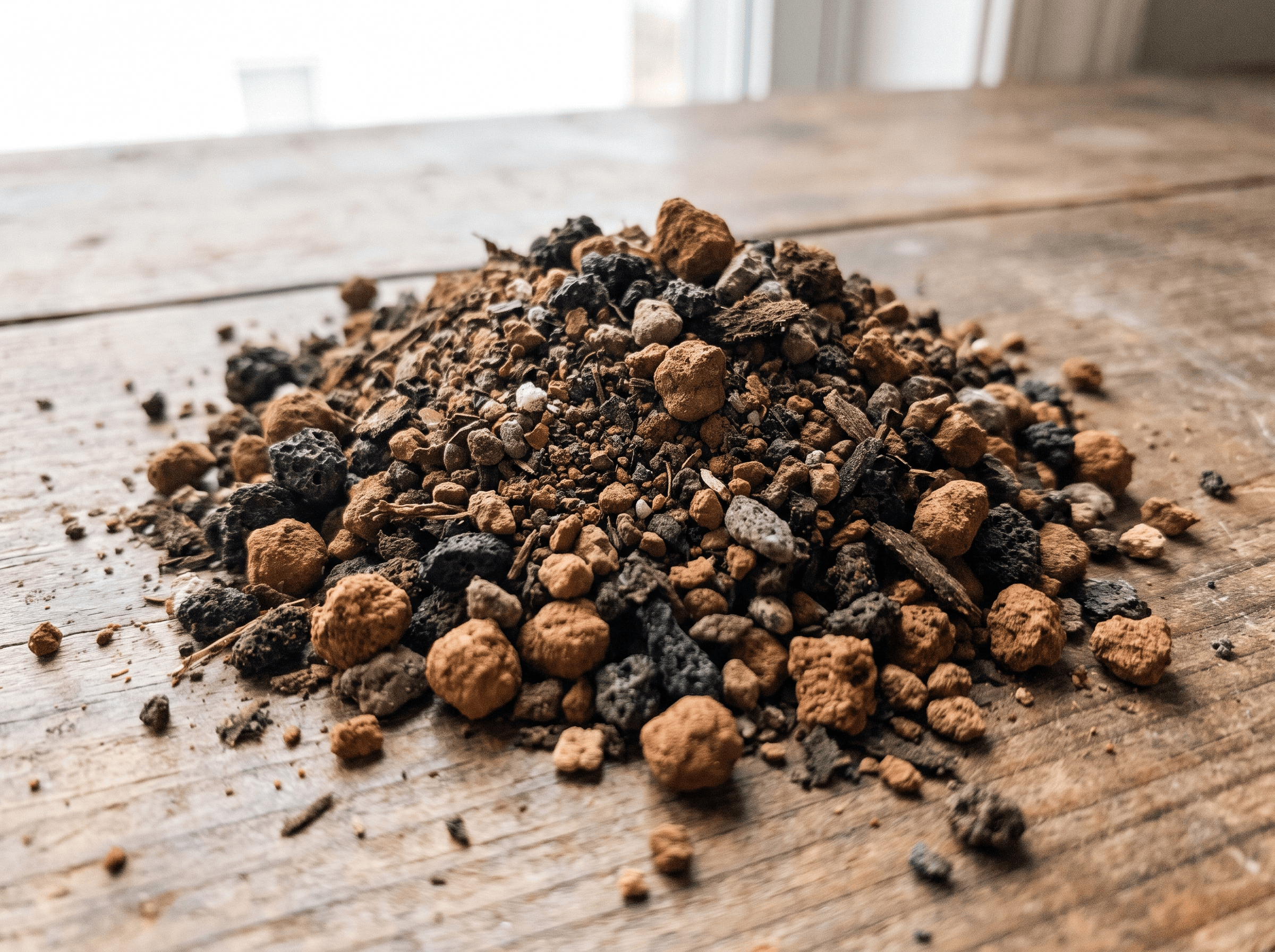
Every year I get someone showing up with a struggling tree they've potted in ordinary potting soil, the bag from the garden center with the picture of a lush houseplant on the front, convinced the tree is sick when really the soil is just wrong for the container it's in. It's an understandable mistake. That soil is often fine in a deep plastic pot on a windowsill, where there's enough volume to buffer the extra moisture it holds. In a shallow bonsai pot, the same soil behaves completely differently, and that difference is really what bonsai soil is about.
Ordinary potting mix is built around organic matter, peat, compost, bark fines held together in a dense structure that retains moisture well in a deep container with plenty of volume. Put that same mix in a pot two or three inches deep and the dynamic changes. Drainage slows and the mix can stay damp for days at a time, and roots sitting in that kind of saturation, roots that need oxygen as much as moisture to stay healthy, can start to suffocate and rot.
Bonsai substrate solves that by prioritizing drainage and aeration first, moisture and nutrient retention second, and getting the balance between those two things right is really the whole game.
Fast drainage without drying out completely
The core tension in any bonsai mix is that water needs to move through it quickly, so roots aren't sitting in standing moisture, while still leaving enough held in and around the particles that the tree isn't gasping for water an hour after you've watered it. Pure gravel would drain instantly but hold almost nothing, and the tree would need watering constantly. Pure organic compost holds plenty but drains poorly and compacts in a shallow pot. Bonsai substrates sit deliberately between those extremes, usually built from mineral, granular components that let water pass through freely while still holding a film of moisture on and inside each particle for the roots to draw on.
Aeration matters as much as ingredients
This is the part beginners underestimate most. It's tempting to think the choice of ingredient is the whole story, but particle size and the air gaps between particles matter just as much, sometimes more. A mix made of genuinely excellent bonsai components, but sifted down to dust or left uneven with a lot of fine material mixed in, will compact in the pot regardless of what those components are. Compacted soil loses the air pockets roots need, and once those pockets are gone, you're effectively back to the same suffocation problem as dense potting soil, just with better-sounding ingredients. Uniform, appropriately sized granules with fine dust sifted out are what actually keep a mix open and airy season after season.
Why ordinary potting soil falls short long term
Regular garden soil or houseplant potting mix isn't inherently bad soil, it's just built for a different job. In a deep container with a large volume relative to the plant, its slower drainage and moisture retention are an advantage, less frequent watering, more buffer against drying out. In a shallow bonsai pot, that same slower drainage becomes a liability almost immediately, and it gets worse over time as the organic components break down further and compact even more. A tree can sometimes survive in the wrong soil for a season or two on sheer resilience, especially a tough, adaptable species, but I've yet to see one thrive long term in dense potting mix once you compare it to the same tree in appropriate substrate.
Adjusting the mix for what the tree actually needs
There's no single perfect bonsai mix that suits every tree, because species differ quite a bit in how much moisture they want between waterings. Something adapted to naturally wet ground tolerates, even prefers, a mix that holds more moisture than a Mediterranean or drought-adapted species would want. A grower in a hot, dry climate will often lean the mix slightly toward more moisture retention than a grower in a consistently humid one, even for the same species, simply because the water is evaporating faster in their conditions. This is one reason a mix that works beautifully for a friend's tree in a different climate can behave differently for the same species in yours. The underlying principles, fast drainage, good aeration, adequate but not excessive retention, stay constant. The exact ratio you land on to satisfy those principles shifts with the tree and the place it's growing.
Common questions
Can I use regular potting soil for bonsai if I just water less often?
Not reliably. The problem with potting soil in a shallow pot isn't just that it holds water, it's that it compacts and loses the aeration roots need over time, regardless of how carefully you time your watering. Watering less often just trades overwatering risk for underwatering risk without fixing the underlying drainage and compaction issue.
What's the simplest way to tell if a bag of soil is suitable for bonsai?
As a rough rule of thumb, wet a handful and squeeze it gently. If it clumps into a dense, muddy ball that holds its shape, that's a sign it's too fine and organic for most bonsai use. It isn't a scientific test, but a suitable mix generally stays loose and granular, water passes through visibly, and the particles don't smear together.
Does bonsai soil need to contain any organic matter at all?
Some mixes include a modest organic component, and that's fine in the right proportion. The issue isn't organic matter existing at all, it's organic matter dominating the mix and creating the dense, slow-draining structure that causes problems in a shallow pot.
Why does my soil look fine but still stay wet for days?
This usually points to particle size rather than the ingredients themselves. Fine dust and small broken-down particles fill the gaps between the larger granules and choke off drainage and airflow, even if the original components were perfectly good bonsai substrate before they broke down or were left unsifted.
Is one universal bonsai soil mix enough for every tree I own?
Not really, though it's a reasonable place to start if you're new to this. As you get more comfortable, you'll likely find yourself adjusting the ratio slightly for species with different water preferences and for your specific climate, rather than using one identical bag for everything in the collection.
How can I tell my soil has broken down and needs replacing?
Watch how water behaves at the surface. If it used to run through quickly and now sits and drains slowly, or if probing the top layer reveals a mushy, mud-like texture instead of distinct granules, that usually points to the substrate breaking down and compacting over time, which is normal and isn't necessarily a sign you did something wrong. Slow drainage can occasionally come from a clogged drainage hole or a dense root mass instead, so it's worth checking underneath before assuming the soil itself is the cause.
Do succulents or cacti-style mixes work as a bonsai soil substitute?
They're closer to appropriate than ordinary potting soil, since they're also built around drainage, but they're usually not a direct substitute. Cactus mixes are often formulated for pots and watering habits that differ enough from bonsai practice that I'd still adjust the ratio rather than use one straight from the bag.
You might also like
General guidance based on 20+ years of practice. Every tree and every climate is different — when in doubt, ask us.