
Bonsai Root Pruning During Repotting
Good bonsai root pruning is about removing the old, thick, circling roots while protecting the fine feeder roots that actually keep the tree fed, not about how much you can cut away in one go.
Someone at a workshop once told me proudly that he'd bare-rooted his entire collection that spring, stripped every tree right down to almost nothing, because he'd read that aggressive root pruning promotes better root structure. Two of those trees didn't make it through the summer. Aggressive root work has its place, but it's a tool for specific situations and specific trees, not a default setting, and treating every tree the same way regardless of its vigor or species is how you lose material.
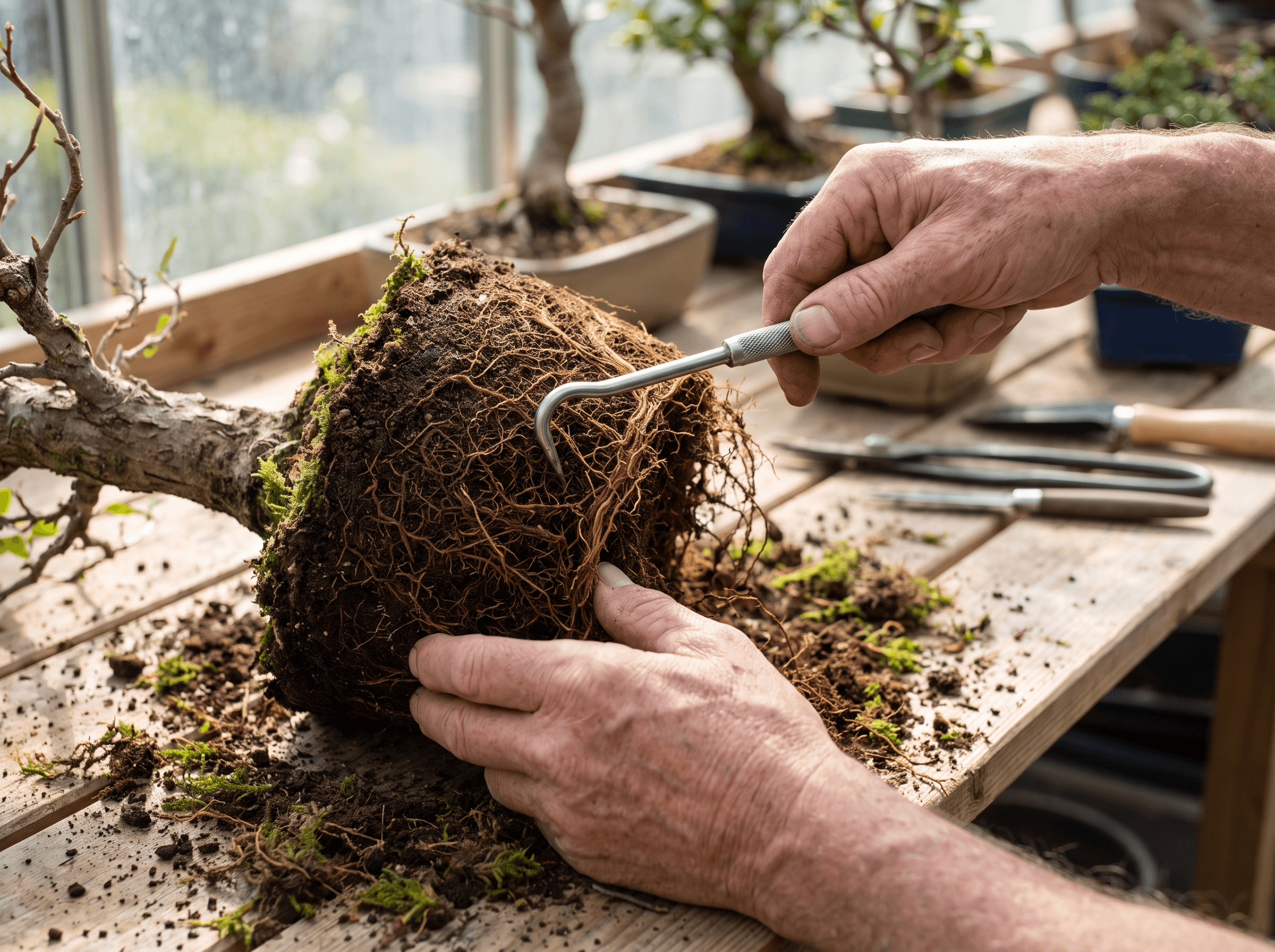
The actual goal of root pruning is fairly narrow. You want to remove roots that aren't doing useful work anymore, old thick roots, roots circling pointlessly around the inside of the pot, roots crossing over each other, while preserving the fine, hair-like feeder roots throughout the root ball, especially near the root tips, that do most of the actual water and nutrient absorption. Thick roots are mainly transport and structural tissue, so most of the real uptake happens through the fine ones, and it's easy to forget that when you're looking at a root ball and reaching for the scissors.
How much you can safely remove in one sitting depends a lot on the individual tree, and getting a feel for that balance is really the whole skill. Timing matters just as much: this work is done at repotting, generally in early spring as buds begin to swell and before the tree commits energy to leafing out, since summer and winter root work carries far more risk for most species.
What to remove and what to protect
Target the old, thickened roots, especially any that are circling around the inside wall of the pot rather than growing outward and downward as they should, along with any roots crossing awkwardly over each other near the base. These thick roots contribute little to nutrient uptake directly, they're mainly transport and structural roots, and bonsai practice usually reduces them back to the point where finer roots branch off rather than removing them outright. The fine, fibrous feeder roots throughout the root ball, particularly near the tips, are the ones you want to keep as intact as possible, since these are what the tree actually relies on to take up water and nutrients after it goes back in the pot. It's worth slowing down specifically around this distinction, because it's easy to get scissor-happy and remove healthy fine roots along with the thick ones you're actually trying to clear out.
The roughly-a-third guideline
A commonly used conservative approach is to remove somewhere around a third of the total root mass at any one repotting, rather than attempting a full, aggressive bare-root job in a single session. This gives the tree a substantial amount of new room and fresh substrate to grow into while leaving enough of the existing root system intact to support it through recovery. It's a guideline rather than a hard rule, and healthy, vigorous trees can sometimes tolerate more than this in one sitting, but for anything less vigorous, older, or already a bit stressed, this more conservative amount is the safer default. Whatever amount is removed, the tree recovers better with a stretch of shade and wind protection afterward, along with careful, attentive watering rather than a resumed heavy feeding schedule right away.
Species and individual tree tolerance vary widely
Some species handle heavy root pruning remarkably well and bounce back quickly even from a fairly aggressive session. Trident maple is a well-known example of a species that tolerates aggressive root work, including full bare-rooting in the right conditions, while pines and most other conifers are the classic caution case, fully bare-rooting them is much riskier, and it's generally safer to leave a good portion of the root mass, and the fine roots that go with it, intact. Others are considerably more sensitive and need a much lighter touch, where even moderate root removal can set the tree back significantly or, in a bad case, kill it outright. This isn't something you can fully judge from a book, it comes from knowing the particular species you're working with and, honestly, from paying attention to how that individual tree has responded to root work in the past. When working with an unfamiliar species or a tree you're not confident about, erring toward the lighter end of root removal is the sensible default until you've got more direct experience with how it responds.
Why clean, sharp tools matter here specifically
Root tissue is soft and tears easily under a dull blade, and a torn or crushed cut heals far less cleanly than a sharp, precise one, leaving a ragged wound that's slower to callus over and leaves more damaged tissue for the tree to deal with while it recovers. Using genuinely sharp root scissors, and keeping them clean between trees to avoid spreading any disease between different plants, isn't a minor detail here, it directly affects how well the tree recovers from the work you're doing. A single clean cut through a root heals dramatically better than the same root torn or crushed by a blunt tool, even if the amount of tissue removed is identical.
Common questions
How much of the root mass is safe to remove at once?
A commonly used conservative guideline is around a third of the total root mass per repotting, though healthy, vigorous trees can sometimes tolerate more and older or weaker trees generally need less. It's a beginner-safe starting guideline to adjust based on the specific tree, not a fixed rule.
Which roots should I prioritize removing?
Old, thickened roots and any roots circling around the inside wall of the pot rather than growing outward are the main targets, along with roots crossing awkwardly over each other near the base. These contribute little to nutrient uptake compared with the fine feeder roots.
What are feeder roots and why do they matter so much?
Feeder roots are the fine, hair-like roots throughout the root ball, especially near the tips, that do most of the actual work of absorbing water and nutrients. Thicker roots are mainly structural and transport tissue, so preserving the feeder roots during pruning matters much more for the tree's recovery than preserving thick roots does.
Can bare-rooting a bonsai during repotting ever be a good idea?
It's sometimes used deliberately on specific, vigorous species like trident maple as part of intentional root development work, but it's a specialized technique for particular situations, not a general default. Pines and most conifers are the clearest example of species where this is risky, applied to them, or to any tree that isn't vigorous enough to handle it, bare-rooting can seriously set the tree back or kill it.
Do all bonsai species tolerate root pruning equally well?
No, tolerance varies a good deal between species, and some are considerably more sensitive to root disturbance than others. Getting a feel for how a given species and individual tree responds generally comes from direct experience with that particular plant over time.
Why do my roots tear instead of cutting cleanly?
This is almost always a sign the tool being used is dull or not designed for root work. Root tissue is soft and tears easily under pressure from a blunt blade, and a torn cut heals far less cleanly than a sharp, precise one.
Should I sterilize my tools between trees when root pruning?
It's a good habit, particularly if you're working through several trees in one session, since it reduces the chance of spreading disease or pathogens between plants through cuts made on the roots. A quick wipe with disinfectant between trees is a small step that costs very little time.
You might also like
General guidance based on 20+ years of practice. Every tree and every climate is different — when in doubt, ask us.