
Bonsai girdling root strangling the trunk
A root that circles the trunk instead of spreading outward will slowly tighten around it as both thicken, eventually choking off the flow of nutrients at that point.
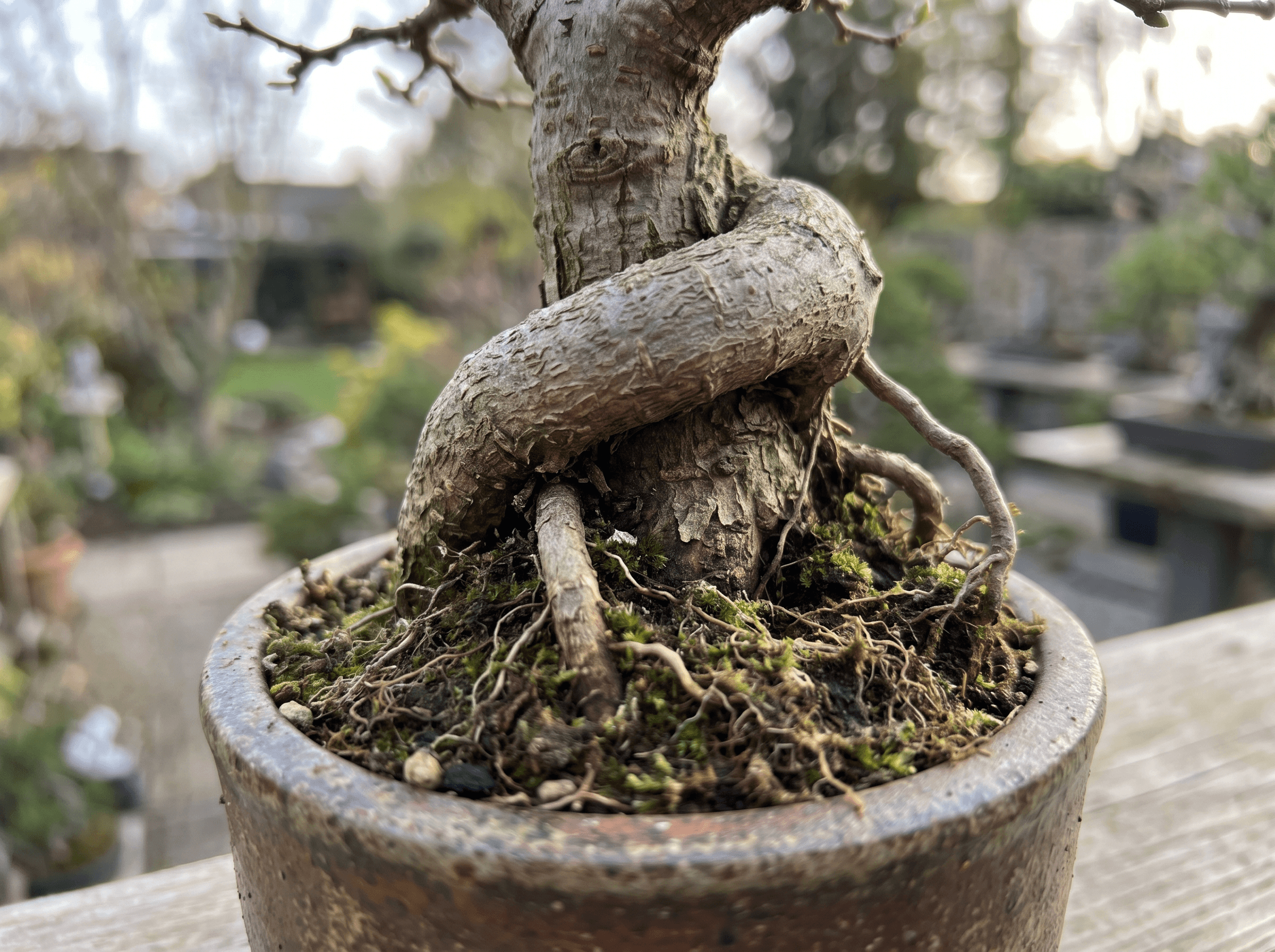
A girdling root is easy to miss because it doesn't look dramatic at first, it just looks like one more root among many at the base of the trunk. The problem is what happens over years rather than what you see in a single season. Instead of radiating outward like a normal root, it grew across or around the trunk early on, and as the tree ages, both the trunk and that root keep thickening together. Because the root is wrapped tight against the trunk rather than free to expand outward into open soil, it starts acting like a slowly closing loop, pressing into the bark and eventually into the living tissue just beneath it.
This is a different problem from a generally root-bound tree, where the whole root mass has become congested and needs a routine repot to open it back up. A girdling root is one specific root, in one specific place, doing specific damage. You can have a bonsai with perfectly healthy, well-managed roots everywhere except for that one root that never got corrected, and it can undo the flare and vigor of an otherwise excellent tree if it's left in place long enough.
What makes this particularly worth catching early is that the damage is mechanical rather than something you can feed or water your way out of. A girdling root doesn't loosen its grip on its own, and if it's left through several more years of growth it can genuinely cut off enough nutrient and water flow to weaken or kill everything above that point on the trunk. The fix is almost always physical removal, ideally done gradually and at the right moment in the tree's repotting cycle rather than as an emergency, though a severe, long-established case may call for staged reduction over several years, or accepting some permanent distortion in the flare, rather than one clean cut.
Likely causes
A root that grew inward instead of radiating outward
How to tell: At the soil line, you can see or feel a root pressing directly against the trunk or partly wrapped around it, sometimes visible as a slight flattening or indentation in the trunk's shape right where the root crosses it. It's often easiest to spot by gently brushing soil away from the base and looking at the nebari, the flare of roots at the trunk's base, from directly above.
The fix: At the next appropriate repotting for that species (early spring as buds swell for most deciduous trees; more conservative, species-specific timing for conifers and other sensitive species that may not tolerate full bare-rooting), carefully expose the root fully so you can see its whole path around the trunk, then cut it away if it's genuinely circling and pressing rather than just running close by. If the root is thick, fused to the trunk, or clearly supplying a large share of the tree's fine feeder roots, don't remove it all at once, take only the safest section now, or shorten it back to a point where replacement feeder roots can develop, then remove the rest at a later repot once the tree has responded. Keep enough healthy fine roots intact at each stage so the tree can still take up water while it recovers.
Never corrected at earlier repottings
How to tell: The tree has clearly been repotted before, judging by the soil and root development, but the same girdling root was left in place each time, usually because it's genuinely easy to overlook if you're not deliberately checking the trunk base and are focused instead on trimming the outer root mass.
The fix: Make checking the nebari for girdling or crossing roots a standard part of every repot from now on, not just an occasional extra step. Brush soil away from the trunk base before you do anything else and look specifically for any root that touches or wraps the trunk rather than growing away from it, since catching one early, while it's still thin, is a far smaller cut than catching it years later.
Nursery stock planted without root correction at the start
How to tell: The tree came from nursery stock or a young seedling that was potted on without anyone straightening or correcting its early root growth. Container-grown nursery stock commonly develops roots that circle the inside of the pot as it grows, which is exactly the pattern that turns into a girdling root later if it's never corrected.
The fix: Treat the first repot of any new nursery material as an inspection opportunity as much as a routine repot: examine the whole root base carefully for any root already crossing or circling the trunk while it's still young and thin, since correcting it at this stage is far easier and less risky than waiting until the tree, and the root, are both thicker.
How to prevent it
The best defence against a girdling root is simply looking for one every time you repot, before you get absorbed in trimming the rest of the root mass. Gently clear soil away from the trunk base so you can see the nebari clearly, and trace each major root from where it meets the trunk outward, checking that none of them cross back over another root or press against the trunk itself. This takes only a minute or two but it's the one habit that catches the problem while a correction is still a small, low-risk cut rather than a major surgery on a mature, established root. It's especially worth being thorough on nursery-sourced material and young trees still being developed, since that's when girdling roots most often originate and when they're cheapest to fix. After any significant root correction, keep the tree in a sheltered spot out of strong sun and wind, water attentively, and hold off on fertilising until you see new growth confirming it's recovering.
Common questions
How do I spot a girdling root before it becomes a real problem?
Check the nebari at every repot by clearing soil away from the trunk base and looking at how each root leaves the trunk. A root that touches, crosses, or wraps around the trunk rather than growing straight outward is worth watching closely even if it isn't causing visible damage yet.
Is it ever too late to fix a girdling root?
If the constriction has already cut deeply into the trunk and caused dieback above that point, removing the root won't undo that damage, though it can still stop things from getting worse. Earlier correction, before real constriction has set in, gives a far better outcome, which is why regular checking matters. For a severe, long-established constriction, it's worth having an experienced bonsai practitioner look at the tree in person before you cut, since judging how much root can safely come away in one sitting takes some hands-on experience.
Does a girdling root affect nebari development and trunk taper?
Yes, significantly. A healthy, radiating nebari is a big part of what makes a bonsai's base look convincing, and a girdling root distorts that flare, often creating a flat spot or indentation exactly where good taper and root spread should be.
How common are girdling roots in nursery stock?
Fairly common. Container-grown stock in particular tends to develop roots that circle the inside of the pot as it grows, and commercial nurseries are generally optimised for growth speed rather than root architecture. It's one of the main reasons the first repot of new material deserves a careful root inspection.
Can I just cut the girdling root immediately instead of waiting for a repot?
It's best done at repotting time when the tree is already out of the pot and you can see the whole root system clearly, rather than digging in mid-season, which risks unnecessary root and soil disturbance outside the tree's normal recovery window. This is the safer default for anyone without hands-on experience; more advanced practitioners sometimes carry out minor, localised root work outside a full repot, but that's a judgment call best learned from experience rather than a beginner starting point.
Will removing a girdling root shock the tree?
It can, particularly if the root is thick and has been supplying a meaningful share of the tree's water uptake. That's exactly why staged removal over more than one repotting is often the safer approach for a severe case rather than cutting it all away at once.
You might also like
General guidance based on 20+ years of practice. Every tree is different — when in doubt, ask us.