
Bare-Rooting vs Partial Root Work for Bonsai
Bare-rooting a bonsai, stripping essentially all the old soil away from the roots, is the right call for a narrower set of situations on most conifers than beginners assume, while many broadleaf deciduous and tropical bonsai tolerate it far more readily.
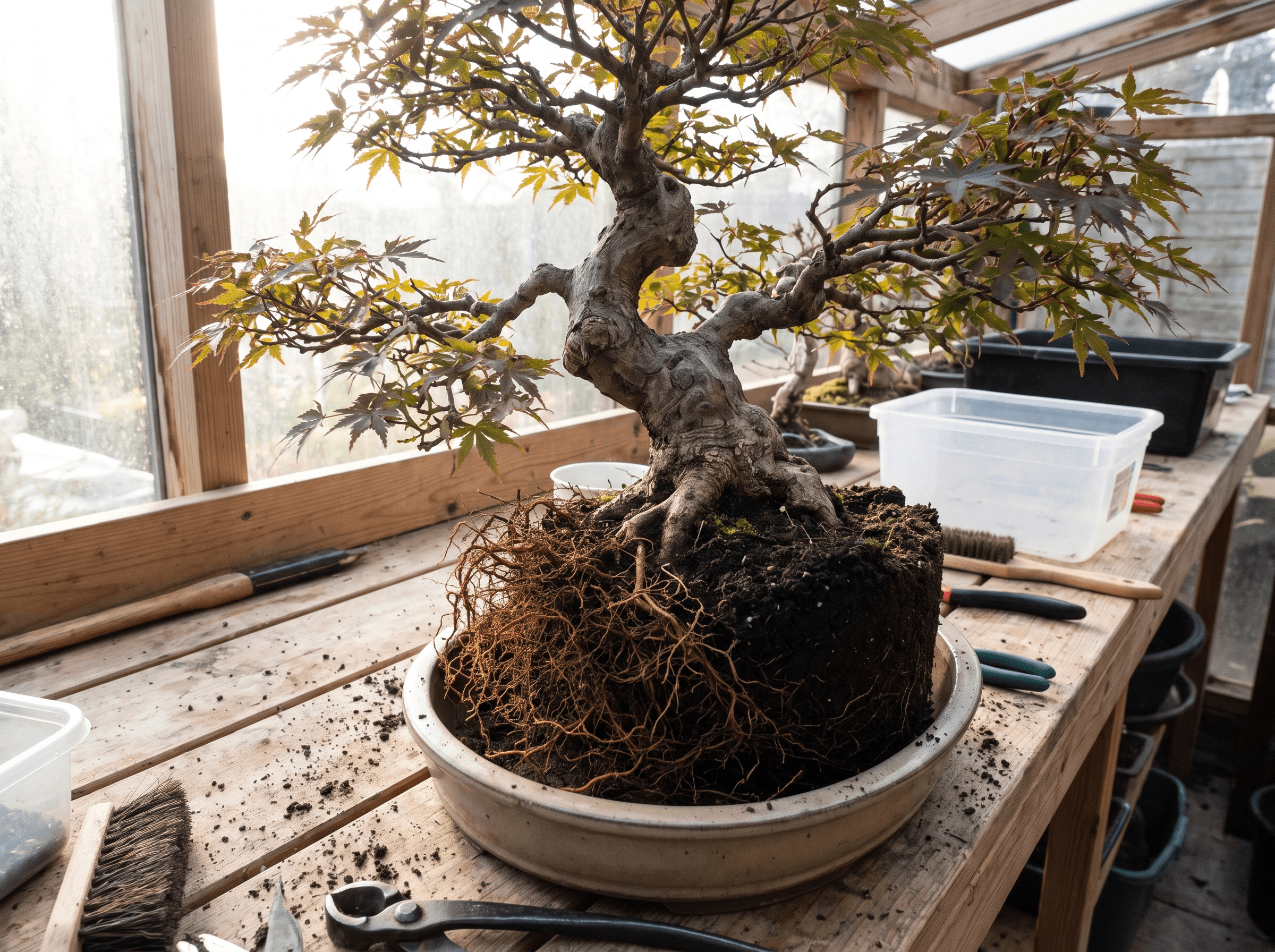
I still remember watching someone at a club meeting bare-root a young Japanese black pine because they'd seen it done to a tropical ficus in a video and assumed the technique was universal. The pine sulked for two years afterward and never fully forgave them for it. That's the mistake I want to help you avoid here, treating root work as one technique instead of a spectrum of choices that depends heavily on what's actually growing in the pot.
At one end of that spectrum is bare-rooting, removing nearly all the existing substrate from around the roots in a single session. At the other end is partial root work, where you comb out and reduce the outer portion of the root ball but leave a solid core of undisturbed soil and roots at the center. For conifers especially, most repots land somewhere in the partial category. Many broadleaf deciduous and tropical species are more commonly bare-rooted, particularly at their first repot out of nursery soil, so this is less a single rule for all bonsai and more a question of matching the technique to what's actually in the pot.
The decision isn't really about technique preference. It's about how much stress a given species can absorb at once, and how much of the root system it can afford to lose before it's unable to take up enough water to keep the foliage alive while new roots form.
What bare-rooting actually does to a tree
When you bare-root, you're removing every root's access to a stable, established environment all at once. The fine feeder roots that were doing most of the water and nutrient uptake are gone or badly damaged, and the tree has to rebuild that network from scratch before it can support itself normally again. That's a legitimate thing to ask of a tree, but it's a big ask, and the tree needs the physiological toolkit to answer it: vigorous regrowth, tolerance for a hard reset, and often a growing season ahead of it rather than behind it. Species that recover fast and root back out readily can shrug this off in a single season. Others simply can't replace lost roots quickly enough and decline slowly over the following year, sometimes without an obvious single cause that traces back to the repot.
When bare-rooting is actually the right call
There are several situations where I'll reach for it. The most common is a genuine soil change, moving a tree that's been sitting in dense, compacted, or inappropriate substrate, often poor nursery soil on a newly purchased tree, into a proper free-draining bonsai mix. Partial root work can't fully achieve that if the old soil is packed all through the root mass, since you'd just be wrapping fresh mix around a wet, compacted core. Bare-rooting is also useful for inspecting a weak or suspicious rootball, where you genuinely need to see the center to understand what's going on, and it's routine for many broadleaf deciduous and tropical species that recover fast and tolerate aggressive root work well; ficus is the classic example. Some collected or field-grown material gets bare-rooted too, as part of the first transition into a container. Outside of those situations, I'd want a specific reason before stripping a root ball bare, not just a habit carried over from a different plant or a different grower's routine.
Why partial root work is the safer default
Working the outer portion of the root ball, combing out and trimming the perimeter roots while leaving the inner core of soil and roots undisturbed, gives you most of the benefit of a repot with a fraction of the risk. You can still improve drainage at the margins, remove circling or crossing roots, and refresh a meaningful portion of the substrate, all while the tree keeps an intact, functioning core that can keep supplying water to the foliage during recovery. This is why it's the default I reach for on the great majority of repots, particularly on anything I haven't worked on before or don't have a strong read on yet. It's a technique that lets you be a little more aggressive at the next repot once you've seen how the tree responds, rather than gambling everything on one session.
Conifers and other slow, cautious recoverers
Temperate conifers, and pines in particular, are the group I'd steer people away from bare-rooting most firmly. Their root systems tend to rely on beneficial fungal associations in the existing soil that take real time to reestablish, and their overall pace of recovery is slow compared to something like a trident maple or a tropical species. Strip a pine's roots bare and you're not just removing feeder roots, you're often disrupting that fungal relationship too, on top of asking for a rapid root rebuild the species isn't built to deliver. This is exactly the case where partial root work over several repots, gradually renewing the substrate a bit at a time, gets you to a fully improved soil situation without the single catastrophic stress event.
Judging tolerance species by species
The honest answer to how much root disturbance a given tree can take is that it depends on which tree, and there's no universal percentage or rule that covers everything from a juniper to a ficus to a deciduous flowering species. Some species tolerate having nearly the entire root system replaced in one sitting and barely miss a beat. Others need root work rationed out gradually across several sessions over years. If you're not certain where a species falls on that spectrum, the safer assumption is that it leans toward caution rather than aggression, and partial work followed by watching how the tree responds over the following season is a reasonable way to find out without betting the whole tree on a guess. A quick way to work through the decision: first, identify roughly which category the species falls into, tolerant broadleaf/tropical versus cautious conifer; second, assess how bad the current soil actually is; third, assess the tree's recent vigor; and fourth, pick full or staged soil replacement and match it to a season when the tree has real recovery capacity ahead of it.
Common questions
How do I know if my tree needs bare-rooting or just partial root work?
Ask what problem you're solving. If the substrate itself is the issue, dense, compacted, or an inappropriate mix packed through the whole root ball, and the species is known to tolerate aggressive work, bare-rooting may be justified. If you're just doing routine maintenance on soil that's otherwise reasonable, partial root work is almost always the better choice.
Can I bare-root a tree that's never had its roots worked before?
It's possible on tolerant species, but I'd be cautious. A tree with a completely undisturbed root system has no track record with you of how it handles root work, so a first encounter is not the moment to take the most aggressive option available. Start with partial work and build up if the species and the tree's response support it.
Is bare-rooting always more effective at improving drainage than partial root work?
In a single session, yes, it gets you further toward a full substrate change. But partial root work done consistently over several repots, the exact number depends on the species and how it responds, gets you most of the way to the same result with far less risk of setback, so effective isn't the same as necessary.
What signs suggest a tree didn't handle bare-rooting well?
Slow or absent new growth the following season, foliage that thins or yellows without an obvious other cause, and generally sluggish recovery are the common signs. These can take months to show up clearly, which is part of why the stress from bare-rooting is easy to underestimate at the time.
Do deciduous trees generally tolerate bare-rooting better than conifers?
As a broad generalization, many deciduous species do recover faster from aggressive root work than temperate conifers, but this varies enough by species that I'd confirm it for the specific tree rather than assume it from the general category alone.
Should I bare-root every time I repot to keep the soil fully fresh?
No. Repeated full bare-rooting on a species that doesn't tolerate it well accumulates stress rather than resetting it. Partial root work at each repot, renewing a portion of the substrate each time, keeps the soil fresh over a few cycles without repeatedly hitting the tree with maximum root disturbance.
Does the season affect whether bare-rooting is safe?
Yes, timing matters as much as the technique. Root work of any kind, and bare-rooting especially, is generally done when the tree has the most capacity ahead of it to regrow roots and recover, rather than heading into a period of dormancy or heat stress. The right window still depends on the species and your local climate.
You might also like
General guidance based on 20+ years of practice. Every tree and every climate is different — when in doubt, ask us.