
How Often Should You Water Bonsai
There is no universal number of days between waterings that works, because pot size, substrate, species, season, and weather change the drying rate too much for a fixed schedule to hold.
I wish I had a clean number to give people, because it would make this whole conversation a lot shorter. Water it every three days. Done. But it would be bad advice, and it's exactly the advice that kills the most bonsai, because a schedule ignores everything that actually determines when a tree needs water: how big the pot is, what the substrate is made of, what species it is, what season it is, and what the weather did that particular week.
The real skill in bonsai watering isn't memorizing a number, it's learning to check. That sounds almost too simple to be useful advice, but it's genuinely the entire answer. Growers with decades of experience aren't watering on some more sophisticated schedule than beginners, they're just better and faster at reading the soil, the pot weight, and the weather to know when a tree actually needs water that day.
So instead of a number, here's how to actually figure out the right frequency for your specific tree, in your specific conditions, on any given day.
Check the soil daily during the growing season
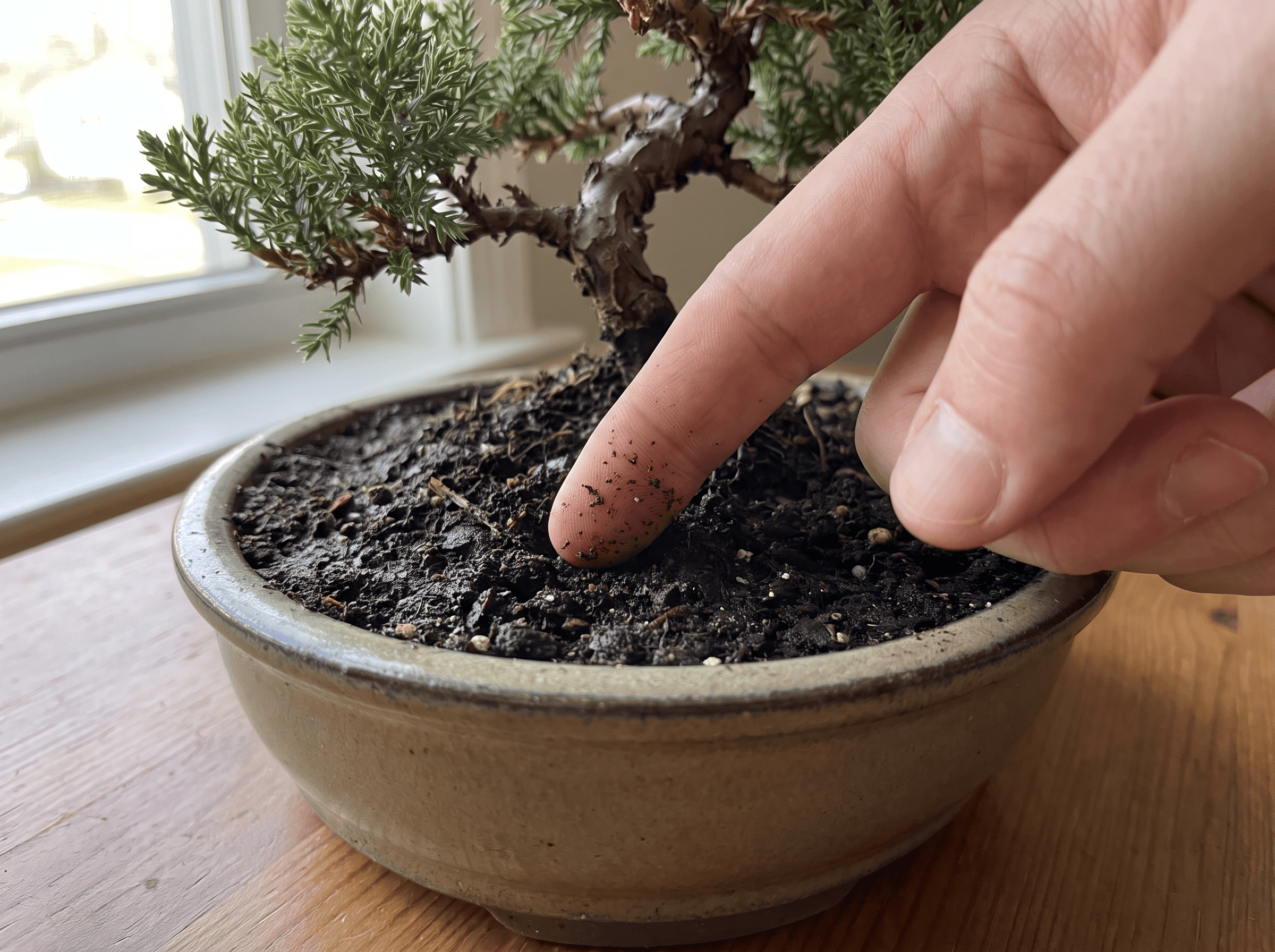
During spring and summer, when the tree is actively growing and pulling water up through its roots and out through the leaves, check the top layer of soil at least once a day. A finger pressed about a centimetre in, just slightly below the surface, tells you a lot: if it's still visibly moist and cool to the touch, wait. If it feels slightly dry, water thoroughly, rather than waiting for the whole root ball to dry out completely. This daily check is the habit that replaces a fixed schedule, and it takes maybe ten seconds once it's routine.
Small, shallow pots in sun or wind can dry out in hours
This is the detail that catches people off guard. A small bonsai in a shallow pot, sitting in full summer sun or a breezy spot, can go from freshly watered to bone dry in a matter of hours on a hot day, not days. The combination of shallow soil volume, fast-draining substrate, and a lot of foliage relative to root mass means there's very little buffer. If your tree lives somewhere hot and exposed, checking once in the morning may not be enough during peak summer; a second check in the afternoon is often warranted.
Dormant winter trees need far less frequent watering
Once a temperate species goes dormant for winter, especially a deciduous one that's dropped its leaves entirely, its water needs drop dramatically since it isn't actively transpiring through a full canopy anymore. Checking every few days rather than daily is usually sufficient, though don't stop checking altogether: a dry, windy winter week, or a spell spent sheltered near a heat source, can catch a dormant tree out almost as easily as summer heat can. Watering on autopilot through winter as if it were still summer is just as reliable a way to waterlog dormant roots as ignoring the pot for weeks is to dry one out. Evergreen species still need occasional watering since they retain foliage, but even they slow down considerably compared to their growing-season pace.
Substrate and species change the equation too
A fast-draining substrate with a lot of pumice or lava rock dries out quicker than one with more moisture-retentive material, which affects how often you'll find yourself watering even at the same pot size and season. Species matters as well: something naturally suited to wetter ground, like a willow or bald cypress, tolerates more frequent watering without issue, while junipers, pines, and other species adapted to drier, rocky native ground actually do better when allowed to dry out somewhat between waterings. Get to know your specific tree's substrate and species tendencies rather than assuming one rule covers everything in your collection.
The habit that matters more than any number
If you take one thing from this, let it be the check-first habit rather than any specific frequency. Look at the soil, feel it, maybe lift the pot to judge its weight against how it feels freshly watered. Water when it actually needs it, whether that turns out to be once a day in August or once a week in January. When you do water, soak the pot until water runs freely from the drainage holes rather than giving it a light surface splash, so the whole root ball actually gets wet rather than just the top layer. That single habit, checking before watering and watering properly when you do, does more to prevent both overwatering and underwatering than any schedule ever could.
Common questions
How many times a week should I water my bonsai?
There's no fixed number that applies broadly, since pot size, substrate, species, and weather all change how fast soil dries out. Check the soil daily during the growing season and water only when it's actually dry, rather than following a set weekly count.
Should I water my bonsai every day?
Only if the soil actually needs it that often, which is common for small pots in hot, sunny, or windy conditions during the growing season. Watering daily purely out of habit, regardless of soil moisture, is how overwatering happens even in a well-draining mix.
How do I check if my bonsai needs water without overthinking it?
Press a finger about a centimetre in, just below the surface. If it feels slightly dry, water. If it's still visibly moist and cool, wait and check again later. Lifting the pot to feel its weight is a quick secondary check once you're familiar with how heavy it feels freshly watered versus dry.
Does watering frequency change with the seasons?
Significantly. Growing-season trees, especially in hot weather, may need checking once or even twice a day. Dormant winter trees, particularly deciduous species without leaves, need far less, sometimes just every few days, since they're not actively drawing up water the way they do in summer. Keep checking regularly even so, rather than assuming winter is safe to ignore, since a dry spell or an exposed spot can still catch a dormant tree out.
Why does my small bonsai dry out so much faster than my houseplants?
Shallow bonsai pots hold far less soil volume than typical houseplant containers, and bonsai substrate is deliberately fast-draining rather than moisture-retentive. Combined with a relatively large amount of foliage pulling water through the tree, this means small bonsai pots can dry out within hours in hot or windy conditions.
Is there a difference in watering frequency between species?
Yes. Species naturally adapted to consistently moist ground, like willow or bald cypress, tolerate and often prefer more frequent watering, while species from drier native climates, like junipers, pines, and many Mediterranean trees, actually do better when allowed to dry out somewhat between waterings. Learning your specific species' preference matters more than any general rule.
What happens if I miss a watering during the growing season?
A single missed check usually isn't catastrophic if you catch it soon after, though a small pot in hot sun can suffer real stress within a day of drying out completely. If you know you'll be away, it's worth arranging a check-in, a drip system, or moving pots somewhere sheltered and shaded to slow drying.
You might also like
General guidance based on 20+ years of practice. Every tree and every climate is different — when in doubt, ask us.