
How to Fertilize a Bonsai Tree
Feed most outdoor bonsai during active growth and taper off through dormancy, though indoor and subtropical trees often keep feeding lightly year-round, and most of the ways people get fertilizing wrong simply never come up once the schedule matches the tree.
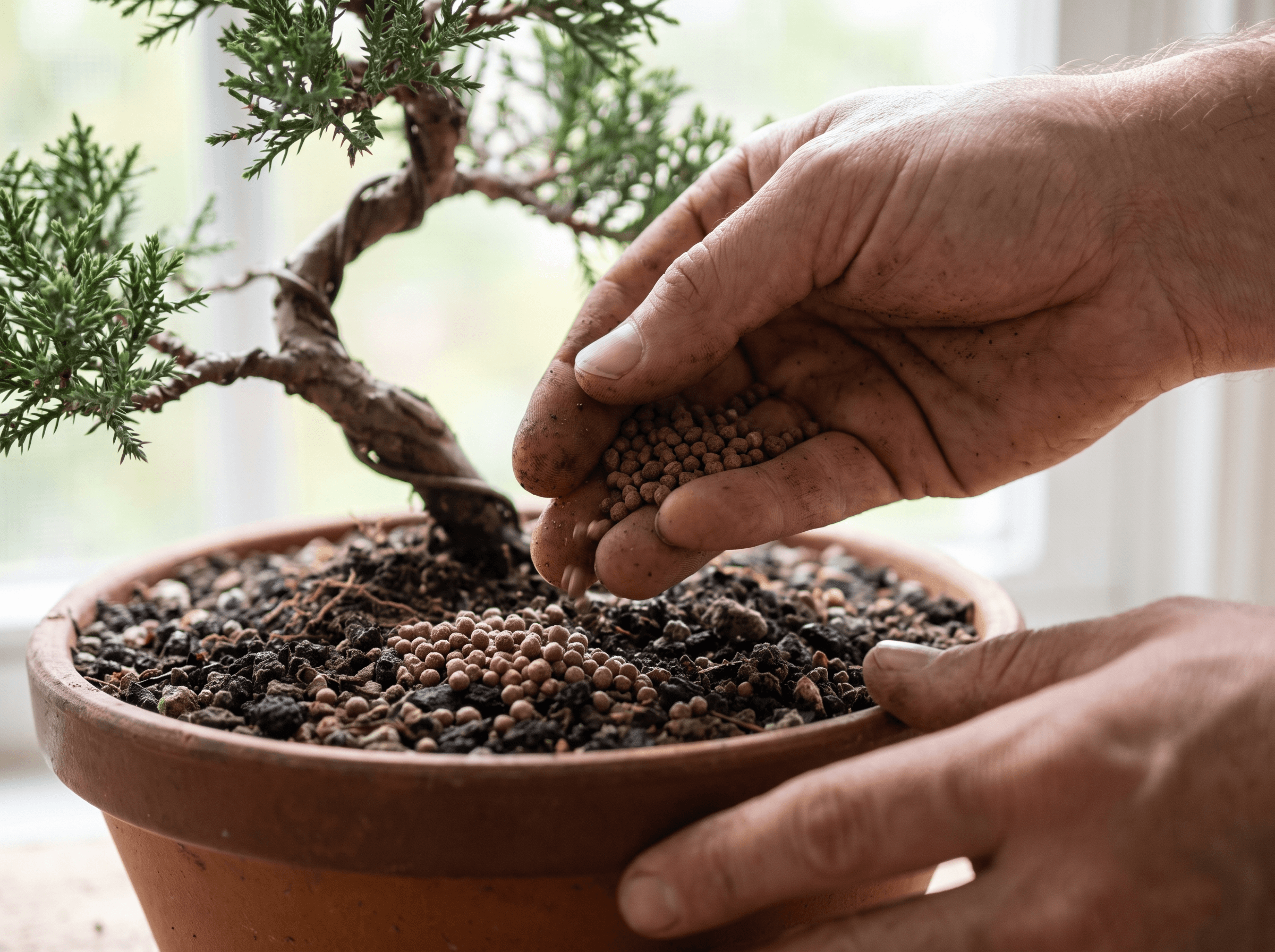
Fertilizing causes more anxiety than it deserves. I think it's because the packaging on most fertilizer bottles is written for people growing tomatoes or lawns, and a lot of that advice doesn't translate cleanly to a tree confined to a small pot of fast-draining substrate. New growers either panic and skip feeding altogether, worried about getting it wrong, or overcorrect and feed constantly, worried the tree is starving.
Neither extreme is necessary. A bonsai in the ground would be feeding itself continuously through a much larger root system reaching into much more soil. In a pot, we're substituting for that, mostly during the months the tree is actually growing and able to use what we give it. Outside that window, for most outdoor temperate species, feeding does little good, though indoor and subtropical trees kept under good light can often continue light feeding through the year.
The mechanics are genuinely simple once you separate the question of when from the question of how, which is where most of the confusion actually lives, and once you account for the fact that timing shifts with species, climate, and how established a given tree is.
Feed during active growth, for most outdoor trees
For most temperate species, that means roughly spring through early autumn, the stretch when the tree is pushing new shoots and leaves and actively using nutrients to build tissue. Outside that window, growth slows or stops entirely depending on species and climate, and the tree simply isn't in a position to use fertilizer the way it would in season. Indoor and subtropical species are a different case, since they may keep growing through winter under good light, and exact timing for any species also shifts with your local climate and how established the tree is, so treat this as a starting point rather than a fixed calendar. I start feeding my deciduous trees around when the first buds swell in spring, though some growers begin earlier for vigorous or coniferous material, and taper off well before the leaves begin to colour in autumn.
Liquid feed or slow-release pellets, both work
A diluted liquid fertilizer applied every one to two weeks during the growing season gives you fine control and quick results you can see in leaf colour within days. Slow-release organic pellets, tucked onto the soil surface and topped up monthly, release nutrients gradually as you water and require far less attention once they're placed. I use pellets on the bulk of my collection because I simply don't have time for a fortnightly liquid schedule across hundreds of trees, but I'll switch a specific tree to liquid feed if I want to push it harder ahead of a show or after a strong pruning recovery.
Always water before you feed
This is a habit worth building: water the soil thoroughly first, then apply liquid fertilizer once the substrate is already moist. The main reason is even saturation, a pre-moistened root system takes up diluted nutrients more gradually and evenly, and feeding into bone-dry soil also carries some risk of concentrating fertilizer salts right at the driest roots. It takes an extra thirty seconds and it's a small step that helps the fertilizer do its job properly instead of sitting unevenly in the pot.
Go lighter on young and recently repotted trees
A tree that's been recently repotted has a disturbed, healing root system that isn't ready for full-strength feeding, and a young tree still establishing itself needs a gentler hand than a mature, settled specimen. I typically wait several weeks after repotting before resuming any feeding at all, and then start at a reduced strength, maybe half of what I'd use on an established tree, before building back up over the following weeks as new growth confirms the roots have recovered.
Stop or reduce feeding as dormancy approaches
As days shorten and growth visibly slows heading into autumn, for outdoor and temperate trees, ease off feeding rather than continuing at full strength. Feeding a tree that's shutting down for winter can push soft new growth right as the plant should be hardening off, and that late growth is often the first thing damaged by the first real frost. I watch the trees rather than the calendar for this; when new shoot extension stops and the wood on new growth starts to firm up, that's my cue to stop. Indoor and subtropical trees under consistent light don't follow this same shutdown, so this guidance applies mainly to outdoor deciduous and conifer species.
Common questions
How often should I fertilize my bonsai?
During the growing season, roughly every one to two weeks with a diluted liquid feed, or monthly if you're using slow-release pellets. Outside the growing season, stop or reduce feeding substantially for most outdoor species, depending on climate; indoor and subtropical trees under good light can often continue lighter feeding year-round.
What happens if I forget to fertilize my bonsai for a few weeks?
Nothing dramatic. A missed feeding or two during the growing season won't seriously harm an otherwise healthy tree; just resume your normal schedule. Fertilizing is cumulative maintenance, not a rescue measure for an already struggling tree.
Can I fertilize a sick or stressed bonsai to help it recover?
Generally no, and this trips people up. A stressed or weak root system can't process fertilizer well and feeding it often makes things worse through burn. Address the underlying stress first, then resume light feeding once the tree shows signs of active recovery.
Should I fertilize indoor tropical bonsai the same way as outdoor trees?
Not quite. Indoor tropical species growing under good light through winter can continue light feeding year round, since they don't go fully dormant the way outdoor temperate species do. Reduce the frequency in winter even so, since growth is usually slower even indoors.
Do all bonsai species need the same amount of fertilizer?
No. Vigorous, fast-growing species like elm or willow generally tolerate and benefit from more frequent feeding, while slower growing conifers like pine typically need less. When in doubt, feed at the lighter end of the recommended range and adjust based on how the tree responds.
Is it better to underfeed or overfeed a bonsai?
Underfeed, without question. An underfed tree grows a bit slower and looks a little pale, both easily corrected. An overfed tree risks burned roots and damaged foliage, which takes far longer to recover from and can set the tree back an entire season.
Can I fertilize the day I repot my bonsai?
No. Wait at least a few weeks after repotting before resuming any feeding, giving the disturbed root system time to begin recovering first. Feeding immediately after repotting is one of the more common causes of avoidable root damage.
You might also like
General guidance based on 20+ years of practice. Every tree and every climate is different — when in doubt, ask us.