
How to Avoid Fertilizer Burn on Bonsai
Fertilizer burn most often comes down to one of two mistakes, feeding too strong a mix or feeding a root system that was already dry and stressed before you started, though salt buildup from repeated feeding and local water quality can play a part too.
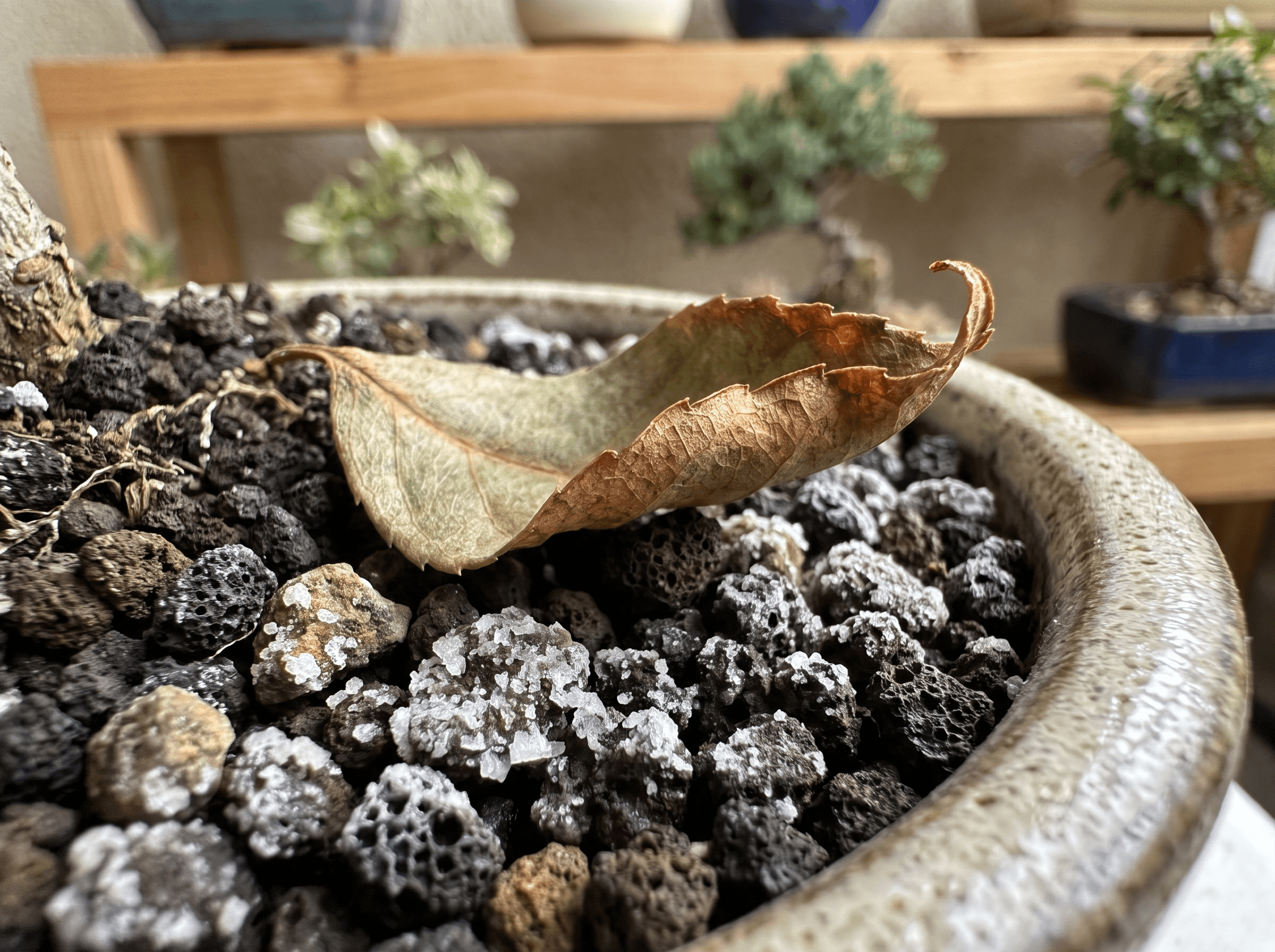
I still remember the first time it happened to me, a maple I'd mixed up a batch of liquid feed for and, in a hurry, poured on too concentrated because I misjudged the dilution. Within a few days the leaf edges had gone crisp and brown, and it took the better part of a season to grow that damage out. It's a mistake almost everyone makes once, usually early on, and it's genuinely avoidable once you understand what's actually happening at the root level.
Fertilizer burn is essentially a salt problem. Fertilizer, organic or synthetic, is made up of mineral salts, and when the concentration around the roots gets too high, water actually moves out of the root cells rather than into them, following the osmotic gradient the wrong way. That's what causes the damage, not some chemical toxicity in the product itself.
Once you see it that way, the prevention becomes fairly intuitive: keep the concentration reasonable, and don't apply it to roots that are already under stress and less able to cope with any concentration at all.
Follow the label dilution, and lean weaker when unsure
Fertilizer labels give a dilution rate for a reason, and it's tempting to assume a bit stronger will just work a bit faster. It doesn't work that way with a bonsai's small pot volume and confined root system, where there's very little soil to buffer a mistake. If you're ever unsure whether you've measured correctly, or you're trying a new product for the first time, mix it weaker than the label suggests rather than stronger. A slightly underfed tree just grows a touch slower for a week or two. An overfed one can lose roots and foliage that take a full season to recover.
Never feed a bone dry pot
This is the mistake I see most often, more than dilution errors honestly, and it's the one from my own maple story too, dry soil combined with feed. Applying fertilizer, especially liquid fertilizer, to soil that's already dried out concentrates those salts directly against roots that are already stressed and less able to tolerate them. As a habit, water thoroughly first, let it drain, and apply fertilizer once the substrate is evenly moist rather than bone dry. It costs you an extra minute and it's one of the more effective things you can do to reduce the risk of burn.
Ease into feeding after repotting
A newly repotted tree has a disturbed root system, some roots cut, others still settling into fresh substrate, and it isn't necessarily ready for full-strength feeding right away. Growers vary in exactly how they handle this: many wait a few weeks after repotting, or until they see clear signs of new growth, before resuming fertilizer, while others use a mild feed sooner, particularly a gentle organic product, depending on how much root work was done and how the tree looks. What most agree on is starting at reduced strength and building back up gradually as new growth confirms the roots are recovering, rather than jumping straight to a full-strength feed on a freshly repotted tree, which is one of the more common and avoidable causes of serious burn.
Recognize the symptoms early
Crispy, browned leaf edges are the classic sign, usually starting at the tips or margins and working inward if the problem continues. On the soil surface, a white or pale mineral crust is worth checking for too, since it can be a visible clue that salts are accumulating, though a crust can also come from hard water minerals rather than fertilizer, so treat it as one piece of evidence rather than proof on its own. If you catch either sign, stop feeding immediately and give the tree a few thorough waterings over the following days, deep soaks that flush excess salts out through the drainage holes, which helps flush the buildup and gives the roots a chance to recover before you resume feeding at a lighter rate.
Common questions
What does fertilizer burn actually look like on a bonsai?
Crispy, browned edges on leaf margins and tips, sometimes an overall pale or scorched look to the foliage, and often a visible white or pale crust of mineral buildup on the soil surface where the fertilizer has concentrated over repeated applications.
Can fertilizer burn kill a bonsai?
In severe, repeated cases, yes, particularly if the root system is damaged badly enough that the tree can't take up water properly afterward. Most cases are recoverable with a few thorough flushing waterings and a pause on feeding, but prevention is far easier than recovery.
How do I flush fertilizer salts out of bonsai soil?
Water thoroughly and repeatedly, letting water run freely through the drainage holes each time, ideally several times over a few days rather than one single soak. This physically carries dissolved salts out of the substrate rather than leaving them to accumulate.
Is organic fertilizer less likely to cause burn than synthetic?
Often, because many organic feeds release nutrients slowly as soil microbes break them down, avoiding the sudden concentration spike that synthetic liquid feed can produce if overdosed. That said, not every organic product is automatically mild, and salts can still build up in the pot over repeated applications regardless of source, so it's a general tendency rather than a guarantee.
How long after fertilizer burn does a bonsai recover?
Damaged leaves themselves usually don't recover; the tree needs to grow past them with new foliage, which can take anywhere from a few weeks to most of a season depending on severity. Root damage from severe burn can take even longer to fully repair.
Can I prevent fertilizer burn just by diluting fertilizer more than the label says?
It helps, and going weaker than the label rate is a reasonable safety margin, especially with a new product. But dilution alone doesn't prevent burn caused by feeding dry soil, so combine a conservative dose with always watering first.
Does fertilizer burn look the same as underwatering stress?
They can look similar at a glance, both showing crispy leaf margins, which is part of why fertilizer burn gets misdiagnosed. A mineral crust on the soil surface is one useful clue, though it isn't definitive on its own since hard water can leave a similar crust, so think back over your recent feeding and watering history together to help tell the two apart.
You might also like
General guidance based on 20+ years of practice. Every tree and every climate is different — when in doubt, ask us.