
Reducing Bonsai Watering in Autumn as Growth Slows
The most common autumn watering mistake isn't watering too much, it's cutting back too fast just because the calendar says autumn has arrived.
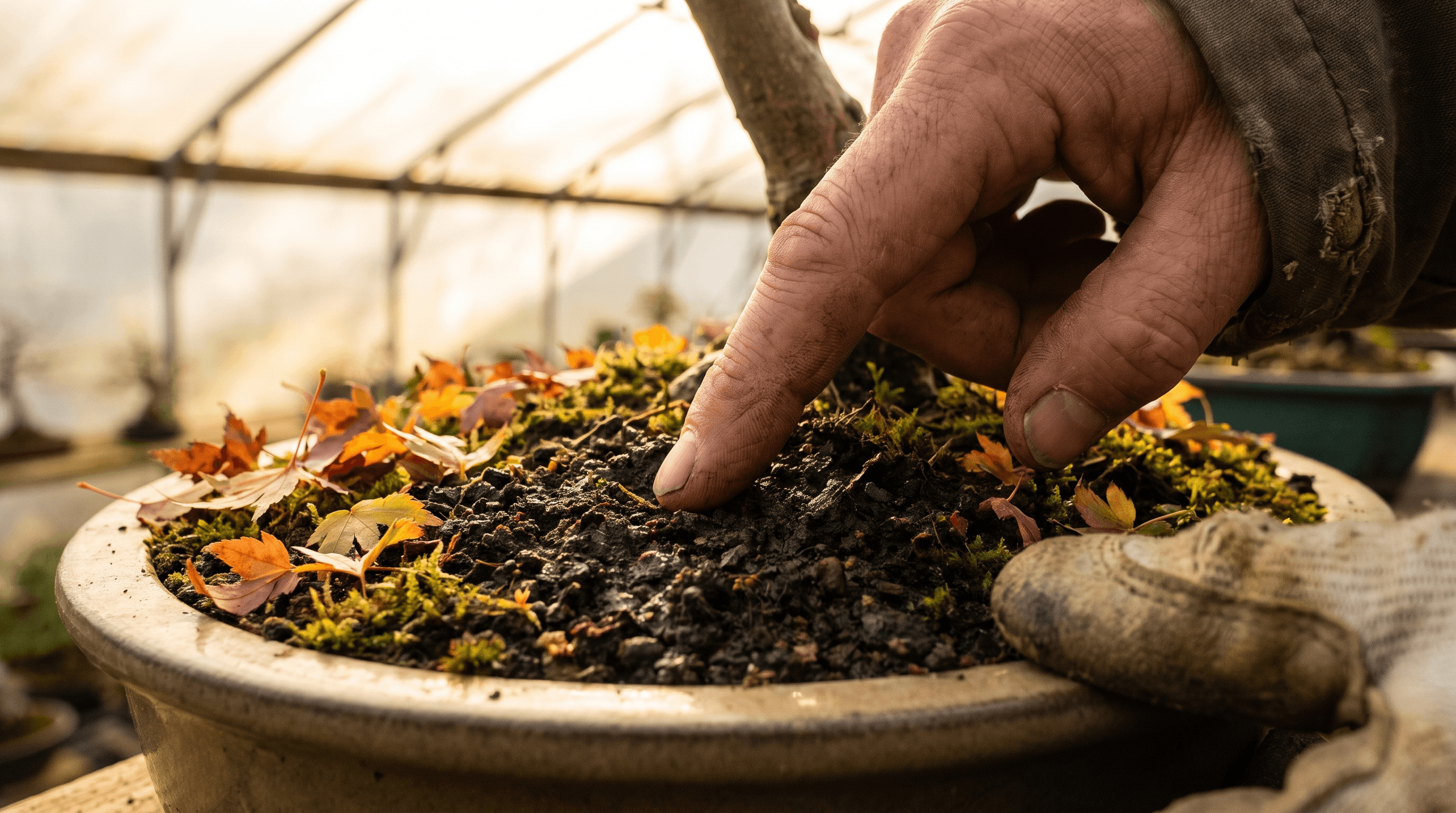
Every autumn I see the same overcorrection, growers who spent all summer carefully watching soil moisture suddenly switch to a fixed reduced schedule the moment September starts, regardless of what the tree is actually doing. And I understand the instinct, everyone knows dormant trees need less water, so cutting back feels like the responsible move. But a tree in early autumn, especially during a mild spell here, is often still using a meaningful amount of water, and dropping frequency off a cliff before the tree's own water use has actually slowed to match creates a real underwatering problem dressed up as seasonal responsibility.
The right approach tracks the tree, not the date. Watering frequency should ease off gradually, in step with declining temperatures, shortening days, and the visible slowdown in growth, rather than jumping from a summer schedule to a winter one on a fixed autumn date. That means more substrate checking through the transition, not less, at exactly the point when it would be easiest to relax and assume you already know the answer.
This matters more here than it might in a guide written for a colder climate, since our autumns run mild and drawn out, and a tree here in October is often still doing meaningfully more than a tree in October somewhere with an earlier onset of real cold. If you're gardening somewhere with an earlier, sharper autumn, the same principle still applies, tracking the tree rather than the date, but your own transition window will simply arrive and finish sooner than ours does.
Why the overcorrection happens
It comes from good intentions applied at the wrong pace. People know overwatering a dormant tree is a real risk, so as autumn approaches they preemptively cut back, sometimes weeks before the tree has actually slowed its own water use to match. The problem is that early autumn growth reduction is gradual and species-dependent, not a switch that flips on a specific date, and a tree that's still pushing some growth, or just still experiencing warm enough weather to keep transpiring at a decent rate, needs closer to its summer watering rhythm than its eventual winter one, right up until it genuinely doesn't.
What tracking actual use looks like in practice
I keep checking the substrate through autumn the same way I would in summer, rather than switching to a predetermined reduced schedule. As the tree's own use genuinely slows, evidenced by the soil staying moist longer between waterings even without me changing anything, I let the interval between waterings extend naturally to match. This means autumn watering frequency declines as a direct response to what I'm observing in the pot, not as a schedule I decided on in advance based on the season alone.
Signs the tree's water use has genuinely slowed
The clearest and most reliable sign is that the substrate itself stays adequately moist for longer than it did a few weeks earlier, even with no change in your watering amount or the weather pattern. Visible growth easing off, leaf color beginning to shift on deciduous species, and generally less vigor in new shoot extension are useful supporting context alongside that, but I treat them as secondary confirmation rather than the actual trigger. It's the substrate check, tracked over time, that actually tells me when to stretch the watering interval.
The cost of getting it wrong in either direction
Underwatering in early autumn from cutting back too soon stresses a tree that's still meaningfully active, right before it needs to go into winter in good condition, which is a worse setup than a slightly generous watering schedule for a few extra weeks would have been. Overwatering into true dormancy carries its own real risk of root problems in cold, wet, inactive soil. Neither mistake is catastrophic on its own from a single missed check, but both compound if the pattern continues across the whole transition, which is exactly why tracking the tree rather than a fixed schedule matters through this stretch specifically.
Common questions
How much should I reduce watering frequency in autumn?
There's no fixed ratio I'd recommend, since it depends entirely on how much your specific tree's water use has actually slowed, which itself depends on species, weather, and how mild or sharp your autumn is running. Track the substrate directly and let the interval extend gradually as the soil genuinely stays moist longer, rather than applying a preset reduction.
Is it safer to underwater or overwater slightly during the autumn transition?
Neither is really safer, both carry real costs, but the mistake I see far more often is overcorrecting into underwatering too early, cutting back before the tree's actual water use has slowed to match. I'd rather err toward continued substrate checking than toward an early, calendar-based reduction.
My tree is still pushing some new growth in October, should I still reduce watering?
Not yet, or at least not by much. A tree that's still visibly active is still using water at closer to its growing-season rate, and cutting watering back significantly at that point risks stressing an actively growing tree rather than easing a dormant one into its winter rhythm.
How do I check soil moisture accurately for this kind of gradual adjustment?
A simple finger check a couple of centimeters into the substrate is the method I trust most, done consistently through the transition rather than just occasionally. Moisture meters can work too, though I find them less consistent depending on the substrate mix, so I lean on the finger check as the standard. The point isn't a single reading, it's noticing the trend over several weeks, whether the soil is staying moist for longer between waterings than it used to.
Does this apply the same way to evergreens and deciduous trees in autumn?
The underlying principle, tracking actual water use rather than a fixed date, applies to both, but the visible cues differ. Deciduous trees give you leaf color and leaf drop as clear signals of slowing activity, while evergreens require watching shoot extension and general vigor more closely since they lack that obvious visual marker.
Why do warm climates like Southern Italy need a different approach to autumn watering than colder-climate guides suggest?
Because the whole transition runs later and more gradually here, a tree in our region in October is often still meaningfully active in a way a tree in a colder climate at the same point in the calendar wouldn't be. Following a reduction schedule built for an earlier, sharper autumn elsewhere risks underwatering a tree that's still genuinely working here.
Should recently repotted trees follow the same autumn watering adjustment?
A tree repotted earlier in the year and now well reestablished follows the same tracking approach as any other. If a tree was repotted very late in the season, though, that's a different situation requiring its own closer attention, since its root system hasn't had normal time to settle before the autumn transition even started.
You might also like
General guidance based on 20+ years of practice. Every tree, climate, and year is different — when in doubt, ask us.