
How to Make Your Own Bonsai Soil Mix
Making your own bonsai soil isn't complicated once you know the starting ratio and the one step almost everyone skips: sifting out the fine dust before it ever goes near a tree.
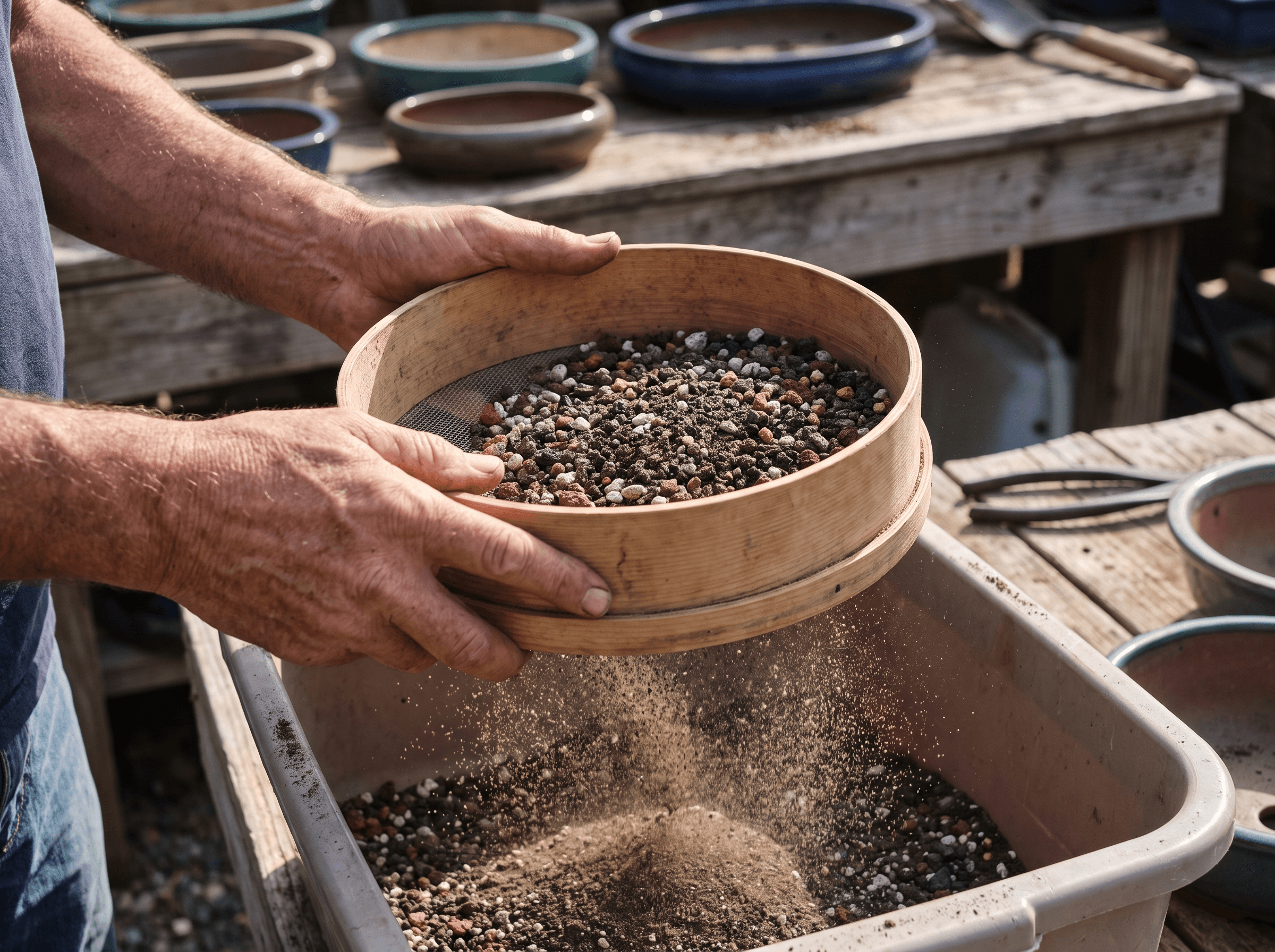
I started mixing my own soil mostly out of frustration with pre-bagged mixes that were either wildly overpriced for what was in them or clearly built for a climate nothing like mine. Once I understood the basic logic, moisture-holding component plus drainage components, adjusted for the tree and the local conditions, it stopped feeling like guesswork and started feeling like a recipe I could actually reason about.
The good news is you don't need exotic imported ingredients to make a mix that works well. A lot of very good bonsai soil is made from locally available materials that cost a fraction of what the specialty bagged stuff runs, once you know what role each ingredient is filling and what to look for as a substitute.
What follows is the process I actually use, from picking a starting ratio through sifting, and the one piece of advice I'd give anyone trying this for the first time: test a new batch on a tree you wouldn't be devastated to lose, not your best one.
Start from a base ratio, then adjust
A commonly cited baseline is around 50% akadama (or a similar clay-based, moisture-holding material), 25% pumice, and 25% lava rock for many deciduous species, with something closer to equal thirds of each for many conifers. Treat those numbers as a starting point to adjust from rather than a fixed formula. A species that wants more consistent moisture, or a hot, dry climate where water evaporates fast, generally pushes the ratio toward more of the moisture-holding fraction. A drought-tolerant species, or a consistently humid climate where things stay damp longer on their own, generally pushes it the other way, toward more drainage. Write down what you used for a given batch and how the tree responded over the following season. That record is more useful for refining your mix over time than any ratio you'll find written down elsewhere, because your climate and your watering habits are part of the equation too.
Sift out dust and fines before mixing
This is the part people skip when they're in a hurry, and skipping it is one of the more common reasons a mix underperforms. Even good components arrive with a certain amount of dust and undersized fragments mixed in, generated during bagging, shipping, and handling. Left in the mix, those fine particles settle into the gaps between the larger granules and choke off the drainage and airflow the mix was built to provide. Not every ingredient needs identical treatment: akadama benefits from being sieved every time, while clean pumice or lava from a good supplier sometimes needs little more than a quick pass to catch stray dust. Sifting each component separately before combining gives you the most control over the finished mix. As a rough guide, particle size should scale with pot size, smaller pots and shohin-sized trees generally want finer particles, larger pots can handle coarser ones, and bark fines below about 2 millimetres are commonly screened out regardless of pot size. It's a tedious step, but it's also a big part of the difference between a mix that performs as intended and one that looks right in the bag but compacts in the pot within a season.
Local substitutes when the classic ingredients aren't available
Akadama, pumice and lava rock aren't available everywhere, or aren't always affordable, and plenty of good bonsai soil is made without any of them. Pine bark fines, screened to remove dust the same way as any other component, can work as part of the moisture-holding and organic fraction. Coarse sand, properly washed to remove dust and salts, contributes drainage and structure, though quality and particle shape vary a lot depending on the source. Expanded shale or expanded clay, sometimes sold for other horticultural or construction purposes, can substitute reasonably well for pumice or lava rock's stable, drainage-focused role. None of these are exact one-to-one substitutes for the ingredient they're replacing, so expect to adjust ratios and observe how a tree responds rather than assuming a straight swap behaves identically.
Mixing and storing
Once each component is sifted to the right particle size, combine them in the ratio you've settled on and mix thoroughly so the components are distributed evenly rather than sitting in clumps of a single ingredient. I mix in batches large enough to cover several repots at a stretch rather than mixing fresh every single time, which saves effort, though I'd avoid mixing so far ahead that organic components like pine bark fines have a chance to start breaking down in storage before they're even used. Keep the mixed batch dry until use, since damp storage encourages the same premature compaction and breakdown you're trying to avoid by sifting in the first place.
Test before you commit a good tree to it
Any time I change a ratio or swap in a new substitute ingredient, I try it on a tree that isn't precious first, a nursery stock piece, a cutting, something in early development where a bad season of growth is a setback rather than a disaster. Soil behaves differently once it's actually in a pot with a real root system pulling water through it than it does in a bag or a bucket, and the only real test is watching how a tree responds over a full growing season. If it drains too fast, holds too much water, or compacts faster than expected, you find that out on a tree you can afford to have found it out on, and adjust the ratio before committing your best material to the same mix.
Common questions
What's a reasonable starting ratio if I've never mixed my own soil before?
A commonly cited baseline is around 50% akadama, 25% pumice, and 25% lava rock for many deciduous species, and roughly equal thirds of each for many conifers. From there, adjust toward more moisture retention for water-loving species or humid-averse climates, and toward more drainage for drought-tolerant species.
Do I really need to sift every component, or just the finished mix?
Sifting each component separately before combining gives you the most control, since different ingredients tend to generate different amounts of dust and break at different points. Akadama in particular benefits from being sieved every time, while clean pumice or lava may need only a quick check. Sifting only the finished mix works in a pinch, but it's easy to miss compacted clumps of one component hiding fine particles from another.
What size mesh should I use for sifting?
This depends on your pot sizes and the scale of your trees, since smaller pots generally want finer particle sizes than larger ones. As a rough range, many growers work somewhere around 2 to 7 millimetres for standard pots, screening out dust below about 2 millimetres, particularly for bark fines, and screening out oversized chunks at the top end. Most growers use a set of two or three graduated mesh screens rather than one single screen size for everything.
Can I substitute perlite for pumice?
Perlite is lighter and more fragile than pumice, and it tends to float to the surface when watered and break down faster under handling. It can work in a pinch, but pumice is generally the more durable, stable long-term option if you can get it.
How long does a batch of homemade soil keep before it needs to be used?
Kept dry and away from moisture, a mixed batch stores reasonably well, though there's no hard rule for exactly how long. Organic components like pine bark fines are the part most likely to start breaking down in storage, so I wouldn't mix enormous batches years ahead of when you'll actually use them.
Is it worth making my own soil if pre-bagged bonsai mix is available where I live?
It depends on cost and how well the pre-bagged option actually suits your trees and climate. If a bagged mix is affordable and performing well, there's no strong reason to switch. Making your own becomes more worthwhile when bagged options are expensive, hard to find, or clearly not suited to what you're growing.
My homemade mix compacted faster than expected. What went wrong?
The most common cause is insufficient sifting, leaving too much fine material in the mix that fills the air gaps between larger granules over time. It can also mean one of the components you used, particularly an organic one, breaks down faster than expected in your conditions. Try resifting more aggressively next batch and note which component seems to be the culprit.
You might also like
General guidance based on 20+ years of practice. Every tree and every climate is different — when in doubt, ask us.