
Akadama, Pumice, and Lava Rock in Bonsai Soil
Akadama, pumice and lava rock each do a different job in a bonsai soil mix, and understanding what each one actually contributes makes it much easier to adjust ratios for a specific tree instead of just following someone else's recipe blindly.
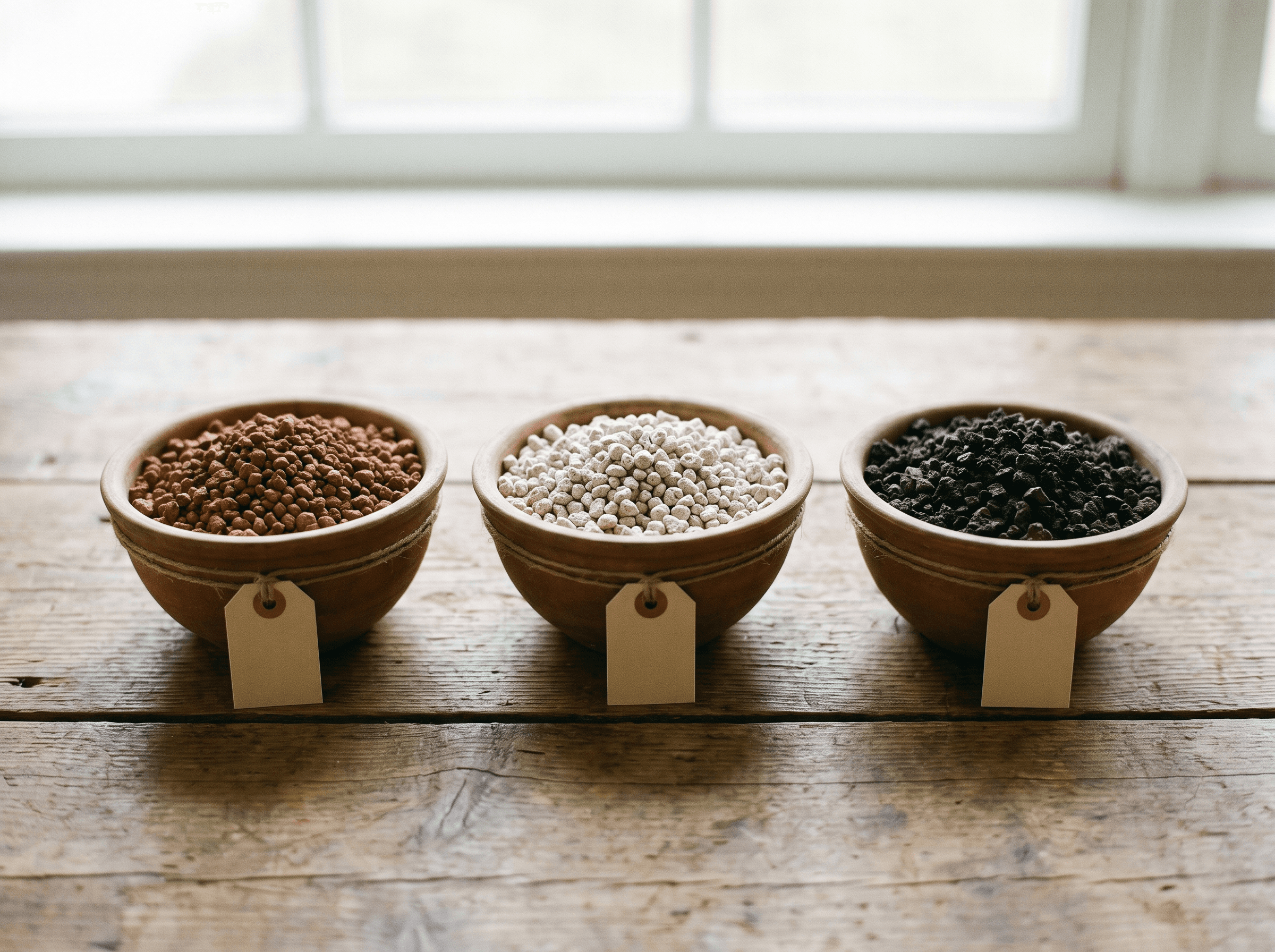
For years I bought pre-mixed bonsai soil without thinking much about what was actually in the bag, and honestly it worked fine until it didn't. The moment it stopped working was when I started growing species with very different water needs side by side and used the same generic mix on all of them. Understanding what akadama, pumice and lava rock each bring to a mix is what let me stop guessing and start adjusting.
Akadama, pumice, and lava rock are the classic components of Japanese-style bonsai soil, and while none of them is mandatory, they're common enough that most growers run into all three names sooner or later, whether in a pre-blended bag or as separate ingredients to combine yourself. Each one solves a slightly different problem, and knowing which is which means you can read a mix's ratio and understand roughly what kind of tree it was built for, rather than trusting the label alone.
Akadama in bonsai soil: the moisture-holding clay
Akadama is a granular, baked clay from Japan, and it's prized because it holds water and nutrients well while still staying porous enough to let roots breathe, at least while it's fresh. That last part matters, because akadama has a known limitation: it breaks down over time, with the pace depending heavily on the grade and how the tree is watered, gradually turning from firm granules into finer, more compacted particles. When that happens, it starts behaving more like the dense soil it was chosen specifically to avoid. This isn't a sign you bought bad akadama or did something wrong, it's just the nature of the material, and it's the main reason akadama-heavy mixes need periodic renewal at repotting time rather than being treated as permanent.
Pumice: light, stable, and good at holding some water
Pumice is a lightweight volcanic rock, full of tiny air pockets from when it cooled rapidly during formation, and those pockets are exactly what makes it useful in bonsai soil. It improves drainage and aeration in a mix while still holding a modest amount of moisture inside its porous structure, which is more than you'd get from something purely inert like gravel. Unlike akadama, pumice is mineral rock rather than clay, so it doesn't break down the same way over a few years. A pumice component you mixed in today is still doing roughly the same job several repot cycles later, which makes it a reliable long-term structural element in a mix even as other components age out.
Lava rock: coarser, drainage-focused, equally stable
Lava rock, sometimes labeled scoria, plays a similar role to pumice, stable, mineral, doesn't break down quickly, and it also holds a meaningful amount of moisture in its own pockets rather than being purely inert. Where the two tend to differ is emphasis and texture: lava rock is often chosen a bit more for structure and drainage, and it commonly runs coarser than pumice, though plenty of reputable growers use it for its water-holding properties too. In practice a lot of growers use pumice and lava somewhat interchangeably or in combination, and the right choice between them often comes down to what's locally available and affordable as much as any strict technical difference.
Combining the three for different species
The classic approach blends all three in ratios adjusted to what a species actually needs. A tree that wants more consistent moisture, something naturally suited to wetter ground, gets a mix leaning more heavily toward akadama for its water-holding capacity. A drought-tolerant species that prefers to dry out somewhat between waterings gets a mix leaning more toward pumice and lava, prioritizing drainage over retention. There's no single correct ratio that applies universally, and you'll see experienced growers cite noticeably different proportions for what looks like the same species, often because their climate, watering habits, or specific tree differ enough to justify it. As a rough starting point rather than a formula, a roughly equal 1:1:1 blend of akadama, pumice, and lava is a common baseline; many growers lean the ratio more toward akadama for deciduous trees that want steadier moisture, and more toward pumice and lava for conifers and other trees that prefer to dry between waterings. Adjust from there based on your climate and how the tree actually responds.
Knowing when akadama needs refreshing
Because akadama is the component in this trio that actually breaks down, it's worth keeping an eye on separately from the rest of the mix. Watering that used to run through quickly and now sits and drains slowly is usually the clearest sign that the akadama fraction has broken down into finer, more compacted particles. In practice growers don't pick akadama granules out of an established rootball; instead, this is exactly what normal repotting is for. At a routine repot, the old substrate, including the degraded akadama, comes out with the root work and is replaced with a fresh mix, so renewing the akadama fraction happens naturally as part of the repotting cycle rather than as a separate task. Pumice and lava rock are relatively stable and don't drive that timing the way akadama does, but a normal repot still refreshes the whole mix, not just one ingredient. It's also worth sifting out fine dust from any fresh material before use and keeping particle size reasonably consistent, since dust fills the air gaps a good mix depends on regardless of which three components you're combining.
Common questions
Can I use a bonsai mix without akadama at all?
Yes, plenty of growers, especially in climates or regions where akadama is expensive or hard to source reliably, build mixes from pumice, lava rock and other components without it. You lose some of akadama's specific water and nutrient-holding qualities, but a well-balanced mix of stable, drainage-focused components can still work well, particularly for species that don't need heavy moisture retention.
How often does the akadama in my mix need replacing?
It varies by grade of akadama, watering frequency, and climate, but a few years is a reasonable general expectation before it's broken down enough to affect drainage noticeably. Rather than working off a fixed calendar, check how quickly water passes through at watering time and let that tell you when a refresh is due.
What's the actual difference between pumice and lava rock if they're both stable and drainage-focused?
The main practical differences are particle texture and how much moisture each holds. Pumice tends to hold a bit more water in its porous structure and often runs a bit finer, while lava rock is typically coarser and leans further toward drainage over retention. Many growers use them somewhat interchangeably depending on availability.
Is akadama worth the cost compared to cheaper alternatives?
For growers who value its specific moisture and nutrient-holding properties, especially on species that benefit from more consistent moisture, many consider it worth the cost. That said, it's a genuine expense that breaks down and needs replacing, so plenty of growers reasonably substitute more affordable, locally available alternatives without a meaningful drop in results.
Should the ratio of these three be the same for every tree in my collection?
No, and this is probably the single most useful thing to take from understanding what each component does. A moisture-loving species and a drought-tolerant species in identical mixes are both being poorly served by whichever ratio doesn't suit them. Adjusting the akadama-to-pumice-and-lava ratio per species is worth the extra effort.
Can I mix akadama, pumice and lava rock myself instead of buying a pre-blended bag?
Yes, and it gives you far more control over the ratio for each specific tree than a generic pre-blended bag ever will. It does take sourcing the individual components and sifting out fine dust before use, which is more effort upfront, but many growers find it pays off once they're managing more than a couple of trees.
Why does my akadama-heavy mix seem to compact faster than a friend's, even with the same tree?
Watering frequency, water hardness, climate, and the specific grade of akadama used can all affect how quickly it breaks down. Someone watering daily in a hot climate will generally see faster breakdown than someone watering less often in a cooler one, even with an identical mix and species.
You might also like
General guidance based on 20+ years of practice. Every tree and every climate is different — when in doubt, ask us.