
White crust on bonsai soil or the pot rim
A crusty white or pale build-up on bonsai soil, or creeping up the outside of an unglazed pot, is almost always mineral salt deposits, not a disease.
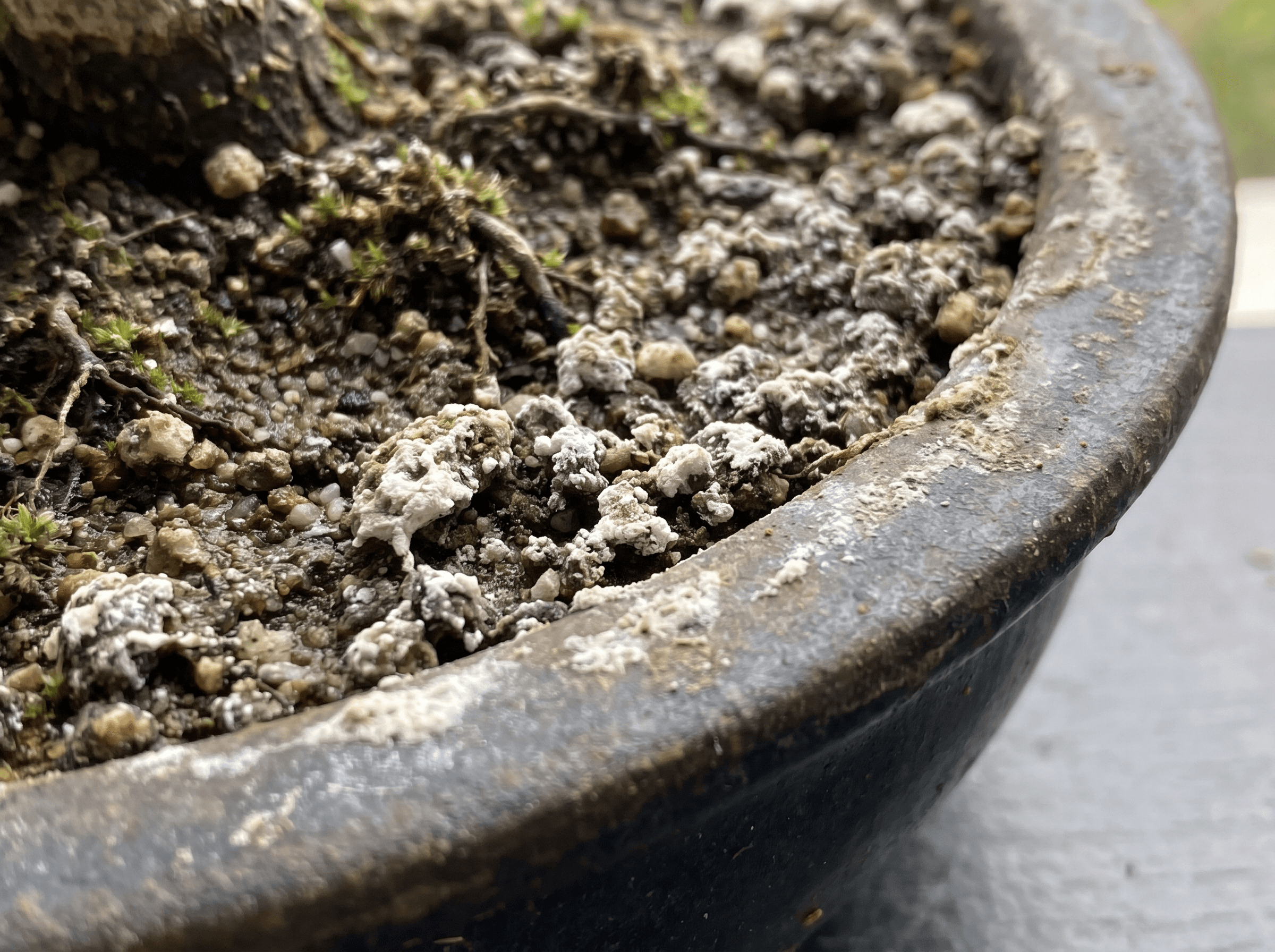
This is one of those diagnoses bonsai owners worry about far more than they need to. A white crust on top of the soil, or a pale, chalky ring climbing the outside of an unglazed pot, looks alarming the first time you notice it, especially if you've read about mould or fungal problems on bonsai forums. In almost every case it's neither. It's the leftover mineral content of your water and fertiliser, concentrated on the surface after the water itself has evaporated or been drawn up through the pot walls.
Every time you water, you're adding a small amount of dissolved minerals along with the water, whether that's calcium and magnesium from hard tap water or the salts in whatever fertiliser you use. The tree takes up water through its roots, but it doesn't take up much of that mineral load, so the dissolved salts stay behind in the soil. As the surface dries between waterings, or as moisture wicks up through a porous pot wall and evaporates from the outside, those minerals are left behind as a solid residue. Do this for months and the residue builds into a visible crust.
I see this constantly on trees that sit in the same spot for a season or two without a proper flush, and especially on unglazed clay, terracotta or other low-fired earthenware pots, which are porous enough to let water and dissolved minerals migrate straight through the wall. Mica pots often get lumped in with those, but that's a bit misleading: a standard mica bonsai pot is a mica-powder and polyethylene, or graphite, composite, which behaves much more like plastic than porous ceramic. Any pale film on the outside of a mica pot is more likely coming from splashing during watering, runoff pooling around the drainage holes, or ordinary surface staining, than from moisture wicking through the wall. It's cosmetic more than anything on a young crust, but it's worth taking seriously once it gets thick, because at that point it's telling you something about salt concentration in the root zone that goes beyond appearances.
Likely causes
Fertiliser or hard-water mineral buildup
How to tell: A white, chalky crust forms gradually on the soil surface, often starting as a faint powdery haze before thickening into a crust you can scrape with a fingernail. On unglazed pots you'll usually see a matching pale ring or streaks climbing the outside wall, most pronounced just above the soil line and around the drainage holes. It tends to be worst on trees watered with hard tap water, or on anyone using liquid fertiliser at every watering rather than diluting and flushing periodically.
The fix: Flush the pot thoroughly every few weeks: run several times the pot's volume of water through the soil so it actually pushes dissolved minerals out through the drainage holes rather than just wetting the top layer. Scrape off hardened surface deposits with an old chopstick or a soil scoop afterward, since flushing alone may not clear old crust quickly and you don't want it washing back into the substrate; calcium-based deposits are only slightly soluble in ordinary water, while fertiliser salts are generally more soluble and rinse out more readily. If the pot's outer wall has a heavy mineral ring, a soft brush and plain water will lift most of it, though very old deposits on unglazed clay can be stubborn and may never come off entirely.
Overfeeding
How to tell: The crust appears faster than you'd expect from watering alone, often within a few weeks rather than months, and it tends to coincide with a period of frequent feeding, feeding at full strength rather than diluted, or using a fertiliser with a high salt index. You may also notice slightly scorched leaf tips alongside the crust, which is a separate sign of the same underlying problem: too much soluble salt sitting in the root zone.
The fix: Cut back to the fertiliser dilution recommended on the label rather than a stronger mix, and space feeding out properly instead of applying it at every watering. Flush the soil with plain water between feeds, even during the growing season when you're feeding regularly, so salts don't have the chance to accumulate faster than they're washed out. If you've been feeding heavily for a while and the crust is already thick, do one deliberate deep flush and hold off fertilising for a week or two before resuming at a lighter rate.
Evaporation concentrating minerals on unglazed pots
How to tell: This one is really a variation of the first cause, but it's worth calling out on its own because it shows up differently: a pale, sometimes slightly crystalline film forms specifically on the outside of an unglazed clay, terracotta or other low-fired earthenware pot, even when the soil surface itself looks relatively clean. It happens because the porous pot wall acts like a wick, drawing moisture (and the minerals dissolved in it) out through the clay to evaporate on the outside surface, where the water leaves and the minerals stay. A mica pot can show a similar-looking film, but it's usually not from wicking: standard mica bonsai pots are a mica-powder and polyethylene, or graphite, composite that behaves much more like plastic than porous ceramic, so deposits there more likely come from splashing during watering, runoff pooling around the drainage holes, or general surface staining, unless you know your particular pot to be genuinely porous.
The fix: This is largely cosmetic and doesn't reflect what's happening in the root zone the way a soil-surface crust does, so don't over-react to it on its own. A damp cloth or soft brush removes light deposits; for a heavier, longer-standing bloom, a diluted white vinegar solution wiped on and rinsed off will dissolve most mineral scale without harming a glazed or unglazed pot, though I'd avoid vinegar near the soil itself. If it keeps recurring quickly after cleaning, treat it as a sign to flush the soil more often rather than just cleaning the pot repeatedly.
How to prevent it
The single most useful habit is flushing: every few weeks, run enough water through the pot that it clearly drains out the bottom several times over, rather than the quick top-up watering most of us default to day to day. This keeps dissolved minerals moving through and out of the soil instead of settling and concentrating at the surface. If your tap water is very hard, which you can usually tell just by the limescale in your kettle, switching to rainwater or filtered water for at least some of your waterings will slow the buildup considerably, though I wouldn't say it's worth the effort for everyone; plenty of growers manage fine on hard tap water as long as they flush regularly. One caution: if your home runs water through a sodium-based softener, don't assume that water is doing you any favours here, since swapping calcium and magnesium for sodium still leaves you with a salt that can contribute to the same buildup, so use unsoftened tap water, rainwater or filtered water for your trees instead. Keep feeding at the label's recommended dilution rather than assuming stronger is better, since overfeeding is the fastest route to a heavy crust. And if you're using an unglazed pot, expect some mineral bloom on the outside over time as a normal side effect of that material, and treat it as a cue to check your flushing routine rather than a defect in the pot.
Common questions
Is the white crust harmful to my bonsai?
A thin surface crust on its own is mostly cosmetic and won't hurt the tree. It becomes a genuine concern once it's thick and has built up over a long period without flushing, because that usually means the salt concentration throughout the root zone has climbed too, and that can interfere with the roots' ability to take up water properly, showing up as leaf tip burn or generally sluggish growth.
How can I tell mineral crust apart from mould or fungus?
Mineral deposits are dry, gritty, chalky or crystalline, and they typically crust hard enough that you can scrape at them with a fingernail without much give. Mould can be white too, so colour alone isn't a reliable way to tell them apart; look instead for texture. Mould is fuzzy, cottony or web-like and noticeably softer than a mineral crust, and it tends to show up where the surface has stayed persistently damp with poor airflow around it, often with a musty smell. If you're unsure, scrape a bit off: mineral crust crumbles into a dry powder, while mould has some give and doesn't turn to powder the same way.
How often should I flush the pot to prevent this?
Every two to four weeks during the growing season is a reasonable default for most trees and most tap water, though very hard water or heavy feeding routines might call for flushing more often. Thorough top-watering like this is fine for free-draining bonsai soil, but flushing far more than needed, or leaching heavily in a denser or slower-draining mix, can wash out nutrients along with the salts and keep the tree wetter than it wants to be, so it isn't entirely without downsides. The practical version: flush through a pot with good drainage, let it drain completely, and resume feeding at your normal rate afterward, rather than treating extra flushing as a free habit.
Will the crust damage my unglazed pot over time?
Generally no, not structurally. The mineral bloom on unglazed clay or mica is a surface deposit rather than something that erodes or weakens the material, and many growers simply accept it as part of the character of an older, well-used pot. If it bothers you visually, cleaning with a soft brush or a mild vinegar solution will lift most of it, though very old, deeply set deposits can leave a faint permanent staining even after cleaning.
Is it worth switching to distilled or rainwater to stop this?
If your water is genuinely hard and you're seeing crust build up within weeks rather than months, switching some of your waterings to rainwater or filtered water will noticeably slow it down, since you're simply adding fewer minerals in the first place. That said, distilled water strips out everything, including minerals a tree can actually use, so I wouldn't rely on it exclusively; using it for some waterings while flushing periodically is a more practical balance than chasing mineral-free water all the time.
Should I repot immediately if I see heavy crusting?
Not necessarily right away. Try a thorough flush first and see whether that brings things under control, since a lot of surface crust responds well to a proper watering-through routine. If the crust keeps returning quickly after flushing, or if you dig down and find the soil itself looks salt-crusted below the surface rather than just on top, that's a better sign it's time to repot with fresh soil at the next appropriate season for your species, rather than trying to flush your way out of a soil that's saturated throughout.
You might also like
General guidance based on 20+ years of practice. Every tree is different — when in doubt, ask us.