
Vine weevil on bonsai: notched leaves and sudden wilting
Neat U- or C-shaped notches chewed into the leaf margins point to vine weevil on bonsai, and the real damage from this pest is happening underground where you can't see it.
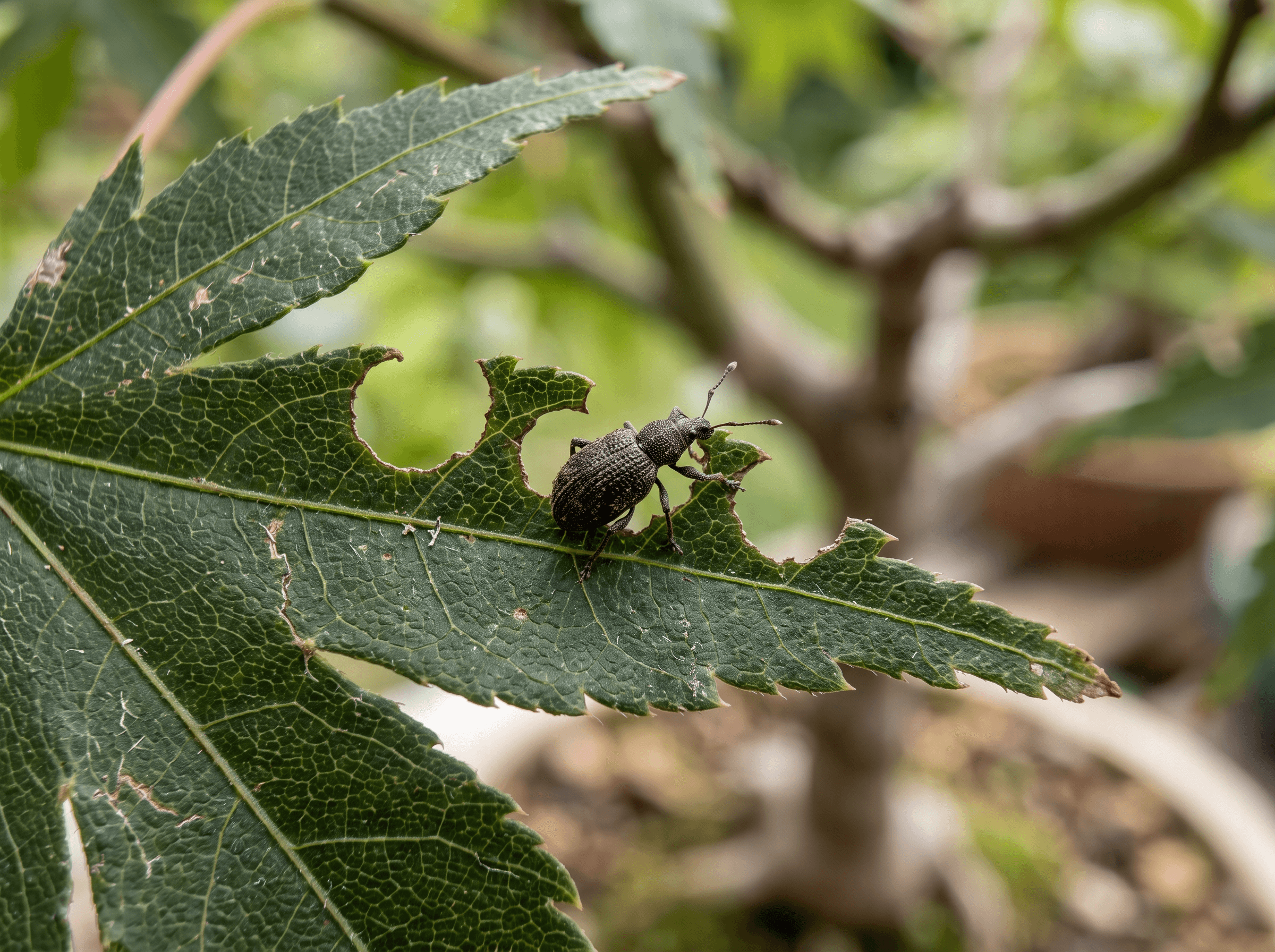
Vine weevil is a two-stage problem, and the stage you actually notice is usually the least dangerous one. The adult beetle chews small U- or C-shaped, sometimes angular or ragged notches out of leaf edges at night and hides during the day, so what you find in the morning is cosmetic damage with no insect in sight. On an established, healthy bonsai that leaf notching alone rarely does serious harm.
The part that matters is what's happening in the soil. Adult females lay eggs in the pot, and the larvae that hatch are cream-coloured grubs that feed on roots through autumn and into spring, sometimes right through a mild winter. Root damage doesn't show above ground the way a pest on the leaves does. Early feeding can go completely unnoticed, and by the time you see wilting, yellowing or a canopy that's lost its usual density, the roots have often already lost a substantial amount of mass.
That's what makes this pest worth taking seriously even when the visible sign looks minor. A tree can look completely normal one week and wilt or collapse the next, with watering having been perfectly normal the whole time, because the roots that should be taking up that water are gone. Any time you spot fresh notching on the leaves, treat it as a prompt to check the roots rather than something to shrug off.
Likely causes
Adult vine weevils chewing leaf edges
How to tell: U- or C-shaped notches, sometimes angular or a bit ragged, appear along the leaf margins, usually discovered in the morning since the adults feed at night and hide in soil, mulch or dark crevices during the day. The adults themselves are dark grey to black, roughly a centimetre long, with a slightly hunched, pear-shaped body, and they're slow-moving and easy to miss if you're not specifically looking after dark with a torch. On an established tree the notching itself is mostly cosmetic and doesn't threaten the tree's health directly.
The fix: Treat visible notching as a warning sign rather than the actual problem, and check the roots for grubs at the next opportunity, ideally by sliding the tree out of the pot for a proper look through the rootball rather than just scanning the surface, since grubs can sit anywhere from the outer roots to deep in the mix. To deal with the adults directly, hand-pick them at night with a torch, they don't fly and move slowly once spotted, or wrap the trunk in a protective barrier with the sticky coating on the wrap itself rather than applied straight onto the bark. A trunk barrier only slows adults trying to climb up and feed on the canopy though; it won't stop egg-laying in the pot, since eggs go into the soil rather than up the trunk, so also check that neighbouring pots, benches or overhanging foliage aren't giving adults a bridge around the band.
Grubs feeding on roots underground
How to tell: The tree wilts, loses vigour, or collapses suddenly despite watering that hasn't changed, because the root system that should be supplying it with water has been eaten away. If you tip the tree gently out of its pot, you'll typically find cream-coloured, C-shaped grubs with a light brown head sitting in the soil around the roots, often concentrated where the finer feeder roots used to be. This is the stage that actually threatens the tree, and by the time wilting is visible the damage is usually already extensive.
The fix: Remove every grub you can find by hand when you have the tree out of the pot, working through the root ball carefully rather than just checking the surface. A biological nematode drench gives you a way to reach any grubs you missed by hand; apply it to moist soil, out of direct sun or heat, and follow the product label for temperature and timing, since different nematode species are effective at different soil temperatures. Late summer into early autumn, when grubs are still small, is the commonly recommended window, though some products also work in spring depending on the species and your local climate. After clearing them out, repot into fresh, uncontaminated soil rather than reusing the old mix, since eggs and small grubs can be easy to overlook.
How to prevent it
Since the damaging stage of this pest lives out of sight, prevention is mostly about routine, not reaction. Check the root edges and surface soil whenever you handle a pot, whether that's for watering, feeding or a scheduled repot, and treat any leaf notching you spot as a reason to look closer rather than something purely cosmetic, ideally at the next repot when you can inspect the whole rootball rather than just what's visible from above. Protective, sticky-wrapped trunk barriers during the adult weevil's active season, roughly late spring through summer depending on your climate, cut down how many adults reach the canopy to feed, though they won't stop egg-laying in the pot on their own, so treat them as one part of a routine rather than a standalone fix. If vine weevil has hit a tree before, a preventive nematode drench timed to the following egg-laying season is worth doing on that pot and any others nearby, since an established population in your growing area tends to keep coming back until you break the cycle.
Common questions
Does leaf notching always mean there are grubs in the soil?
Not necessarily, an adult can wander in from elsewhere and feed for a night without having laid eggs in that particular pot. But notching is common enough alongside an active local population that it's always worth checking the roots rather than assuming the pot is clear.
How do I time a nematode treatment correctly?
It depends on the product, different nematode species are effective at different soil temperatures, so check the label rather than going by one fixed number. As a general guide most products need soil reliably above roughly 10 to 12 degrees Celsius, and they work best against small, young grubs rather than nearly mature ones. Late summer into early autumn, shortly after eggs have hatched, is usually the best window, though some products also work in spring, so it varies with your local climate and the specific nematode used.
Can a bonsai recover after grub damage to the roots?
Yes, if enough root mass survives and you repot into fresh soil promptly after clearing the grubs out. Expect a slower recovery than from most other problems on this list, since the tree needs to regrow root structure before it can support much top growth again.
Are certain bonsai species more vulnerable to vine weevil?
Vine weevil has a wide host range and no bonsai species is immune. Some plants show adult notching a little more visibly than others simply because of leaf texture, but the bigger factor is that any tree grown in a container is more exposed to grub damage than the same species would be in open ground, since the roots are confined to a small volume of soil with nowhere to escape to. It's worth checking any tree regardless of species.
Is it worth treating the adults if I've already treated the grubs?
Yes. Adults that survive will lay more eggs in the same pot or a neighbouring one, so hand-picking or barrier banding through their active season keeps the problem from restarting even after a successful nematode treatment.
How urgent is sudden wilting if I suspect vine weevil?
Treat it as urgent. Tip the tree out of the pot as soon as you can to check the roots, since by the time wilting shows above ground the grubs have usually already done significant damage, and getting it into clean soil quickly gives it the best chance to recover.
You might also like
General guidance based on 20+ years of practice. Every tree is different — when in doubt, ask us.