
Holes chewed in your bonsai's leaves
Clean holes or chewed edges without any slime trail, often with small dark droppings nearby, point to caterpillars or chewing beetles rather than slugs or sap-sucking pests.
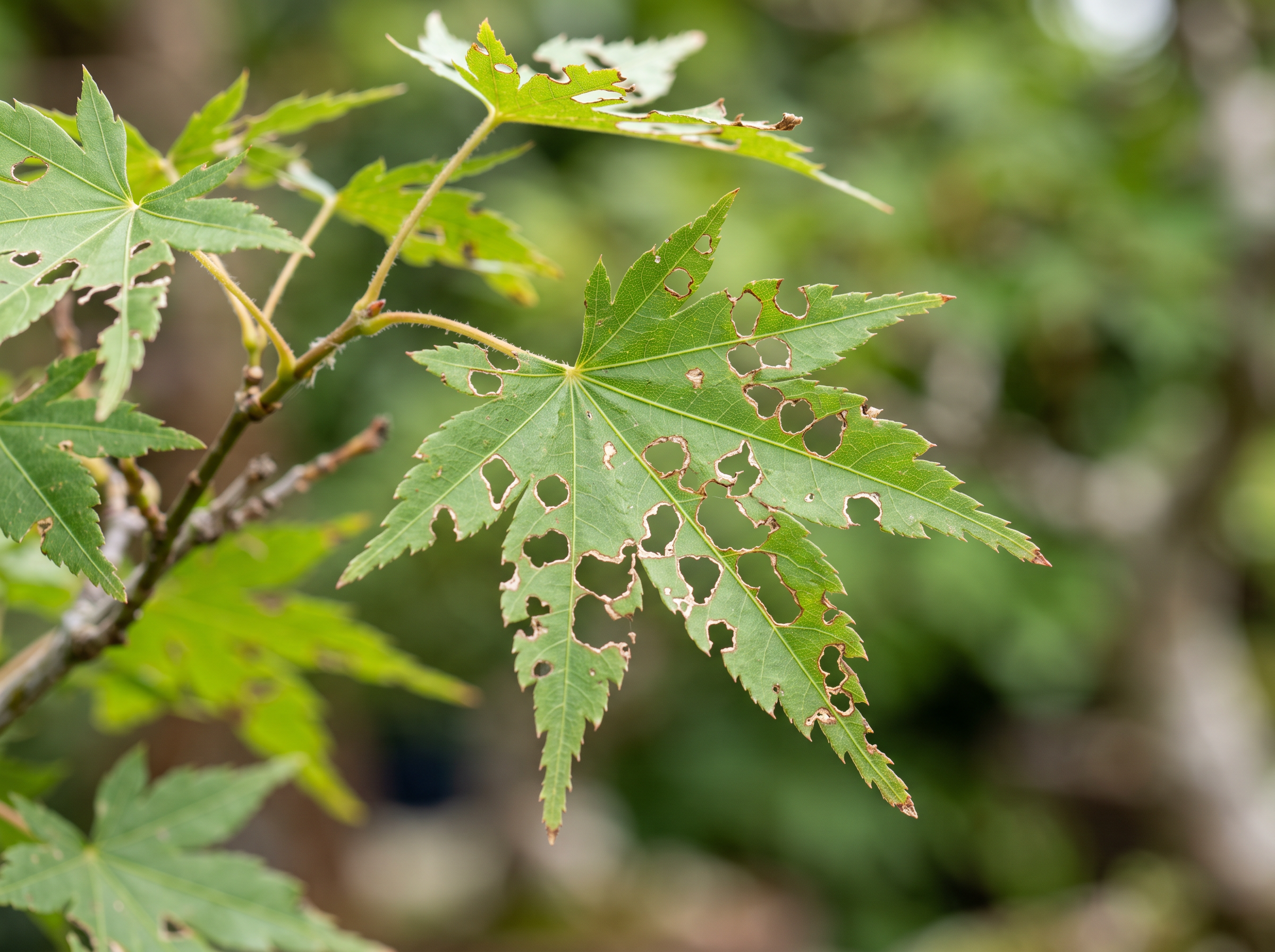
Holes chewed in bonsai leaves get blamed on the wrong culprit more often than almost any other symptom on this site, mostly because people jump straight to slugs or snails the moment they see a hole. It's worth slowing down and looking closely, because the pest actually responsible changes the fix. Thrips leave fine silvery streaking and rasped patches rather than proper holes, since they scrape and suck rather than bite through tissue. Slugs and snails leave ragged, ugly holes but almost always with a telltale slime trail somewhere on the leaf or branch nearby. What's left, clean-edged holes or chewed margins with no slime at all, is most often caterpillars or chewing beetles, though sawflies, earwigs, grasshoppers, leafcutter bees, and occasionally a shot-hole type of leaf disease or plain mechanical damage can leave similar-looking holes too.
Caterpillars and beetles leave slightly different signatures once you know to look, though neither pattern is a hard rule. Caterpillars tend to eat in a more open, irregular pattern, sometimes skeletonising a leaf by eating the soft tissue between the veins and leaving the vein structure behind like lace. Many beetles chew rounder holes or notch the leaf margin, and their damage often appears seemingly overnight since a lot of species feed mostly after dark, but some, Japanese beetles among them, feed by day in groups and skeletonise leaves in a way that can look a lot like caterpillar damage. Both leave frass behind, small dark droppings on the leaf surface or on the leaves below the damage, which is one of the more reliable clues that you're dealing with a chewing insect rather than something that sucks sap or rasps the surface.
In my experience these pests are generally more of an aesthetic problem than a serious threat to a healthy, established bonsai, unless the infestation is heavy or repeated, in which case the loss of leaf area does start to cost the tree real energy. The upside is that both caterpillars and beetles are usually visible if you look for them, which makes hand-picking a genuinely effective first line of defence rather than something you resort to only when chemical options fail.
Likely causes
Caterpillars feeding
How to tell: Irregular holes chewed through the leaf blade, sometimes concentrated between the veins so the leaf takes on a lacy, skeletonised look where only the tougher vein tissue is left behind. Small, dark, roughly cylindrical frass droppings collect on the leaf surface below the feeding site, and the caterpillars themselves are often findable with a careful look, particularly at dusk or early morning when many species are most active and least camouflaged.
The fix: Hand-pick caterpillars off the tree whenever you spot them, checking leaf undersides carefully since many species rest there during the day and blend in remarkably well with the foliage colour. For an infestation that's hard to keep on top of by hand, a biological treatment based on Bacillus thuringiensis, usually sold as Bt, targets caterpillars specifically by disrupting their digestive system without harming bees, ladybirds, or other beneficial insects on the tree. Bear in mind it affects any caterpillar that eats the treated foliage, including non-pest butterfly and moth larvae, and it has no effect on beetles, so it's worth confirming caterpillars are actually the problem before you use it.
Adult beetles chewing leaf edges or making round holes
How to tell: Often rounder holes or notched, scalloped edges rather than the more irregular caterpillar pattern, though this isn't a hard rule; some species, Japanese beetles among them, feed by day in groups and skeletonise leaves in a pattern that can resemble caterpillar damage. Many other chewing beetles feed mainly during darkness and retreat to shelter by day, so their damage often seems to appear overnight. Adults can sometimes be found actually on the tree, at whatever time of day the species is active, or hiding in nearby leaf litter, mulch, or crevices in the bark when they're not feeding.
The fix: Identify the beetle before you treat it, since the right approach depends on the species. Hand-pick at night with a torch for species that hide by day, or straight off the leaves for day-active feeders such as Japanese beetles, dropping them into a container of soapy water rather than just relocating them nearby. If hand-picking isn't keeping the damage under control on a repeat or heavy infestation, use an insecticide labelled for that specific beetle and follow the label's timing guidance, since some species are best treated at dusk while day-active ones need daytime application, and avoid spraying open flowers or when bees are actively foraging.
Larvae feeding on roots or lower stems alongside leaf damage
How to tell: Leaf chewing is accompanied by unexplained wilting, weak growth, or a tree that seems to be struggling more than the visible leaf damage alone would explain. This is a pattern seen with vine weevils and some other root-feeding beetles, where the larval stage feeds below ground on roots while the adults chew leaves above; it isn't true of every chewing beetle, but it's worth ruling out when decline goes beyond what the leaf damage explains.
The fix: If leaf damage is paired with wilting or a tree that's clearly declining, don't wait for the next scheduled repot, gently check the root area now for grubs rather than assuming the visible adult beetles are the whole story. Beneficial nematodes applied to the soil are a targeted option for grubs if you confirm they're present, and a local plant clinic or extension service can help with identification if you're not sure what you're looking at.
How to prevent it
A quick visual check of your bonsai every few days during the growing season, particularly the leaf undersides and any low branches near the soil, catches most chewing pests before the damage adds up to anything significant. Caterpillars are far easier to remove by hand while numbers are still small than after they've had weeks to build a population, and adult beetles are worth catching early too, though beetle eggs are usually laid in the soil rather than on the leaves, so hand-picking won't reach them; that's where checking the root zone comes in for species with soil-dwelling larvae. Keeping the area around the pot free of excess leaf litter and debris removes some of the daytime shelter beetles rely on, and a light dusk inspection with a torch every so often will tell you quickly whether nighttime feeders are active on a particular tree.
Common questions
How can I tell caterpillar damage apart from beetle damage?
Caterpillars tend to leave more irregular holes and sometimes skeletonise the leaf between veins, while many beetles leave rounder holes or notched edges, though day-active species like Japanese beetles can skeletonise leaves too and blur that distinction. Frass droppings are common with both, so that clue alone won't tell you which pest you have; timing and hole shape are more useful, and finding the insect itself is the most reliable check.
Is Bt safe for bees and other beneficial insects?
Yes, that's one of its main advantages. Bacillus thuringiensis works specifically on the digestive system of caterpillars and doesn't harm bees, ladybirds, lacewings, or other beneficial insects that might visit or live on the tree. It will affect any caterpillar that eats the sprayed leaves though, pest or not, so it's worth confirming caterpillars are actually the problem before you use it, and it won't do anything against beetles.
How often should I check for chewing pests during the season?
A quick look every few days during spring and summer, when both caterpillars and beetles are most active, is enough to catch most problems early. Pay particular attention to leaf undersides and low branches, which is where these pests are most often missed.
Should I remove leaves that have already been chewed?
It's usually not necessary purely for the tree's health, since a partially eaten leaf still photosynthesises with whatever tissue remains. Removing heavily skeletonised leaves is mostly a cosmetic choice, though it can also help you spot any remaining caterpillars hiding nearby.
Can chewing pests kill a bonsai?
On their own, rarely, unless the infestation is severe and repeated over a full growing season, in which case the cumulative loss of leaf area can genuinely weaken the tree. A light, occasional infestation is more of a cosmetic nuisance than a serious threat.
Do I need to treat the soil as well as the leaves?
Only if you suspect root-feeding larvae alongside the visible adult damage, usually signalled by unexplained wilting or weak growth beyond what the leaf chewing alone would cause. For straightforward caterpillar or adult beetle feeding, treating the foliage and hand-picking is generally enough.
You might also like
General guidance based on 20+ years of practice. Every tree is different — when in doubt, ask us.