
Sudden wilting or dieback on one side of a bonsai
Wilting, yellowing or dieback that shows up on one side of a bonsai, or in specific branches while the rest of the tree still looks fine, is a sign worth taking seriously: it points toward verticillium wilt, a vascular disease rather than an ordinary stress response.
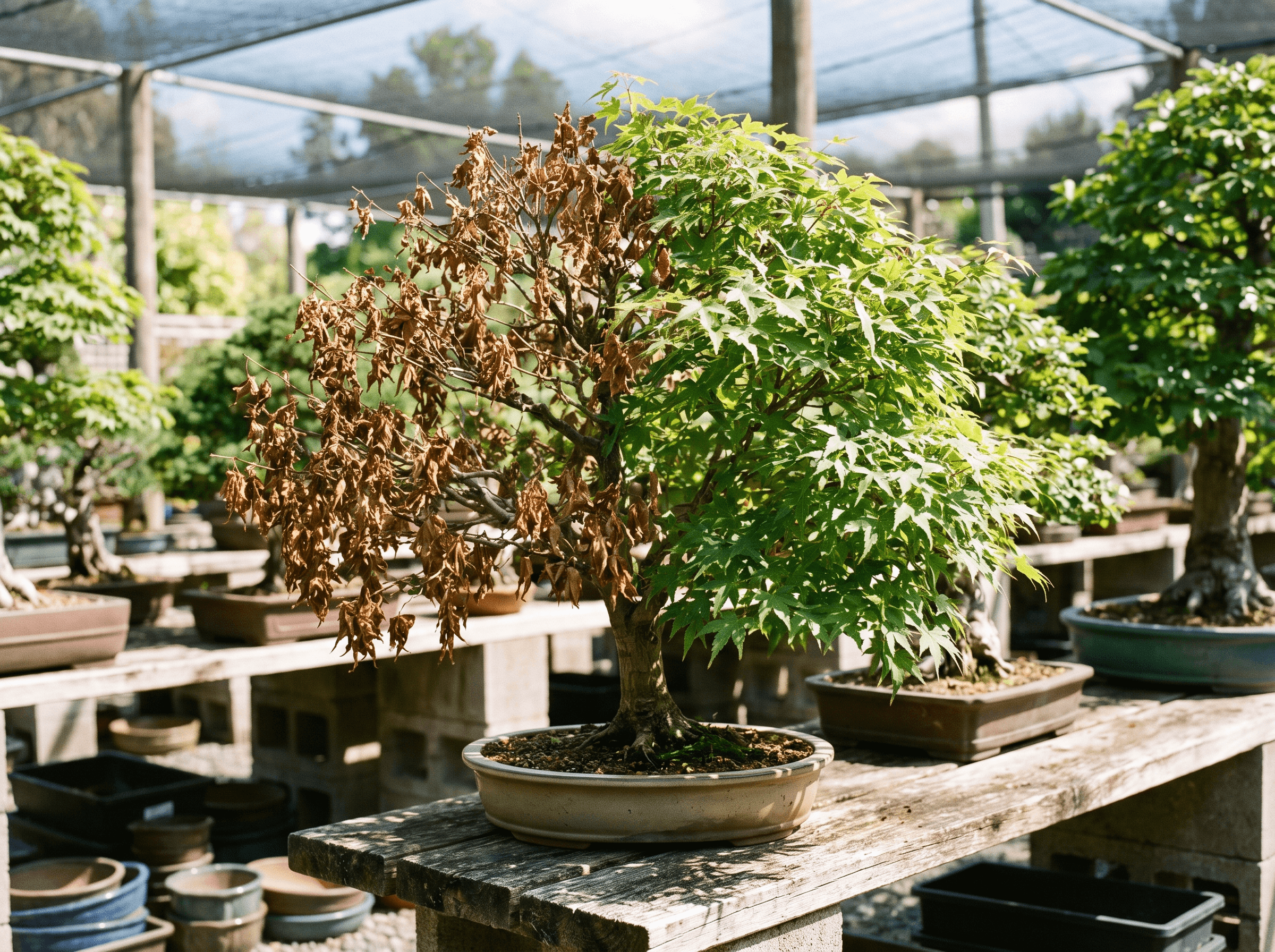
This is a symptom pattern I always tell people to pay close attention to, because the shape of it matters as much as the symptom itself. Ordinary stress, whether from underwatering, heat, or a nutrient problem, tends to affect a tree fairly evenly across its whole canopy, though it's worth knowing that drought, girdling roots, wire damage, a canker, or a localised root problem can also produce dieback confined to one side or branch. Verticillium wilt shows up in its own distinctive way too: typically on one side of the tree, or in one or two specific branches, while everything else carries on looking perfectly healthy, at least at first. That lopsided pattern is worth treating as a strong prompt to look closer rather than proof on its own, since it's not the only thing that can produce a similar picture.
The reason it behaves this way comes down to how the disease works. Verticillium is a soil-borne fungus that enters through the roots and then colonises the tree's vascular tissue, the internal plumbing that carries water up through the trunk and out into individual branches. Because that plumbing runs somewhat independently to different parts of the canopy, the fungus can block water flow to one branch or one side of the tree well before it's spread through the whole system, which is exactly why the symptoms look so oddly localised in the early stages. Maples are particularly susceptible to this disease and it's the species I see it in most often, though it isn't limited to them.
I won't pretend this is a cheerful topic, because unlike most of what's on this site, there's no product or treatment that clears verticillium out of a tree entirely. It's a disease you manage rather than cure, and the earlier you catch that one-sided wilting pattern and act on it, the better a tree's odds of carrying on for years despite carrying the fungus. What follows is aimed at getting you to that management stage as quickly as possible, and at telling this apart from the more common, more localised causes of branch dieback that this site also covers separately.
Likely causes
Verticillium wilt fungal infection
How to tell: Wilting, yellowing, or dieback appearing on one side of the tree or working through specific branches one at a time, rather than affecting the canopy evenly. If you cut into a small affected branch and look at the cross section, you'll sometimes see a ring or streak of dark discolouration in the wood just under the bark, which is the fungus sitting in the vascular tissue itself and is one of the more reliable confirming signs available without lab testing.
The fix: Prune out affected branches, cutting well back into wood that shows no discolouration when you check the cross section, since cutting too close to the visible damage often leaves infected tissue behind. Disinfect your tools between every cut, not just between trees, since the fungus can be carried on blades from one branch to the next on the same tree. Bag and dispose of the pruned material rather than composting it or using it as mulch or chipped material near your other trees, since the fungus can persist in infected wood and debris. There's no cure that removes the fungus from the tree entirely, so the ongoing plan is keeping the tree as vigorous as possible: consistent watering, appropriate feeding, and minimising any additional stress, since a tree under good vigour manages a low-level infection far better than one that's already struggling.
Soil-borne fungus present and triggered by stress
How to tell: Symptoms that appeared not long after a genuinely stressful period for the tree, such as a drought stretch, a hard repot, or root disturbance from any cause. The fungus can persist in soil or in infected plant debris and tissue for a long time, sometimes as a latent, symptomless infection, until stress tips the balance and it becomes active.
The fix: Minimise further stress on the tree while you manage the visible symptoms: keep watering consistent rather than letting the tree swing between dry and soaked, and avoid unnecessary root work until it's stabilised. If the tree doesn't recover and you eventually need to replace it, don't reuse the same soil for a new, susceptible species in that spot or pot, since the fungus can persist in soil and infect a new tree the same way.
How to prevent it
There's no reliable way to guarantee a tree never encounters verticillium, since it's a naturally occurring soil fungus in a lot of places, but keeping trees generally vigorous goes a long way toward keeping any infection they do pick up at a low, manageable level rather than a rapidly spreading one. Avoid unnecessary root disturbance, keep watering and feeding consistent rather than erratic, and if you know a particular batch of soil or a particular source tree has had verticillium before, don't reuse that soil for susceptible species like maples. Buying trees from a nursery you trust, and inspecting new material for one-sided dieback before it goes anywhere near the rest of your collection, catches a lot of problems, this one included, before they can spread further.
Common questions
Which species are most susceptible to verticillium wilt?
Maples are the ones I encounter it in most often and they're widely known to be particularly vulnerable, but the fungus affects a broad range of woody species beyond maples too. If you grow a lot of maples, it's worth knowing this symptom pattern specifically, since it's the group where I'd be quickest to suspect it.
Can a tree fully recover from verticillium wilt?
Full elimination of the fungus from the tree isn't realistic with anything currently available to home growers, but plenty of trees live for years managing a low-level infection, especially once affected branches are removed and vigour is kept up. Think of it as ongoing management rather than a problem you solve once and move past.
Does it spread to my other trees through shared tools or soil?
Yes, both are realistic transmission routes, which is exactly why disinfecting tools between cuts and between trees matters, and why reusing soil from an infected tree for a new susceptible species is worth avoiding. It doesn't spread through the air the way some fungal issues do, but in a bonsai collection it's still worth separating a suspect pot from the rest of your trees while you confirm the diagnosis, keeping it off shared drip trays or benches where splash or runoff can move between pots, and treating its tools and pot as dedicated to that tree until you know more.
How is this different from ordinary branch dieback?
Ordinary branch dieback usually has a fairly identifiable local cause, a pest, a wire left on too long, a physical injury, or a branch that simply lost out to stronger growth elsewhere on the tree. Verticillium tends to show that distinctive one-sided or branch-by-branch pattern without an obvious physical cause, and the internal wood discolouration on a cut cross section is a further distinguishing clue that points specifically to the fungal cause.
Is there a lab test to confirm verticillium instead of guessing?
Yes, a plant pathology lab can test a sample of affected wood and confirm it more reliably than visual inspection alone, and if you have access to an agricultural extension service or a university plant clinic, that's worth pursuing for a valuable or particularly important tree. For the best chance of a useful result, take the sample from a branch that's recently wilted rather than one that's already fully dead, ideally with a few leaves still attached, since labs need living infected tissue at the margin of the damage to work with. For most home growers, though, the one-sided symptom pattern combined with the wood discolouration is usually enough to act on.
Should I remove the whole tree if I confirm verticillium?
Not necessarily, and I'd generally try management first, especially on a tree you're attached to. Removal becomes the sensible option mainly if the infection is clearly progressing despite pruning and good care, or if you specifically need that soil or spot free of the fungus for other susceptible trees you're planning to grow there.
You might also like
General guidance based on 20+ years of practice. Every tree is different — when in doubt, ask us.