
Discoloured or sunken bark on a bonsai's trunk
A discoloured, sunken or peeling patch of bark on the sun-facing side of a bonsai's trunk is sunscald, also called sunburn, sun damage to the bark itself rather than to the leaves.
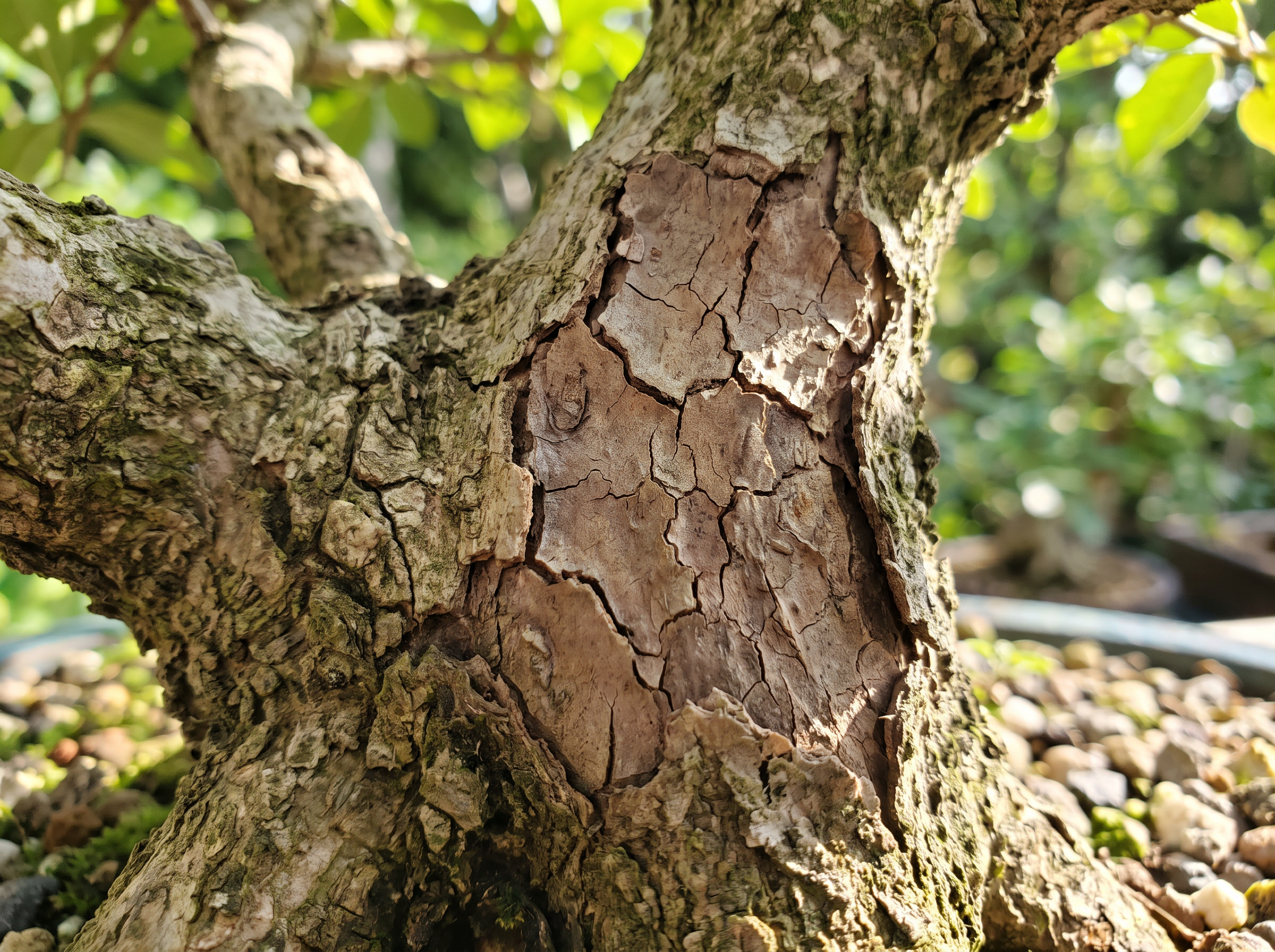
It's worth being clear from the start about what this page covers, because it's easy to confuse with a more common problem. Sunscald is damage to the bark and trunk tissue, a patch that looks discoloured, sunken or cracked, sometimes peeling, on the side of the trunk that faces strong sun. If what you're seeing is dry, brown leaf tips instead, that's a leaf problem covered on the brown tips page, and it has different causes and a different fix.
Bark protects the living tissue just underneath it, and that tissue can be damaged by heat and intense light in much the same way skin can be sunburned. What makes sunscald particular to bonsai is how often we create the conditions for it ourselves without meaning to. A tree that's been growing in dappled shade under a canopy of its own foliage, then gets a hard prune that strips away that shading growth, suddenly has bark exposed to direct sun it was never conditioned for. The same happens when a tree is moved from a shaded bench into full sun too quickly, whether that's a seasonal move or just a new spot in the garden.
Some species are simply more exposed to this risk than others because of the bark they have. Thin, smooth bark, the kind you see on some maples in particular, offers far less natural insulation than the thick, corky bark of most older pines or a mature juniper, so the same afternoon of strong sun that a thick-barked tree shrugs off can scald a thin-barked one. That said, thick bark isn't an absolute guarantee, a handful of pine species with lighter bark, eastern white pine among them, are also known to scald, so treat bark thickness as a strong indicator of risk rather than a rule. Neither cause is complicated once you know to look for it, but sunscald can take a season or more to fully heal, so catching it early and managing the exposure matters.
Likely causes
Sudden exposure to intense sun (sunburn) on thin bark
How to tell: A discoloured or sunken patch of bark shows up on the side of the trunk facing strong afternoon sun, most commonly after a heavy prune removed foliage that had been shading that section of trunk, or after the tree was moved from a shadier spot into more direct sun than it was used to. The damage can show within days, but it's just as common for it to go unnoticed until weeks later, or even the following season, once the dead tissue starts to crack, sink or peel. The patch may look bleached or reddish-brown at first and can progress to a sunken, cracked, or peeling texture as the underlying tissue dies back.
The fix: Shade the affected side while the tree recovers, a simple piece of shade cloth, burlap, or even a strategically placed board angled to block the afternoon sun is enough. As a general guide, leave it in place for the rest of the season rather than removing it as soon as the patch stops looking fresh, though a thin-barked young trunk in a hot climate may need protection for longer. For any future change in sun exposure, whether from pruning or from moving the tree, acclimate the trunk gradually, a week or two as a rough rule of thumb in hot weather, rather than switching it from shade to full sun in one step, giving the bark time to build some tolerance.
Species with naturally thin, sun-sensitive bark
How to tell: The same tree develops scald repeatedly, sometimes in more than one spot in a season, even when you feel you've been reasonably careful with its care. This tends to happen on species known for smooth, thin bark rather than being a one-off accident, and it's worth checking whether your species is one of the commonly affected ones, several maples in particular are notably prone to this.
The fix: For these species, treat afternoon shade as a standing part of the care routine rather than something you only add after damage has already appeared. A permanent partial-shade position for the hottest part of the day, or a shade cloth kept up through the peak of summer, prevents the recurring pattern rather than just treating each new patch as it shows up.
Reflected or intensified heat from nearby surfaces
How to tell: Scald appears even on a day that doesn't feel unusually hot, and when you look at the tree's position you notice it sits close to a light-coloured wall, paving, or greenhouse glass on the side that's damaged. These surfaces reflect and re-radiate heat back onto the trunk on top of the direct sun the tree is already getting, pushing the total exposure well past what the same sunlight alone would cause.
The fix: Reposition the tree a little further from the reflective surface, or add a light diffusing barrier, shade cloth or a simple screen, between the tree and the wall or paving on hot, bright days. If repositioning isn't practical, treat that spot as a higher-risk location and shade the tree there proactively rather than waiting for damage to appear again.
How to prevent it
The pattern behind most sunscald cases is a sudden jump in sun exposure rather than gradual acclimatisation, so the core prevention habit is simple: change a tree's light conditions in stages, not in one move. After a heavy prune that removes significant shading foliage, or before shifting a tree to a sunnier spot, give the trunk one to two weeks of partial shade to adjust rather than exposing it fully on day one. Know your species, if you're growing something with naturally thin bark, build afternoon shade into its regular position rather than treating it as an exception, and be alert to reflected heat from nearby walls, paving or glass that can intensify sun exposure beyond what the sky alone is delivering. A few minutes of thinking through a tree's light path before you prune or move it prevents most of the cases I see.
Common questions
Does sunscald heal on its own?
Bark can heal over a scald patch given time and reduced stress, often growing callus tissue around the edges of the damage, but it's a slow process that can take a full season or more. Deep or extensive scald may leave a permanent scar even after the tree recovers otherwise.
Which bonsai species are most prone to sunscald?
Species with thin, smooth bark are the most vulnerable, several maples are the classic example, since their bark offers little natural insulation compared to the thick, corky bark of most pines or older junipers. A few thinner-barked pines, eastern white pine included, can still scald, so thick bark lowers the risk rather than removing it entirely. If you grow a thin-barked species, treat afternoon shade as routine care rather than an emergency measure.
How is sunscald different from normal bark texture or cracking?
Normal bark develops texture, ridges and fissures as a tree ages, spread fairly evenly around the trunk rather than concentrated on one side. Sunscald is localised to the sun-facing side, appears as a discrete discoloured or sunken patch, and usually follows a recent change in sun exposure rather than showing up gradually as the tree matures. It's also worth ruling out other causes that can look similar: canker disease, borer damage, frost cracks, mechanical injury from a stake or wire, and rot at the root flare can all produce discoloured or sunken bark. If the patch isn't on the sun-facing side, or there's oozing, boreholes, or soft, foul-smelling tissue, suspect one of those instead.
Should I seal or cover the damaged bark?
Shading the area to prevent further damage matters more than sealing it. A wound sealant isn't necessary for surface scald in most cases, but keep the area protected from further sun and avoid disturbing any loose bark, letting the tree callus over the damage naturally.
Can sunscald kill a bonsai?
A small patch rarely threatens the tree's survival, but scald that girdles a significant portion of the trunk's circumference can cut off the flow of water and nutrients through that section and cause dieback above it. Extensive scald is worth taking seriously and monitoring closely through the following growing season.
Is sunscald more likely after repotting?
Indirectly, yes, as a matter of sensible precaution rather than a firmly documented timeline. A tree recovering from root work has fewer reserves to cope with additional stress, so it's worth being extra cautious about sudden sun exposure in the weeks after a repot, even if the trunk itself wasn't touched.
You might also like
General guidance based on 20+ years of practice. Every tree is different — when in doubt, ask us.