
Canker on your bonsai's trunk or branch
A sunken, discoloured patch of bark, sometimes cracked or slightly oozing, usually sitting right on an old wound or pruning cut, is what I'd call bonsai canker bark, a localised infection that can sit there for years without killing the branch beyond it.
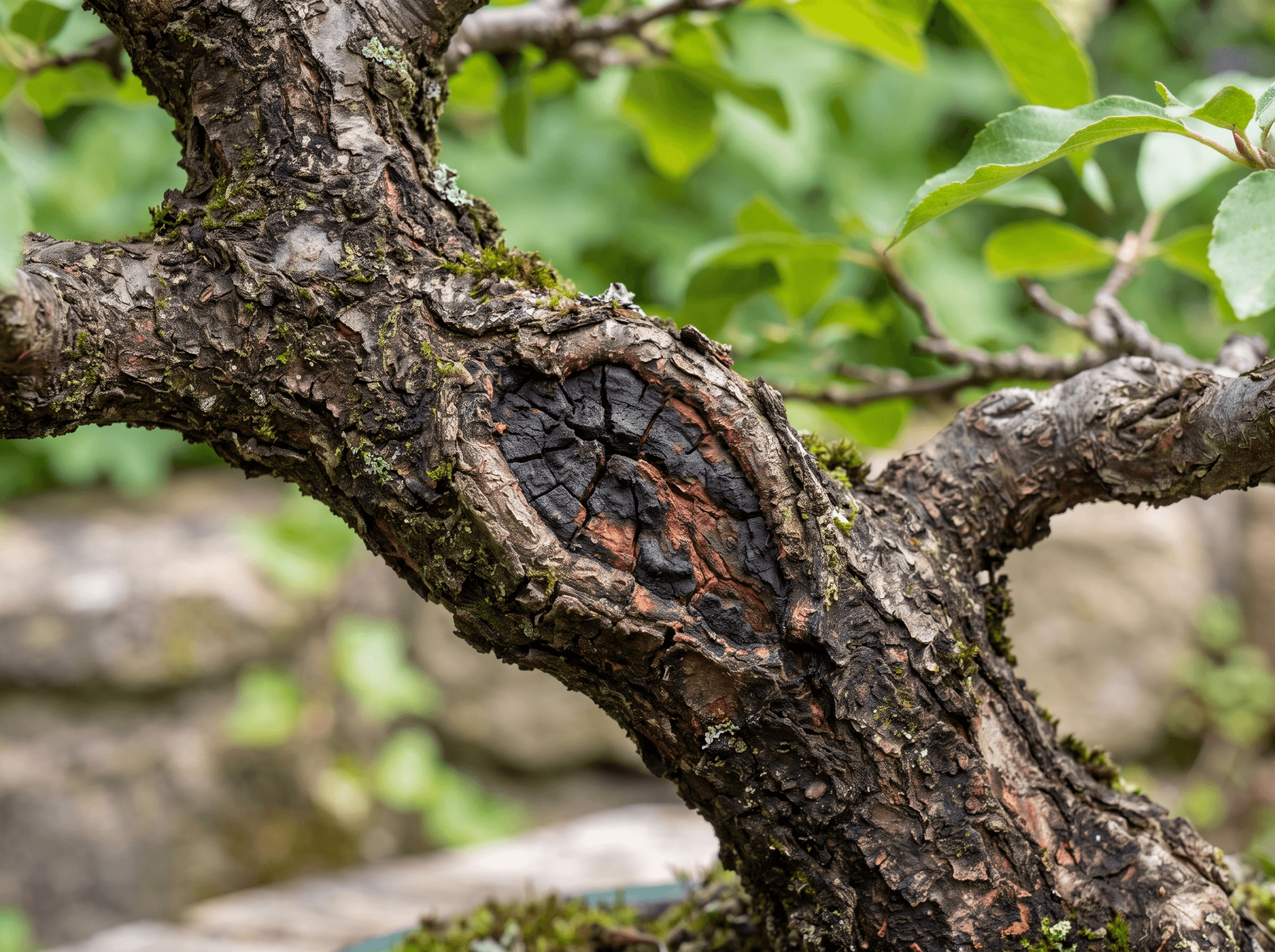
A canker is a dead patch of bark and the wood underneath it, caused by a fungal or bacterial infection that got in through some kind of wound. That could be an old pruning cut that never fully healed, a scrape from moving the tree, frost damage, or even an insect wound. The pathogen doesn't need much of an opening, and once it's in, it kills the tissue in that localised area and keeps a foothold there.
People often confuse a canker with branch dieback, but they're different problems. Dieback is what you see when an entire branch beyond some point dies off, from any number of causes, root trouble, poor light, mechanical damage further down the line. A canker is the lesion itself, a specific wound-centred patch of dead, discoloured bark. A canker can absolutely be the cause of dieback further along a branch if it girdles the branch completely, cutting off the flow of water and nutrients past that point, but plenty of cankers just sit there for a long time without killing anything beyond themselves, especially on a vigorous tree.
I've dealt with cankers on pines, junipers, and deciduous material alike, and the pattern is consistent: they start at a wound, they look worse than they usually are at first glance, and the tree's own vigour has a lot to do with whether it stays contained or spreads. A weak or stressed tree struggles to wall off the infection. A healthy one often does, on its own, without you doing much beyond keeping conditions right.
Likely causes
Canker infection established at a wound site
How to tell: A sunken, discoloured patch of bark, sometimes cracked or slightly oozing sap or a darker fluid, most often centred on an old pruning cut, a graft point, or some past injury to the trunk or branch. Scrape gently at the edge with a clean blade and you'll usually find dead, discoloured wood underneath rather than the healthy pale green or cream layer you'd see on sound bark.
The fix: How you handle it depends on where it is. On a branch you can afford to lose some length from, cut back well past the canker into wood that is clearly healthy on all sides, not just trimming the visible edge of the lesion. On the trunk or a structural branch, be far more cautious: if the canker is already callusing over at the edges, cutting into it can reactivate the infection and do more damage than leaving it alone, so on an older, partly healed canker in a structural spot, just clean away loose or flaking bark without disturbing the callus, and get an experienced second opinion before carving into anything you can't easily replace. Disinfect your tools with alcohol before you start and again afterward, since cankers can carry pathogens from tree to tree on an unclean blade, though this is a sensible precaution rather than the only route of spread. Don't seal over tissue that's still wet, discoloured, or obviously diseased, since sealing over a still-active canker just traps the pathogen against the wood. Let a genuinely clean excision dry out in the open air and start to callus on its own first; bonsai cut paste has its place on fresh, healthy pruning wounds, but a canker wound is different enough that it's worth erring on the side of leaving it open rather than sealing too soon.
Stress or a wound that gave the pathogen its entry point
How to tell: The canker showed up not long after a known injury, a rough repot, storm damage, an accidental knock, or after a particularly hard season for the tree, drought stress, a very cold winter, recovery from heavy root work. The infection is opportunistic rather than something that arrived out of nowhere.
The fix: Focus on getting the tree back to full vigour: consistent watering, appropriate feeding through the growing season, and protection from further stress while it recovers. A genuinely healthy tree can often wall off a small canker by compartmentalising the damaged tissue and continuing to grow around it, which is a natural defence mechanism you want to support rather than interfere with. Avoid stacking more stress on top, heavy pruning or repotting the same season a canker appears is asking for trouble.
Poor wound care after pruning leaving an entry point open
How to tell: A canker forms specifically at a large or poorly made pruning cut that was left rough, torn, or unsealed for an extended period, rather than at a small wound. Big cuts on thick branches are the most common site, since they take longest to callus over on their own.
The fix: Make future cuts clean, using sharp concave cutters rather than tearing through with dull tools, and avoid cutting into the branch collar or other living tissue at the base of the cut even when working close for a tidy bonsai finish. Seal larger cuts promptly with wound sealant once they're dry, and check back on healing cuts through the following season rather than assuming they've closed. A clean, promptly cared-for cut is far less likely to develop a canker than a ragged, neglected one, though cankers can also start from natural openings like leaf scars, frost cracks, or growth splits that had nothing to do with pruning, so good wound care reduces the risk without eliminating it entirely.
How to prevent it
Most cankers trace back to a wound of some kind, though not always one you could have avoided, a hard frost or an insect can open the door just as easily as a bad pruning cut, so the best prevention is careful pruning and careful handling combined with generally protecting the tree from unnecessary damage. Use clean, sharp tools, make flush cuts rather than tearing or leaving stubs, and seal larger wounds once they've dried rather than leaving raw wood exposed for an extended period. Handle the tree gently when moving or repotting it to avoid unnecessary scrapes and knocks to the bark, and protect vulnerable species from hard frost, since frost cracks are a common entry point. Beyond the mechanics of wounding, keep the tree itself vigorous through consistent watering and seasonal feeding, since a strong tree is simply better equipped to contain an infection before it becomes a real problem. Disinfecting your tools between trees is a small habit that removes one preventable route of spreading a canker pathogen from an infected specimen to a healthy one.
Common questions
Can a canker heal on its own without cutting it out?
A small canker on an otherwise vigorous tree can sometimes be walled off naturally as the tree compartmentalises the damaged tissue and grows around it. I still prefer to cut out anything I can see clearly on an expendable branch, since leaving an active infection in place is a gamble on how strong the tree really is.
How do I tell a canker apart from normal rough bark texture?
Normal bark, even rough or flaking bark on an older trunk, is uniform in colour and firm underneath. A canker is localised, sunken relative to the surrounding bark, discoloured, and when you scrape gently at the edge you find dead wood rather than healthy tissue.
Can canker spread to my other trees through my tools?
It's one of the preventable ways it can move between trees in a collection, even if it's not the only route, spores can also travel by rain splash, wind, or insect activity. Always disinfect pruning tools with alcohol before and after working on a tree with a known or suspected canker, since it's a small habit that removes one risk entirely.
When does a canker mean the branch or the whole tree is doomed?
If the canker has fully girdled a branch, wrapping all the way around it and cutting off the flow of water and nutrients past that point, everything beyond it will die regardless of what you do. A canker low on the trunk that girdles the main stem is a much more serious situation than one on a side branch, and is worth getting a second opinion on before deciding how to proceed.
Should I remove a branch entirely rather than cutting out a canker on it?
If the canker is small and well within otherwise healthy wood, cutting it out is usually enough. If it's already extensive along the branch, or the branch isn't essential to the design, removing the whole branch back to a clean point is often simpler and safer than trying to save it.
Is it normal for a treated canker site to look rough for a long time afterward?
Yes. Callusing over a large excised area takes time, often more than one growing season, and the healed scar may never look completely smooth. As long as the wood underneath stays healthy and the callus keeps advancing, that's a good sign, not a cause for concern.
You might also like
General guidance based on 20+ years of practice. Every tree is different — when in doubt, ask us.