
White specks, dots or webbing
Fine webbing, pale stippling and tiny moving dots on a bonsai usually mean spider mites, which thrive in warm, dry air.
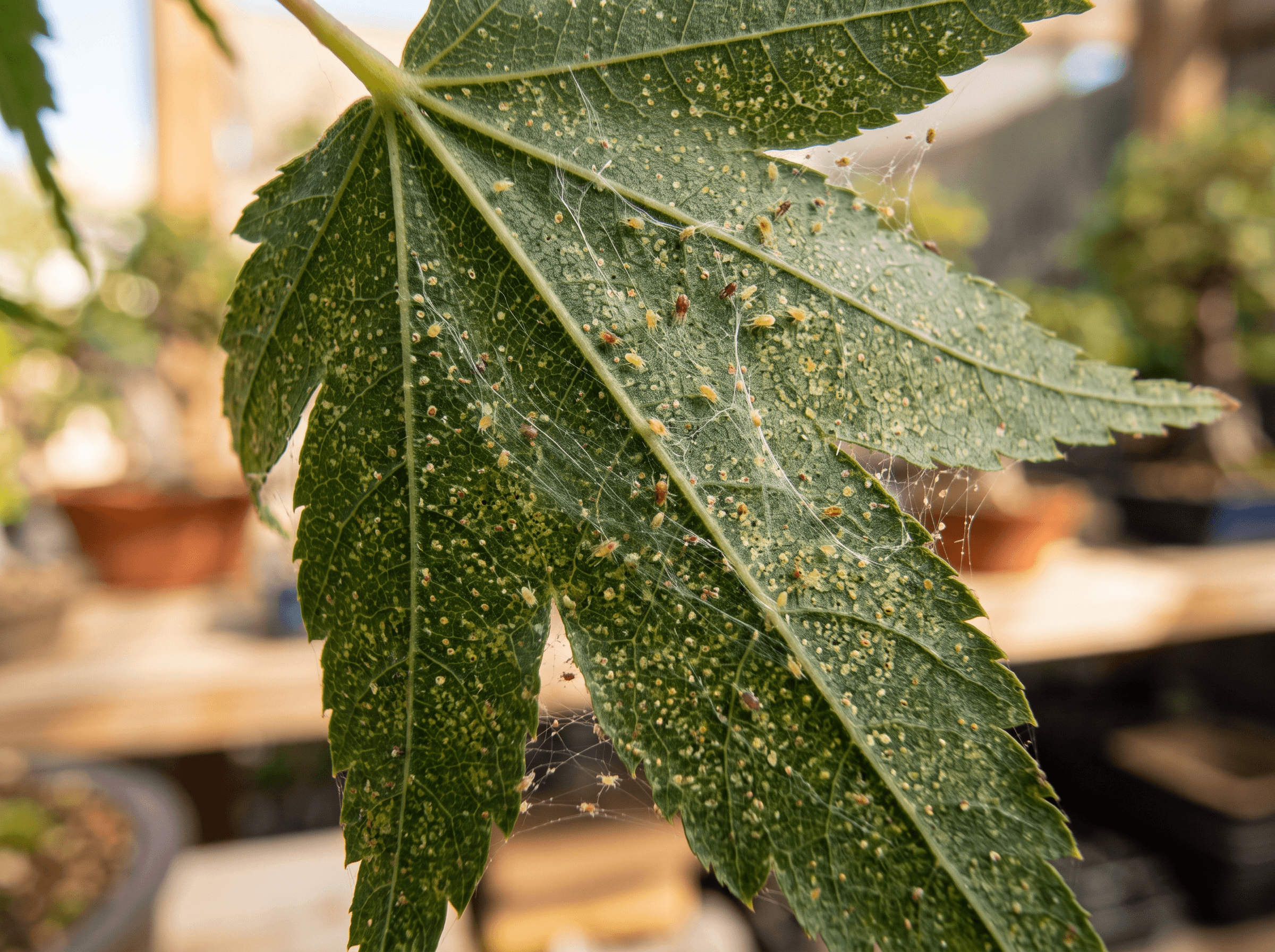
Spider mites are one of the fastest problems to go from unnoticeable to serious on a bonsai, because by the time you can see the damage with the naked eye, the population underneath it is usually already large. They're not insects, they're related to spiders, and they're tiny enough that most people never see the mite itself, only the pale stippled damage and, once numbers build up, the fine webbing that gives them away.
They favour exactly the conditions a lot of indoor and greenhouse bonsai sit in for months at a time, warm air, low humidity, and still air with no wind or rain to disrupt them. Outdoor trees get mites too, especially in a hot dry spell, but it's the trees kept indoors over winter or in a dry conservatory that I see hit hardest, since nothing is knocking the population back naturally.
A light case is easy to miss, a scattering of tiny pale dots on the upper leaf surface that could pass for dust or normal ageing. Left alone, spider mites reproduce fast in warm weather, sometimes a full generation in under two weeks, and a light infestation can become a heavy one, complete with visible webbing and leaves turning bronze or dropping, in a surprisingly short window. This page focuses on spider mites specifically since that's the most common cause of this pattern, with brief notes on two look-alikes at the end.
Likely causes
Spider mites
How to tell: The classic sign is fine, silky webbing strung between branches, leaf stems and along the underside of leaves, paired with a pale, dusty stippling across the leaf surface where the mites have been feeding. To confirm it, hold a sheet of white paper under a branch and tap it firmly, if you see tiny specks land on the paper and then start crawling, those are the mites themselves rather than just dust or debris. Populations build fastest in warm, dry, still conditions, so a heated room in winter or a hot dry stretch outdoors in summer are the times to be checking most often. Left untreated the stippling spreads, leaves take on a bronzed or grey cast, and heavily infested foliage can drop entirely.
The fix: Start by rinsing the whole tree thoroughly under a strong spray of water, focusing on the undersides of leaves where mites concentrate, since this physically knocks a large share of the population off. Raise the humidity around the tree afterward as a supporting step, mites struggle in humid air, but don't rely on humidity alone to clear an infestation that's already established. Follow up with a treatment of neem oil or a miticide labelled for the pest, applied to the point of runoff including leaf undersides and branch forks, always following the product label: patch-test a leaf or two first if you're treating a sensitive species, avoid spraying in full sun or on a drought-stressed tree since oil-based products can scorch foliage under those conditions, and don't combine sulfur and oil treatments unless the label specifically says that's safe. Repeat every five to seven days for at least three rounds, since a single treatment won't reach eggs that hatch afterward, and keep checking with the paper-tap test until you go two consecutive checks with nothing moving.
Mite webbing versus an ordinary cobweb
How to tell: It's worth being able to tell the two apart before you commit to a mite treatment. Mite webbing is fine, close to the plant surface, and strung directly across leaf joints, branch forks and the undersides of leaves, almost like a thin gauze rather than a proper web. An ordinary spider's cobweb, by contrast, is typically a single larger structure in open space between branches or off to one side, built by a spider that's simply using the tree as a support and has nothing to do with plant damage. If you find a web but no stippling on the leaves underneath it and nothing moves when you tap the branch, you're probably looking at a garden spider's web, not an infestation.
The fix: If it turns out to be an incidental cobweb with no stippling and no mites on the tap test, no treatment is needed, just brush it away. If you're unsure, do the paper-tap test on the nearest foliage before treating anything, since spraying miticide for a problem that isn't there is wasted effort and unnecessary chemical load on the tree.
Powdery mildew (look-alike)
How to tell: A white, powdery, almost dusty film sitting on the leaf surface itself, usually favoured by humid, still air with poor airflow rather than the dry conditions mites prefer. There's no webbing and nothing crawls off it on the tap test, it wipes off as a fine white smear rather than moving.
The fix: This isn't a mite problem so miticide won't help. Improve airflow around the tree, remove the worst affected leaves, and treat with a fungicide. The dedicated powdery mildew page on this site covers the fungus and its treatment in much more depth.
Scale insects (look-alike)
How to tell: Small, static brown or white bumps that show up most often on stems and branches but can also appear on leaves, especially the undersides, often with a sticky honeydew residue on the foliage below them. Unlike mites they don't move visibly and there's no fine webbing involved.
The fix: Wipe the bumps off by hand and treat the tree with horticultural oil to smother any that remain. See the dedicated scale insects page for the full treatment approach if this is what you're actually dealing with.
How to prevent it
Spider mites thrive on exactly the conditions that a lot of bonsai sit in unnoticed for months, warm, dry, still air with no natural disruption, so the best prevention is breaking that pattern before it ever builds into an infestation. Rinse the foliage of indoor and greenhouse trees periodically, even when nothing looks wrong, since the spray of water alone keeps early populations from establishing. Keep humidity reasonable around trees that spend winter indoors, and give the air some movement with a small fan or an open window on mild days, mites do far better in dead air than in a breeze. Make the paper-tap test a habit on any tree kept in a warm dry spot, checking every couple of weeks in the growing season and more often during a hot dry stretch, since catching mites while the population is still small is far easier than fighting an established infestation with webbing already showing.
Common questions
How do I know it's mites and not dust?
Tap a branch firmly over a sheet of white paper and watch closely. Dust stays put, mites are tiny specks that start crawling within a few seconds, and that movement is the clearest confirmation you'll get without a magnifying glass.
Why do spider mites show up mostly on indoor trees?
Indoor air, especially in winter with heating running, tends to be warm and very dry with little air movement, which is exactly what mites prefer. Outdoor trees get some natural knockback from rain, wind and humidity that indoor trees don't have.
Will rinsing the tree with water alone get rid of them?
It helps a lot and is worth doing regardless, but on its own it usually isn't enough for an established infestation since it won't reach every egg. Pair it with neem oil or a miticide and repeat over a few weeks for a full clearout.
How can I tell mite webbing from a normal spider's cobweb?
Mite webbing is fine and sits close against leaf joints and branch forks, almost like a thin gauze, and you'll usually find stippled damage on the leaves underneath it. A normal cobweb is a larger, more open structure with no leaf damage nearby and nothing that crawls off when you tap the branch.
Do I need to isolate an infested tree from my other bonsai?
Yes, if possible. Mites spread easily between trees that are close together, especially if branches are touching, so moving an infested tree away from the rest of your collection while you treat it reduces the risk of it becoming a wider problem.
Can spider mites kill a bonsai?
Yes, a severe, untreated infestation can kill a bonsai outright, or weaken it badly enough that another problem finishes the job, particularly on a small tree or one already stressed by other issues. It's rarely a fast death, the decline usually comes through cumulative leaf loss and reduced photosynthesis over a season, but left unchecked it's a genuine threat and not just a cosmetic one.
You might also like
General guidance based on 20+ years of practice. Every tree is different — when in doubt, ask us.