
Pale, washed-out new leaves
New leaves that come in pale yellow-green rather than a healthy colour, while older leaves stay normal, usually point to a nutrient the tree can't access.
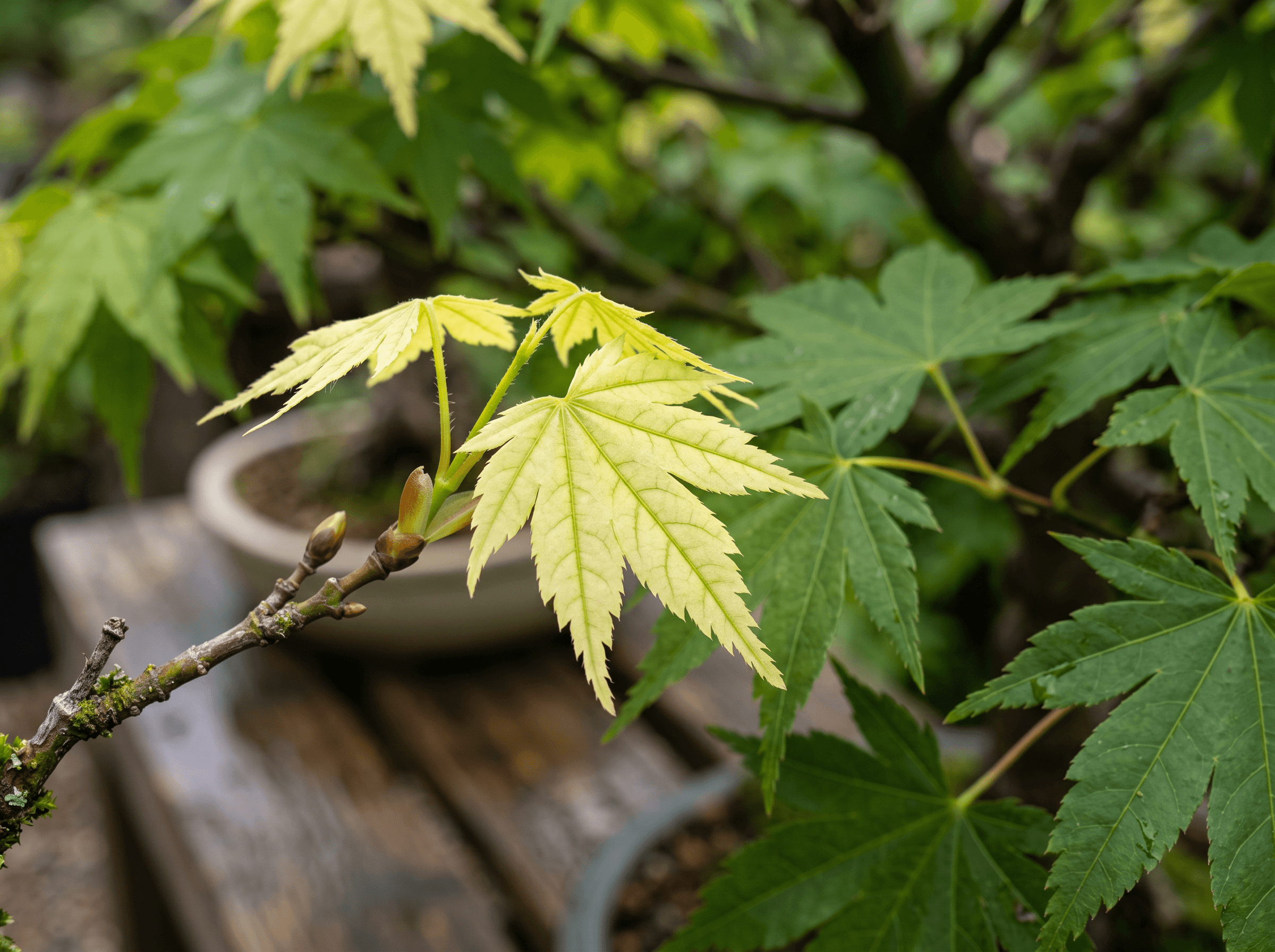
If your bonsai has pale new leaves while the older leaves stay a normal green, you're most likely looking at a nutrient the tree can't access rather than a straightforward watering problem, though it's worth being clear about the difference before you start treating anything. The general yellow leaves page covers older or overall leaf yellowing driven mostly by watering, either too much or too little, and it can affect the whole canopy at once. What I'm describing here is narrower: it's specifically the new growth coming in pale while the older leaves on the same branch look completely fine. That contrast between old and new is a strong lead, though not a certain one, since manganese or sulfur deficiency, overwatering, high pH on its own, low temperature, and root problems can all produce a similar pale pattern without iron being the culprit. A tree that's struggling with watering tends to show stress everywhere. A tree with a nutrient-access problem shows it mostly at the growing tips, because that's where the demand for the missing nutrient is highest, so the old-versus-new contrast is a good starting point rather than a finished diagnosis.
Iron is the classic culprit, and there's a reason for that beyond it just being common. Iron doesn't move well within the plant once it's been used, so the tree can't pull it back out of older leaves and ship it to new ones the way it can with more mobile nutrients like nitrogen or magnesium. Every new leaf has to get its own fresh supply of iron from the roots. If the roots can't take up iron efficiently, whether because there isn't enough in the substrate or because the conditions are wrong for uptake, the newest growth is where the shortage shows up first and worst, and older leaves keep their colour because they already banked what they needed. This is called interveinal chlorosis when it's iron specifically, and it has a fairly recognisable look: the leaf tissue between the veins pales out to yellow-green or even a washed cream colour, while the veins themselves stay a noticeably darker green, like a faint network laid over pale fabric. On a heavily affected leaf the whole thing can look pale, but check a few leaves at different stages and you'll usually catch that vein pattern somewhere.
The reason alkaline soil and hard water come up so often with this symptom is that iron availability is extremely sensitive to pH. In slightly acidic to neutral substrate, iron stays in a form roots can absorb. Push the pH up, which is exactly what happens gradually with hard tap water full of calcium and magnesium carbonates, and the iron that's physically present in the soil locks into a form the roots can't use. So you can have a substrate that isn't actually deficient in iron at all, and still get textbook iron chlorosis, because the tree simply can't reach what's there. That's the trap with this symptom: throwing more fertiliser at it doesn't always help if the underlying issue is pH rather than raw nutrient content, which is why I treat the two separately below.
Likely causes
Nutrient deficiency, often iron, blocked by alkaline soil or hard water
How to tell: The newest leaves at the branch tips come in pale yellow-green, and on a good number of them you can see darker green veins standing out against the paler tissue between them, a pattern that gets more obvious the closer you look. Meanwhile the older leaves lower on the same branch, grown earlier in the season, keep their normal healthy colour. If you've been watering with hard tap water for months or repotted into a substrate that trends alkaline, that's usually the trigger, and it tends to creep in gradually rather than appearing overnight.
The fix: If the tree is otherwise healthy and simply hasn't been fed in a while, a balanced bonsai fertiliser at the normal dose for the species is a reasonable first step. But if the interveinal pattern is clear, greener veins against paler tissue, or you know your water is hard or the substrate trends alkaline, skip straight to testing pH or water hardness and treating the iron access problem directly rather than waiting on a general feed. Not all chelated iron products work the same way here: look for one labelled specifically for alkaline soils. Fe-EDDHA is the chelate that holds up in a soil drench under alkaline conditions, while EDTA-based iron products often fail to work as well once the substrate pH climbs. As a short-term option alongside or instead of a soil drench, a foliar spray of chelated iron applied to the leaves, following the label directions, can green up growth faster while you sort out the underlying pH. Either way, give it a few weeks before judging results, because the correction shows up in leaves that haven't grown yet, not the pale ones already out.
Root problems limiting uptake, even when nutrients are present
How to tell: Paleness in the new growth shows up alongside other signs that the roots aren't functioning well, things like slower than expected growth for the season, a substrate that's stayed soggy for a while, or a tree that's clearly outgrown its pot and become root-bound. In this case the nutrients might well be sitting in the soil in a usable form, but damaged or overcrowded roots simply can't take them up efficiently, so feeding alone doesn't fully solve it.
The fix: Check the roots directly rather than guessing. Ease the tree out of the pot at a sensible point in the season and look for the smell and texture of rot, dark and mushy roots, versus a dense, congested root mass that's simply run out of room. Rot needs pruning back to healthy tissue and a switch to a more free-draining mix; being root-bound needs a proper repot with some root work. Once the roots are functioning again, the paleness in new growth usually clears up on its own over the following flush or two, since the tree can finally move nutrients where they're needed.
Simply under-fed
How to tell: This one is less specific and more about neglect over time: the tree hasn't had a proper feeding in a long stretch. The new leaves aren't the only sign either; the whole tree is growing slowly for the season, with weak extension, small leaves, thin shoots, and poor colour across much of the tree, not just the newest growth. The paleness here tends to be a milder, more general dullness rather than the sharp interveinal pattern you get with a true iron block.
The fix: Get back onto a regular feeding schedule through the growing season, at the dose appropriate for the species and the size of the pot, and stick to it rather than feeding once and waiting to see results. Most bonsai in active growth benefit from feeding every one to two weeks during spring and summer, tapering off as growth slows in autumn. Consistency matters more here than any single strong dose, since a tree recovering from a long gap responds better to steady, moderate feeding than to being caught up all at once.
How to prevent it
The simplest way to avoid this recurring is to keep feeding consistent through the whole growing season rather than in occasional bursts, since a tree that's never actually run short rarely shows this pattern in the first place. If you know your tap water is hard, which is common enough anywhere the local groundwater runs through limestone, it's worth switching to rainwater or a more neutral water source at least some of the time, since the alkalinity that blocks iron uptake builds up gradually with every watering rather than from one bad session. Collecting rainwater isn't practical for everyone, but even alternating it with tap water measurably slows the drift toward a pH that locks iron out of reach. On top of that, get in the habit of checking new growth as it emerges each spring rather than waiting until a tree looks obviously unwell, because catching the first pale flush early means you're correcting a mild issue rather than chasing a tree that's been struggling for a full season.
Common questions
Is pale new growth the same as normal spring colour on some species?
Not quite, though the two can look similar at a glance. Some species, maples in particular, naturally push out lighter, almost translucent new leaves that deepen in colour over the following days or weeks as they mature and toughen. The difference is timing and pattern: normal spring flush colour darkens on its own within a week or two without any intervention, while a true nutrient-access problem stays pale, often with that interveinal vein pattern, and doesn't resolve until you actually correct the feed or the water.
What does iron chlorosis actually mean in plain terms?
It just means the tree isn't getting enough usable iron to build proper chlorophyll in its newest leaves. Chlorophyll is what gives leaves their green colour and does the work of photosynthesis, and iron is a key building block in making it. Without enough available iron, new leaf tissue can't produce full chlorophyll levels, so it comes in pale or yellowish while the leaf veins, which draw on a slightly different supply route, often stay greener for longer.
Why does alkaline soil block iron uptake when the iron is still physically there?
It comes down to chemistry rather than quantity. At a higher, more alkaline pH, iron in the soil converts into a chemical form that plant roots can't absorb, essentially locking it in place even though the total amount of iron in the substrate hasn't changed. This is why simply adding more iron to an alkaline mix often doesn't help much on its own, and why chelated iron products exist specifically to stay absorbable even when the surrounding pH is working against the tree.
How can I tell if my water is too hard for my bonsai?
A cheap aquarium or pool water hardness test strip, sold at most pet shops or garden centres, will give you a quick reading of your tap water's mineral content, and many municipal water suppliers also publish hardness figures you can look up directly for your area. As a rougher clue, if you're getting persistent limescale buildup on kettles, taps, or the surface of your bonsai soil, that's usually a sign the water is hard enough to be worth addressing.
Is paling the same thing as yellowing, or are they different problems?
They overlap but aren't identical, and the distinction matters for diagnosis. Yellowing usually implies a stronger, more uniform colour shift and often affects older leaves as part of general stress, most commonly linked to watering issues. Paling, as covered here, is a lighter, washed-out look concentrated in new growth specifically, frequently with that vein contrast, and it points toward a nutrient-access issue rather than a watering one. If you're unsure which you're seeing, the location on the tree, new growth versus older leaves, is the fastest way to tell them apart.
How long after fixing the feed or water should I expect new leaves to look normal again?
Don't expect the already-pale leaves to green up much, since the correction mainly affects growth that hasn't emerged yet. Once you've adjusted the feed or the water source, watch the next flush of new growth rather than the current one; on most species that's somewhere between two and six weeks depending on how actively the tree is growing at the time. If two full flushes still come in pale, it's worth rechecking the roots, since an uptake problem there can mimic a straightforward nutrient shortage.
You might also like
General guidance based on 20+ years of practice. Every tree is different — when in doubt, ask us.