
Older leaves yellowing while new growth stays green
When it's the oldest, lowest leaves on your bonsai that yellow or brown first while the newest growth at the tips still looks perfectly green, you're usually looking at a mobile nutrient deficiency, most often nitrogen or potassium, not a disease.
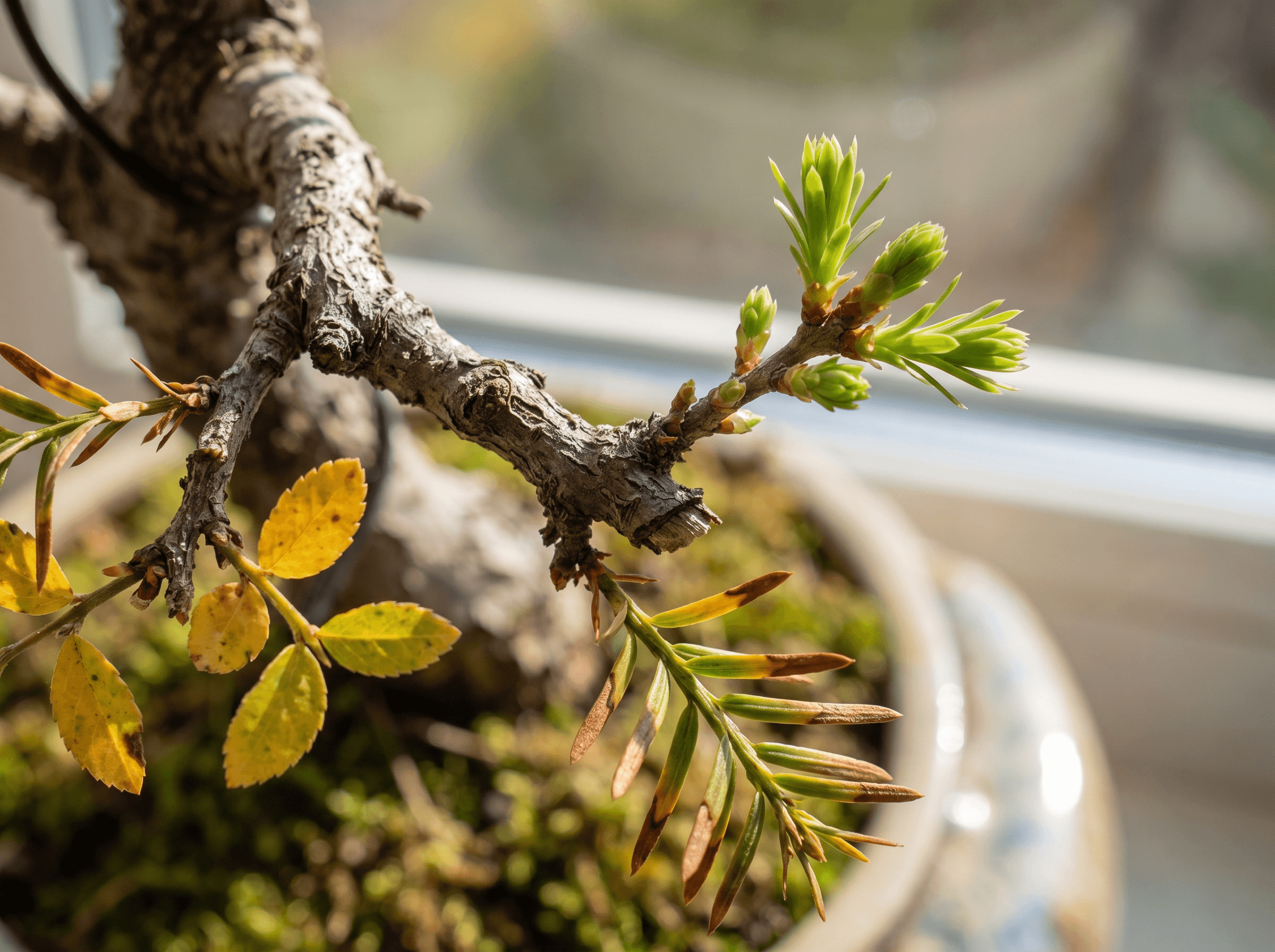
Plants are more resourceful than people give them credit for. Nitrogen and potassium are both mobile nutrients, meaning that when the tree doesn't have enough coming in from the roots, it will actually pull what it does have out of its older leaves and ship it to the newer growth, where it's needed most for active development. The older leaf pays the price and starts to yellow or brown, while the new growth at the tips carries on looking fine, sometimes for weeks, because it's being fed at the older leaves' expense.
This is genuinely useful for diagnosis, because the location of the yellowing tells you a lot. If the damage starts on the oldest, lowest leaves and the newest growth is unaffected, think nitrogen or potassium first. That's a very different pattern from iron deficiency, which shows up on new growth first because iron isn't mobile in the plant, the tree can't relocate it from older tissue the same way. Worth knowing too that magnesium, and less commonly phosphorus, can also start on older leaves, so the old-leaves-first pattern points strongly at a mobile nutrient rather than confirming nitrogen or potassium on its own, and it's worth ruling out normal old-leaf shedding, watering problems, low light, root stress, salt or pH build-up, and pests or disease before you reach for fertiliser. I get asked about this distinction constantly, and once you know to check which leaves are affected first, it's one of the more reliable things you can read off a tree without any testing.
This kind of deficiency is common on bonsai specifically because we grow trees in small volumes of fast-draining soil that gets flushed with every watering, and because we deliberately keep trees on the lean side to control growth. That's a fine strategy up to a point, but a tree that hasn't been fed properly in a long stretch, especially through an active growing season, will start showing it in exactly this pattern.
Likely causes
Nitrogen deficiency
How to tell: Older, lower leaves yellow fairly evenly across the whole leaf, not in the blotchy pattern between the veins that you'd see with iron chlorosis, while the newest growth at the tips stays a normal healthy green. Growth overall may also be slower and thinner than you'd expect for the season. This is most common on a tree that hasn't had regular fertiliser in a long time, or one that's been repotted into fresh, nutrient-poor soil without a follow-up feeding schedule.
The fix: Resume regular feeding with a balanced or nitrogen-forward fertiliser through the growing season, following the label dose rather than guessing, since overcorrecting with too much nitrogen causes its own problems, weak, leggy growth and poor autumn colour on deciduous species. If the tree was recently repotted, hold off until it's clearly back in active growth before resuming feeding, rather than fertilising a still-recovering root system. A liquid feed applied every one to two weeks, or a slow-release solid fertiliser refreshed through spring and summer, both work well. You should see new growth continue looking healthy and, over a few weeks, the yellowing on older leaves stop progressing, though the already-yellowed leaves themselves usually don't turn back green.
Potassium deficiency
How to tell: Older leaves show yellowing or browning that starts at the edges and the tip rather than spreading evenly across the whole leaf, sometimes leaving the centre of the leaf still green while the margin browns and can look scorched. This pattern can show up on trees fed for a long stretch with a fertiliser that's heavy on nitrogen relative to potassium, an imbalance worth checking for on the label rather than assuming any bonsai feed has the ratio covered.
The fix: Switch to a fertiliser with a fuller potassium ratio rather than continuing on a nitrogen-heavy feed, checking the N-P-K numbers on the label rather than assuming any bonsai fertiliser covers it. Potassium supports overall vigour, root development, and resistance to stress, so correcting a deficiency here often improves more than just the leaf colour. As with nitrogen, expect the correction to show up in new growth and in a halt to further yellowing on older leaves rather than a reversal of leaves already damaged.
General under-feeding or poor root uptake
How to tell: The pattern matches nitrogen or potassium deficiency, oldest leaves affected first, new growth unaffected, but it's happening on a tree that is actually being fed on a reasonable schedule. This points less at what you're applying and more at whether the roots can take it up, which can happen with compacted soil, a pot-bound root system overdue for repotting, or soil that's staying too wet or too dry between waterings.
The fix: Check the root situation before assuming the fertiliser itself is the problem, root-bound and compacted soil are common culprits that block nutrient uptake even when feeding is adequate. Only keep feeding if the tree is actively growing and the roots are clearly functioning; if the soil is waterlogged, compacted, foul-smelling, or the tree looks like it's collapsing rather than simply under-fed, sort out drainage and root health first and hold off on fertiliser until that's resolved. If the tree is due for a repot once it's stable, that's often the real fix. Once the tree is in active growth again, a diluted liquid feed applied more frequently at a lower dose can get some nutrition to a recovering root system more reliably than a single strong feeding that mostly runs straight through poor soil.
How to prevent it
Most cases of this come down to a tree simply not being fed enough for how it's grown, in a small pot with fast-draining soil that doesn't hold nutrients the way garden soil does. Set up a regular feeding schedule through the growing season rather than feeding sporadically, and use a fertiliser with a balanced N-P-K ratio unless you have a specific reason to lean one way, like pushing foliage growth early in the season versus building strength before winter. Get in the habit of glancing at the oldest leaves on the tree every couple of weeks during spring and summer, since catching this early means correcting it before it spreads further up the canopy. Repotting on a normal schedule for the species also matters here, since a root-bound tree can show nutrient deficiency symptoms even when you're feeding it correctly, simply because the roots can't take up what you're giving it.
Common questions
How is this different from the pale new growth caused by iron deficiency?
Location is the key difference. Iron deficiency shows up on the newest leaves first, often with the leaf veins staying green while the tissue between them turns pale, because iron can't be moved from older tissue. This nitrogen or potassium pattern is the opposite, oldest leaves affected first while new growth stays green, because nitrogen and potassium are mobile and get pulled from old leaves to feed new ones.
How do I tell nitrogen deficiency from potassium deficiency on the same tree?
Nitrogen deficiency tends to produce fairly even yellowing across the whole older leaf. Potassium deficiency tends to start at the leaf margin and tip, sometimes leaving the centre still green, giving a scorched-edge look. It's not always perfectly clean-cut, but that's the general pattern to look for.
Is it worth doing a soil test to confirm which nutrient is missing?
For most home growers, no, a home soil test kit isn't precise enough to be worth the trouble, and the visual pattern combined with adjusting your feeding is usually enough to sort it out. If you're managing a large, valuable collection and want more certainty, a proper lab soil test is the way to go rather than a consumer kit.
How long after I start feeding will I see improvement?
During active growth, new growth usually shows the benefit within a few weeks of regular feeding, looking noticeably more vigorous. Outside the growing season, or on a weak or recently repotted tree, it can take considerably longer. The already-yellowed older leaves generally don't recover their colour, since the nutrients were withdrawn from them rather than the tissue simply lacking access, but the yellowing should stop spreading to leaves further up the branch.
Can I use the same fertiliser for both nitrogen and potassium deficiency?
A well-balanced, complete fertiliser covers both in most cases. If you've confirmed the pattern points specifically to potassium, a feed with a higher potassium ratio relative to nitrogen will correct it faster than a generic foliage-growth formula.
Does this happen more in certain seasons?
For outdoor, temperate species it's most noticeable during the growing season, spring through summer, when the tree's demand for nutrients is highest and any shortfall shows up fastest. A tree that goes into winter already under-fed often shows the worst symptoms right as growth resumes in spring. An indoor, tropical bonsai growing steadily through winter doesn't have the same dormancy, so it can show the same pattern at any time of year if feeding lapses.
You might also like
General guidance based on 20+ years of practice. Every tree is different — when in doubt, ask us.