
Bonsai leggy growth: weak, thin new shoots
Long, thin, pale shoots with wide gaps between leaves usually mean the tree is stretching for light it isn't getting enough of.
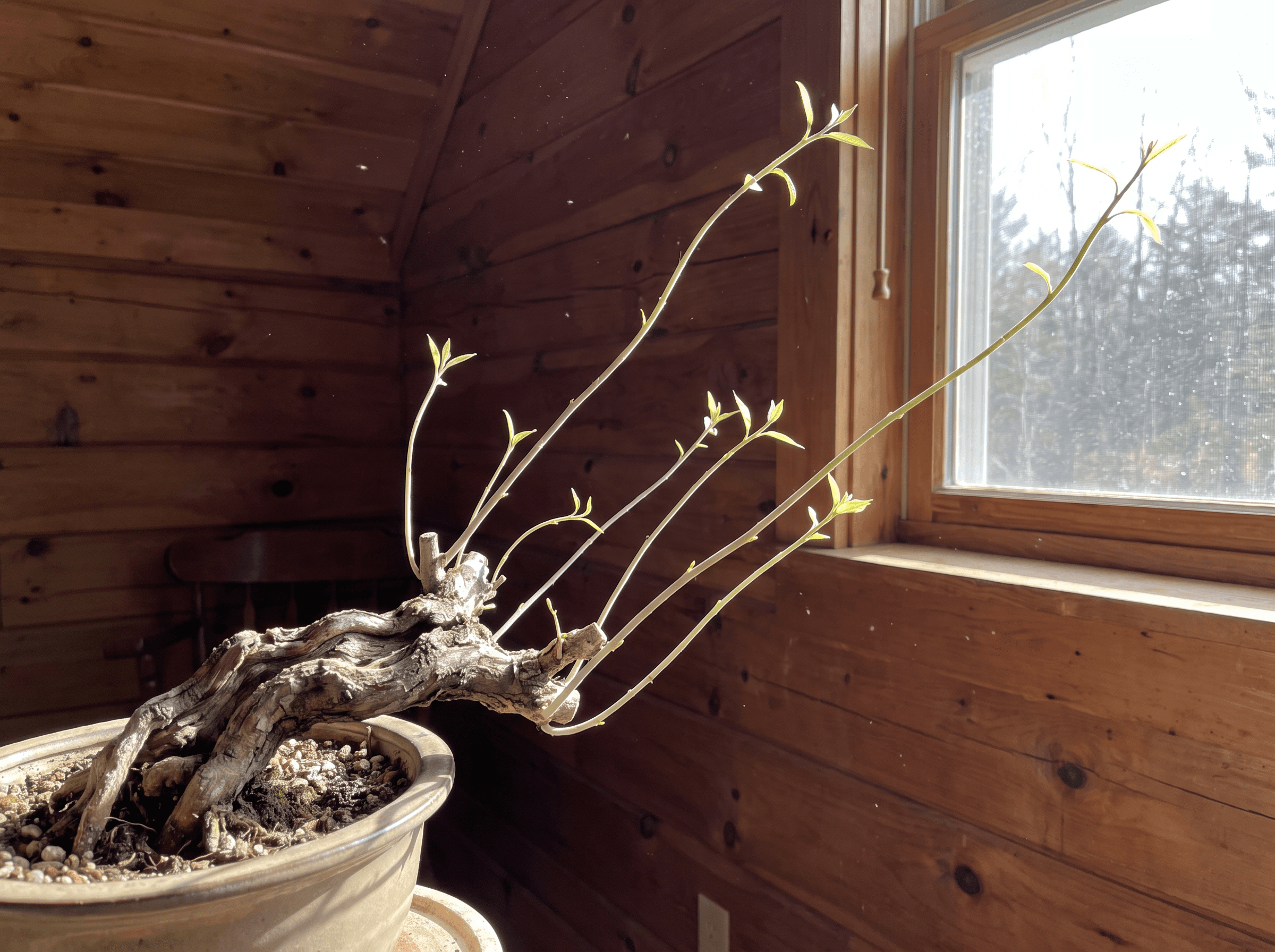
The technical word for this is etiolation, and once you've seen it a few times you recognise it instantly: internodes noticeably longer than normal for that tree or species, leaves smaller and paler than the rest of the canopy, and stems so thin they flop under their own weight. It's the tree's own hormone system working against you. Auxin, the growth hormone concentrated at the shoot tip, accumulates more heavily in low light and pushes cells to elongate faster than they can thicken, so you get length without the strength to support it.
I see this most on trees brought indoors for winter, on cuttings and young stock kept on a windowsill that feels bright to us but is nowhere near bright enough for a plant, and on deciduous species pushing their first spring flush in a room rather than outside. Worth flagging directly here: temperate deciduous trees, pines, junipers and most other outdoor bonsai should not be wintering indoors at all. Those species need real seasonal dormancy outside in the cold, and keeping one in a warm, dim room through winter is a cultivation error in its own right, separate from ordinary legginess, even though stretched growth is often the first visible sign that the tree is in the wrong place. It's also worth telling etiolation apart from ordinary vigorous growth, which isn't as simple as checking internode length alone, since a tree pushed hard with sun and feed can still throw long internodes that need pruning for control. The real distinction is in the whole shoot: etiolated growth is pale, weak, sparse and leaning toward the light source, while healthy vigorous extension is better coloured and sturdier even though it may also need cutting back to keep the branch structure tight.
For bonsai specifically this matters more than it would for a garden shrub, because ramification, the fine branching structure you spend years building, depends on short internodes. Growth pushed out under low light doesn't just look weak now, it sets the spacing for that section of branch permanently. You can prune it back, but the node it grew from is already there, and if you're not careful you end up with a coarser branch structure than the rest of the tree, which shows for years afterward.
Likely causes
Insufficient light
How to tell: New growth is noticeably longer and thinner than normal, with big gaps between leaves, and it often leans or curves toward whichever window or gap in the canopy the light is coming from. Leaf colour on this new growth tends to run pale or yellowish rather than the deep green of older leaves, and the stems feel soft and bend easily instead of holding their shape.
The fix: Move the tree to the brightest spot you have, and outdoors that usually means as close to full sun as the species tolerates rather than dappled shade under a tree or a wall. Rotate the pot a quarter turn every few days if the light is coming from one direction, otherwise you just relocate the lean rather than fix it. For trees that have to stay indoors through the colder months, a proper grow light run for ten to twelve hours a day makes a real difference, ordinary room light from a window almost never gets close to what the tree needs even on a bright-looking sill.
Too much nitrogen, too little light
How to tell: The tree is on a regular, generous feeding schedule but is kept in a spot that's dim relative to what the species wants, and the new growth it produces is soft, leggy and disproportionately leafy compared to the rest of the tree. It's a combination I see a lot with well-intentioned owners who feed on a strict calendar without adjusting for where the tree actually lives.
The fix: Match the feed to the light, not to the calendar. If a tree is indoors or in partial shade, cut nitrogen back significantly, feeding it as if it were half-dormant, because nitrogen without the light to put it to use just manufactures more of the same weak, stretched growth you're trying to get rid of. Once the tree is back in strong light you can return to a normal feeding schedule, and you'll notice the difference in the growth almost immediately.
Self-shading from a dense outer canopy
How to tell: The leggy growth isn't spread evenly over the tree, it's concentrated on interior or lower branches while the outer canopy looks compact and healthy. This is a different mechanism from general low light: the tree itself is blocking the light from reaching its own inner structure, which is common on trees that haven't been thinned in a while, especially maples, elms and other dense-leaved species.
The fix: Thin the outer canopy rather than moving the tree, since the light in the room or the garden spot may already be adequate and the problem is purely structural. Remove crossing branches and excess leaf pairs on the outer perimeter so light can actually reach the interior, and do this as routine maintenance a couple of times through the growing season rather than only once things have gotten leggy inside.
How to prevent it
Give the tree the brightest light the species can genuinely tolerate rather than the brightest spot that's convenient for you. Increase light gradually rather than abruptly, especially when moving a tree that's spent winter indoors back outside, and protect heat- or sun-sensitive species, along with any indoor-grown foliage, from harsh direct sun until it has had a couple of weeks to acclimate. Keep feeding proportional to what the tree can actually use: a tree in strong light through the growing season can handle a full feeding schedule, but the moment it goes into a dimmer spot, indoors for winter or under a shadier part of the garden, the feed needs to drop with it. And build regular thinning into your maintenance routine so the canopy never gets dense enough to shade its own interior. That kind of self-shading is still a light problem in the end, it's just caused by the tree's own structure rather than where you've placed it, and a lot of the leggy growth I get asked about turns out to be exactly that: a tree that hasn't been opened up in too long.
Common questions
Should I prune the leggy growth?
Yes, once you've corrected the light. Cut the stretched shoots back to a healthy node close to where normal growth resumes, since leaving them doesn't help the tree and just locks in wide internode spacing you'll have to work around later. Pruning before fixing the light just gets you another round of the same weak growth, so address the cause first and prune second.
What does etiolation actually mean?
It's the botanical term for the stretched, pale growth a plant produces when it doesn't have enough light. The plant's hormone system pushes cells to elongate rapidly in search of brighter conditions, at the cost of leaf size, stem thickness and chlorophyll production, which is why the growth looks long, thin and washed out rather than compact and dark green.
Will this permanently affect the trunk or branch ramification?
The internode spacing on that particular section of growth is set once it hardens off, so yes, in the sense that pruning back doesn't erase the coarser structure that grew there. It's rarely a disaster on a young or developing tree, since you can prune into it and build finer ramification from the buds further back, but on a branch you were counting on for fine detail it does set you back a season or two.
Is this more of an indoor or outdoor problem?
It's overwhelmingly an indoor problem, or at least a low-light problem, and most of the cases I'm asked about involve trees kept inside through winter. Outdoor light, even on an overcast day, is typically many times stronger than the brightest spot in an average house, so a tree that looks fine outdoors can start stretching within weeks of coming inside.
Which species stretch the most easily?
Fast-growing, naturally vigorous species like ficus, privet and elm tend to show it quickest simply because they push new growth constantly and will do it in whatever light is available. Slower growers like most pines and junipers stretch too under poor light, but you generally notice it later, since their growth rate is already modest to begin with.
How much light does a bonsai actually need?
As a rough guide, most species that tolerate full sun outdoors want several hours of direct sun a day, and even shade-tolerant species need considerably brighter conditions than a typical indoor room provides. If you're keeping a tree indoors, treat a grow light as standard equipment rather than a fallback, because natural window light alone is very rarely enough through a full growing season.
You might also like
General guidance based on 20+ years of practice. Every tree is different — when in doubt, ask us.