
How to Prune a Bonsai Tree for Beginners
Beginner pruning goes wrong less from bad technique and more from cutting too much, too fast, without stepping back to look at the whole tree.
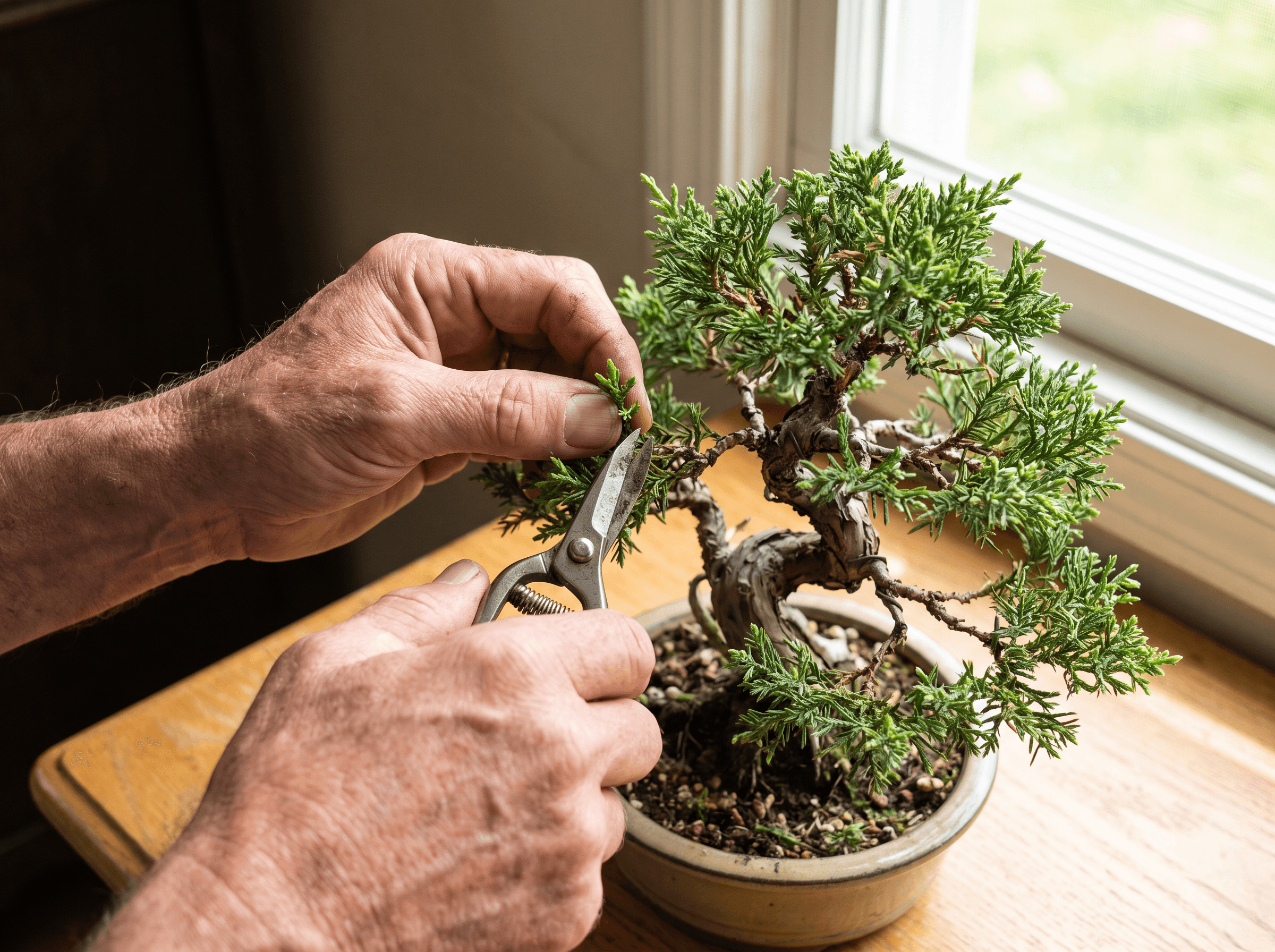
Nearly every beginner I've mentored has the same instinct on their first real pruning session: shears in hand, they start cutting and don't stop until the tree looks tidy. I understand the urge. But a bonsai isn't a hedge, and tidy isn't really the goal. The goal is a tree that keeps growing well and gets better shaped over years, not one perfect afternoon.
The good news is that most of what you'll do as a beginner is maintenance pruning, which is low-risk, forgiving, and something the tree barely notices if done reasonably. It's the light, regular trimming that keeps a tree's silhouette in check and encourages it to branch out finer over time. Heavier structural work, actually reshaping the tree, is a separate skill for later, and mixing the two up is where most early mistakes happen.
What follows is the process I actually walk beginners through on their first trees: where to cut, how much, and how to avoid the single most common beginner error, which is losing sight of the whole tree because you're staring at one branch.
Start with maintenance pruning, not structural cuts
As a beginner, almost everything you do should be maintenance pruning: pinching back new shoots and trimming fresh growth to keep the silhouette you already have, rather than removing branches or changing the tree's design. Maintenance pruning is done throughout the growing season and, kept moderate on a healthy tree, is generally low-stress for it. Structural pruning, cutting off a whole branch or reducing the trunk, is heavier work with real consequences if timed or executed badly, and it's worth holding off on until you've spent a season or two just getting comfortable with a pair of shears in your hand.
Always cut just above a node or bud
Every cut should land just above a node or a healthy bud, not in the middle of an internode. Cutting mid-internode leaves a bare stub with no growth point, which usually dies back to the next node anyway, just messier and slower. Look at the direction the bud is facing before you cut, too, since that's the direction the new shoot will grow, and on a tree you're trying to keep compact and balanced, an outward-facing bud is usually what you want.
Step back and look at the whole tree, not just the branch in front of you
This is the habit that separates careful beginners from ones who overcut. It's easy to get absorbed in one branch, decide it needs three or four cuts to look right up close, and only notice afterward that you've hollowed out that whole side of the canopy. Every few cuts, put the shears down, step back a couple of metres, and look at the tree as a whole shape rather than a collection of individual branches. I do this constantly even after twenty years, because it's astonishingly easy to lose the forest for the twig.
Less is more, especially early on
A beginner's most common mistake isn't a bad cut, it's too many good cuts made in one sitting. Removing a large amount of foliage at once stresses the tree and can knock back growth for the rest of the season, particularly on a tree that isn't fully established or vigorous yet. If you're unsure whether to make a cut, it's almost always safer to leave it for the next session than to take it now and regret it. You can always cut more later. You can't put a branch back.
Use sharp, clean tools
Dull shears crush the stem instead of shearing it cleanly, which bruises the tissue around the cut and slows healing, sometimes leaving an entry point for disease. Keep your bonsai shears sharp and wipe the blades clean between trees, especially if you've been working on something that showed any sign of pest or fungal trouble. It sounds like a small detail, but a clean, sharp cut heals faster and looks better within weeks, while a crushed one can sit there looking ragged for a whole season.
Common questions
How much of a bonsai can I safely prune at once?
As a rough guide for a healthy, vigorous tree, avoid removing more than about a third of the foliage in a single session, and less than that if the tree isn't strongly vigorous. Treat this as a general benchmark rather than a hard rule for every species and condition. Maintenance trims of new growth are lower risk than removing established branches, so the limit really depends on what kind of cutting you're doing.
What tools do I actually need to start pruning bonsai?
A decent pair of bonsai shears covers most beginner maintenance pruning. You don't need a full tool roll on day one. Concave cutters and knob cutters become useful once you start doing heavier structural work, but they're not essential for basic upkeep.
Should I seal the cuts when I prune?
Small maintenance cuts on most species heal fine without sealant. Larger structural cuts generally benefit from cut paste to reduce infection risk and help the wound callus over, though this varies by species: some conifers, like larch, callus well on their own and don't strictly need it, so it's worth checking the guidance for your specific tree rather than assuming every conifer needs sealing.
How do I know if I've pruned too much?
The tree may push little to no new growth for the rest of the season, foliage can look sparse and stressed, and in more serious cases branches can die back further than you cut. If that happens, stop pruning entirely and let the tree recover before doing anything else.
Can I prune a bonsai any time of year?
Light maintenance trimming during active growth is generally fine for most species. Heavier structural work is more time-sensitive and species-dependent: deciduous trees are usually best cut hard in late winter or early spring before growth starts, while major work on conifers and other evergreens is often better timed for autumn or winter instead. Flowering species have their own windows tied to bud set, so it's worth checking the specific species before making a big structural cut.
Why do my cuts keep dying back further than where I cut?
This usually means the cut landed mid-internode instead of just above a node or bud, leaving a stub with no growth point nearby. A dull tool crushing the tissue can also contribute to poor healing. Recut cleanly just above the nearest healthy node next time.
Is pinching the same thing as pruning?
Pinching is a lighter form of maintenance pruning, done with your fingers on soft new growth rather than shears. It's the standard method for pines and many junipers, while most other species are more commonly trimmed with scissors instead, so which one you reach for depends partly on the species in front of you.
You might also like
General guidance based on 20+ years of practice. Every tree and every climate is different — when in doubt, ask us.