
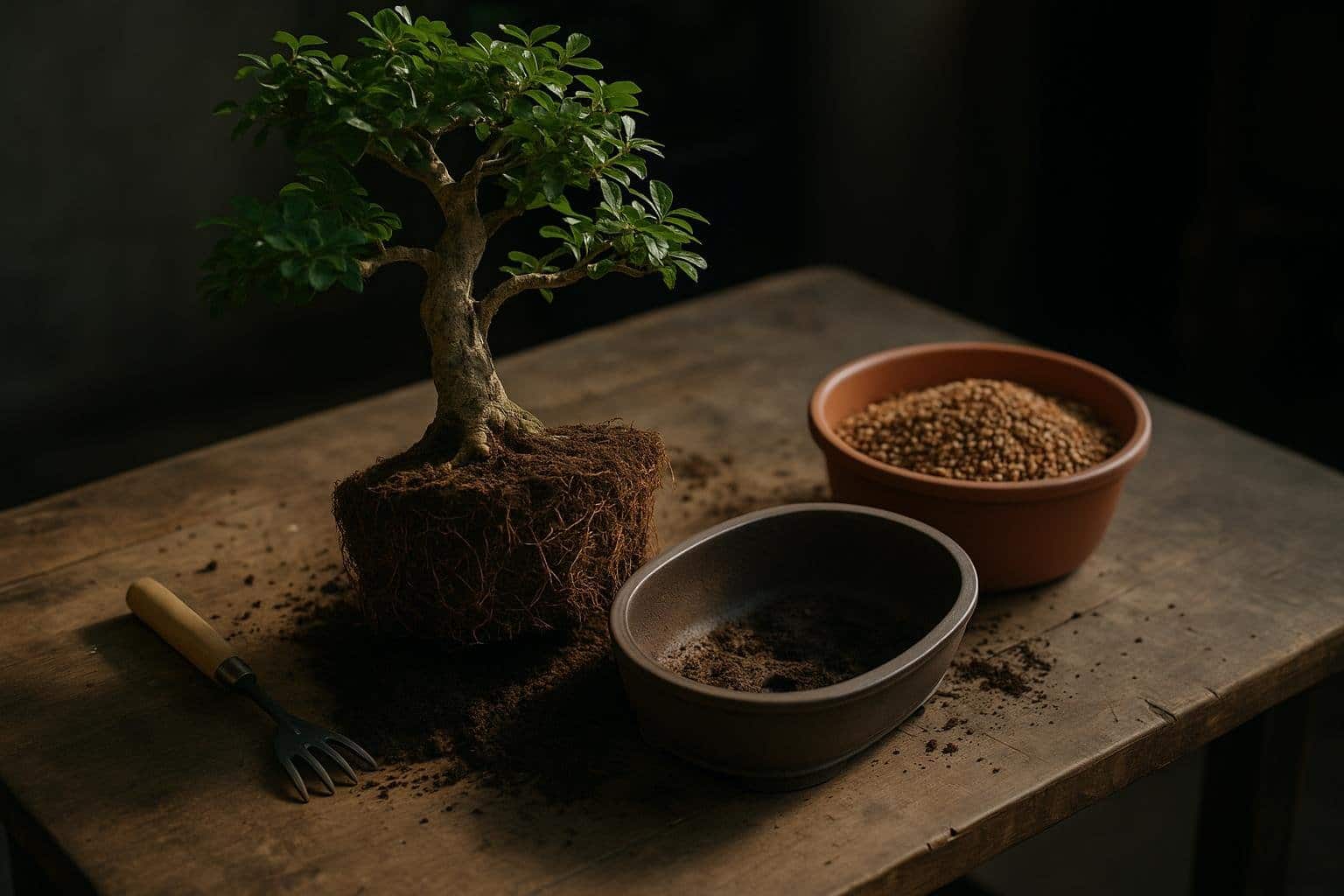
Repotting a bonsai is one of the most important operations in the cultivation calendar. A well-repotted tree starts the spring with energy. A poorly repotted tree can lose months of growth or, in the worst cases, fail to recover. After more than twenty years growing bonsai in Southern Italy, I have learned that repotting is not a calendar operation but a response to what the tree itself asks for.
Repotting renews exhausted substrate, controls root growth, and maintains overall root health. Without repotting, roots fill the pot, drainage degrades, and the tree starts to suffer.
This article covers when I repot, how I choose substrate, and the mistakes I see beginners make again and again.
When to repot a bonsai
The ideal moment to repot is late winter, when buds start to swell but have not opened yet. The roots are about to resume activity but the canopy is not yet drawing on reserves.
In Southern Italy this means late February through mid-March for deciduous species, and March through April for conifers. Mediterranean species like olive and juniper can be repotted even later, into early May.
Frequency depends on age. Young bonsai in development repot every 1-2 years. Mature bonsai in display pots go 3-5 years. Conifers generally need longer cycles than deciduous trees.
How to tell a bonsai needs repotting
The clearest signal is drainage. If water takes more than thirty seconds to drain through the pot, roots have saturated the substrate. When that happens, repotting is urgent.
Another signal is how fast the substrate dries. A pot that dries too quickly indicates exhausted substrate where roots have consumed the matrix.
Roots emerging from drainage holes are a third clear sign. The root mass has filled the pot and is looking for space outside.
The right substrate for bonsai repotting
My standard mix uses three components: akadama, pumice, lava. For deciduous trees I use about 50% akadama, 30% pumice, 20% lava. For conifers I reduce akadama to 30% and increase pumice to 40%.
Akadama holds moisture in a controlled way and breaks down slowly. Pumice gives drainage and aeration. Lava adds structure and long-term stability.
Particle size matters. Small pots use 2-4 mm granules. Medium pots 4-6 mm. Large pots up to 8 mm. Fines and dust must be sieved out before use.
Step by step
I lift the tree from the pot carefully. With a root rake I comb the roots, removing old substrate from the outside of the root mass.
I cut long and damaged roots. Generally I reduce root mass by a third for young trees and a fifth for mature bonsai.
I prepare the new pot with mesh on the drainage holes and a layer of coarse pumice at the bottom. Then I position the bonsai and fill with substrate.
I water thoroughly until clean water comes out of the holes. For more on Mediterranean care, see olive bonsai care.
What to do after repotting
After repotting I keep the tree in semi-shade for two to three weeks. New roots are fragile. Fertilization is suspended for at least a month.
Watering must be measured. Fresh substrate and reduced roots mean lower water demand.
After a month, fertilization and full sun resume gradually.
Common repotting mistakes
The first mistake is repotting at the wrong time. Summer or autumn repotting can kill the tree.
The second mistake is cutting too much root. Excessive root pruning weakens.
The third mistake is non-draining substrate. Peat or garden soil mixes betray within months.
I also often see repotting done without wiring the tree into the pot. An unanchored tree moves at the first strong wind and the new roots break.
Frequently asked questions
Can I repot in summer?
Better not. Roots do not regenerate well in summer heat.
How long for a bonsai to recover from repotting?
Generally three or four weeks for early signs of recovery.
Should I fertilize right after repotting?
No. Wait at least three or four weeks.
Can I reuse the same pot?
Yes if the tree does not need a different one. Clean it and renew the substrate completely.
How do I anchor the bonsai in the new pot?
With aluminum wire passed through the drainage holes and secured around the base.

Roberto Liccardo is a bonsai artist and nurseryman based in Calabria, Italy, with over 20 years of hands-on experience in bonsai cultivation, styling, and sourcing. He travels to Japan to select trees directly from specialist growers and runs WeBonsai, an online nursery shipping handpicked bonsai across Europe. Passionate about both the living art of bonsai and the technology that brings it to a wider audience, Roberto combines traditional Japanese techniques with a modern approach to e-commerce, packaging, and customer care.
He is also a member of Bonsai Calabria, where he actively contributes to the association’s digital presence by managing its websites and online communication.