
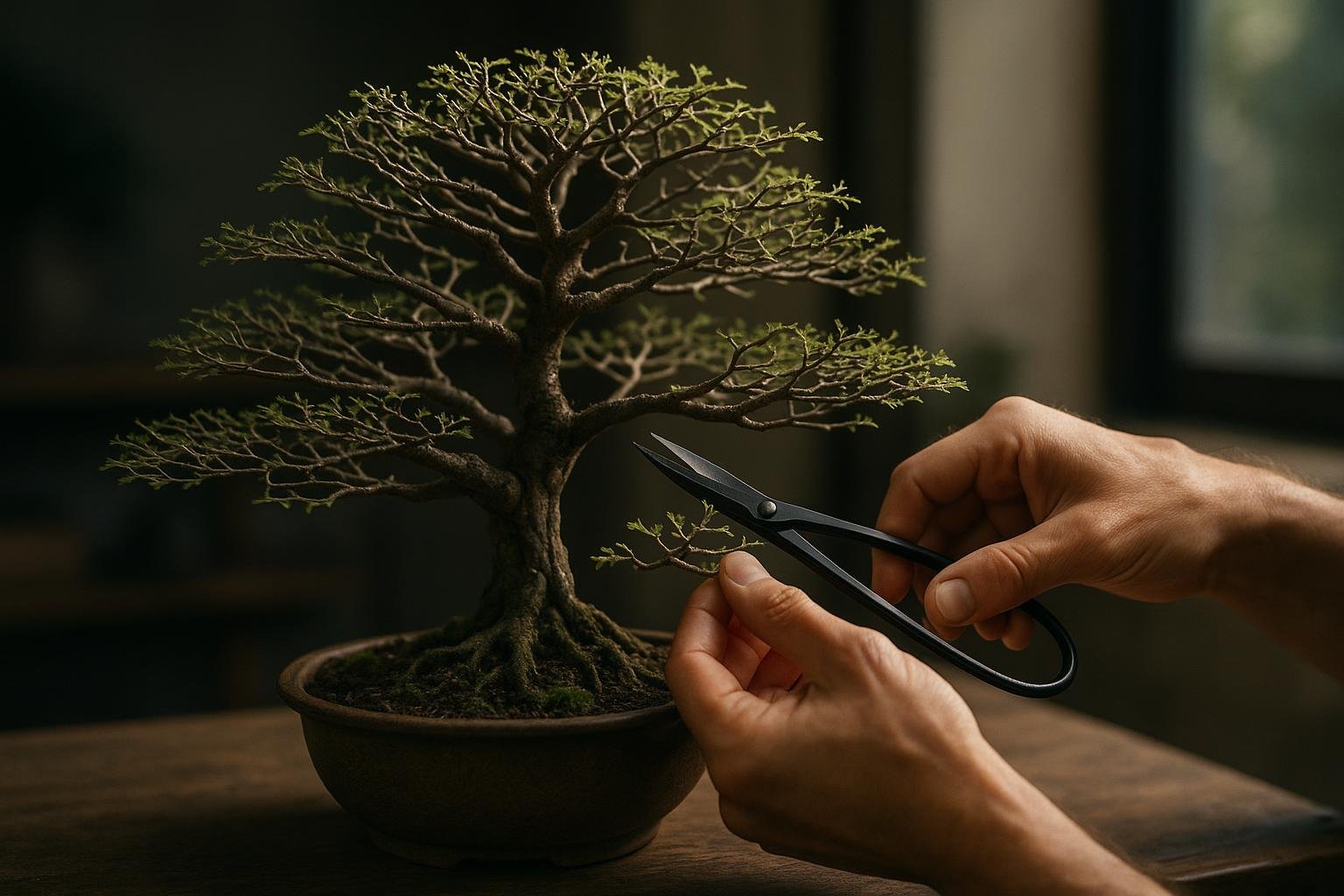
Fine bonsai ramification is one of the qualities that separates a young plant from a mature bonsai. A bonsai with dense, fine branching has the authentic look of an ancient tree. Without good ramification, even the best trunk remains only a promise.
After more than twenty years growing bonsai in Southern Italy, I have learned that bonsai ramification is not built in a season. It requires years of targeted intervention, patient pruning, and careful reading of the tree.
This article covers how I achieve fine ramification, which techniques I use, and which species respond best.
What is fine bonsai ramification
Ramification is the structure of secondary and tertiary branches of the bonsai. The denser and finer it is, the more natural and mature the canopy looks.
A bonsai with few thick branches looks young. A bonsai with many fine branches feels like an ancient tree scaled down.
Fine ramification is achieved by stimulating the tree to push secondary shoots through repeated pruning. Each cut forces the plant to produce new branches.
When to intervene for bonsai ramification
The main pruning window varies by species. For deciduous broadleaves like elm and hornbeam, spring after the first leaf emission is ideal.
For conifers like pine and juniper, summer or early autumn is preferable. Growth is calmer and ramification develops in balance.
Pruning too early weakens. Pruning too late, in autumn or winter, does not stimulate second emission.
Maintenance pruning technique
I use thin sharp scissors to cut new shoots to the right length. Generally I leave two or three internodes on shoots being developed.
The cut must be made just above an internode, so the plant responds by emitting buds from that node.
Pinching soft shoots is a more delicate variation, used especially on sensitive species like Japanese maple.
Defoliation as a stimulus
Total or partial defoliation is another tool for stimulating ramification. By removing the leaves of a branch, the tree is forced to emit new shoots with smaller leaves and denser branching.
It works very well on elms, trident maples and hornbeams. On the Chinese elm, partial spring defoliation produces a much more ramified vegetation in weeks.
On pines and junipers, defoliation is not done. For these species, candle pinching replaces the function.
Exposure and fertilization
Good bonsai ramification cannot be achieved without a tree in full health. Full sun, air circulation, and balanced fertilization are prerequisites.
A bonsai in shade produces long shoots with few internodes. Intense light shortens internodes.
For Mediterranean care details, see olive bonsai care.
Common ramification mistakes
The first mistake is pruning too early. A young plant still building up needs to let branches grow long to thicken the trunk.
The second mistake is uniform pruning. The most vigorous zones must be pruned more drastically.
The third mistake is ignoring overall health. A weak tree does not respond to pruning with second emission.
Frequently asked questions
How many years for good ramification?
Depends on species. On a vigorous Chinese elm, two or three years gives discrete ramification. On a pine, five or six years minimum.
Can I ramify a bonsai in autumn?
Autumn pruning does not stimulate ramification.
How do I know my pruning worked?
Between ten days and four weeks you should see new buds emerging near the cut.
On which species is defoliation most effective?
Chinese elm, trident maple, hornbeam, zelkova.
Should I fertilize more during ramification?
No. Standard balanced fertilization is enough.

Roberto Liccardo is a bonsai artist and nurseryman based in Calabria, Italy, with over 20 years of hands-on experience in bonsai cultivation, styling, and sourcing. He travels to Japan to select trees directly from specialist growers and runs WeBonsai, an online nursery shipping handpicked bonsai across Europe. Passionate about both the living art of bonsai and the technology that brings it to a wider audience, Roberto combines traditional Japanese techniques with a modern approach to e-commerce, packaging, and customer care.
He is also a member of Bonsai Calabria, where he actively contributes to the association’s digital presence by managing its websites and online communication.