
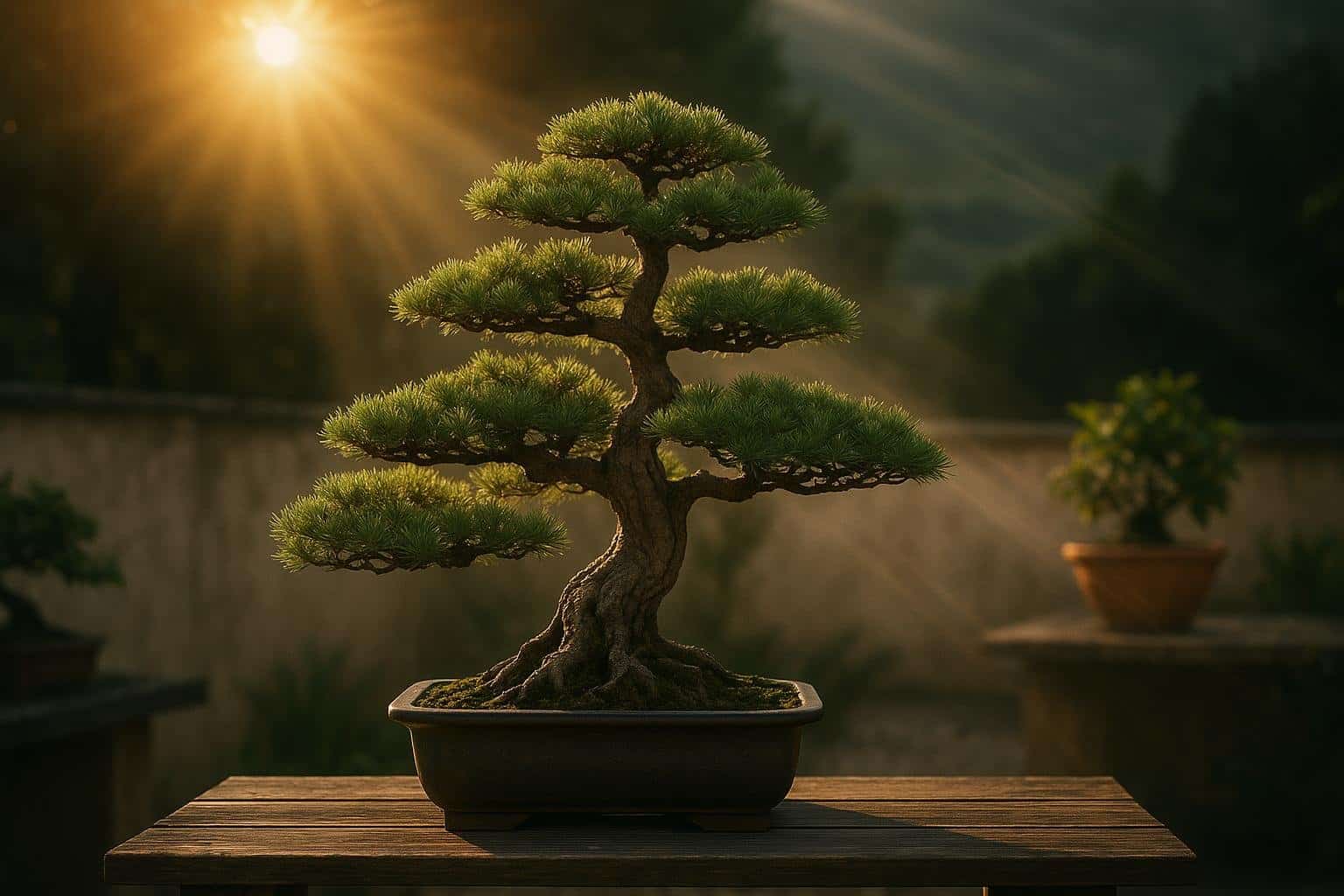
Bonsai summer placement is one of the most important decisions of the cultivation year. A well-placed tree handles summer without problems. A poorly placed tree can lose leaves, burn needles, or suffer severe water stress.
The Mediterranean climate of the South imposes specific choices. Sun hours are many, intensity is high, and dry wind accelerates evaporation. Not every species tolerates summer full sun.
This article covers how I distribute my trees in summer, which species I leave in full sun and which I protect.
Why bonsai summer placement is critical
The bonsai lives in very little substrate. In summer, a small root mass must support an entire canopy and very high transpiration.
Poor placement can cause leaf burn, dehydration, leaf drop. Damage often is not immediate; it shows after weeks of accumulated stress.
Good placement instead lets the tree grow well and build reserves for autumn and winter.
Which species tolerate full summer sun
Olive, juniper, Japanese black pine, and maritime pine tolerate Southern Italy summer sun well. They have evolved precisely for these conditions.
Pomegranate and hawthorn handle full sun if watered regularly.
Chinese elm and zelkova also tolerate sun, but their more delicate leaves may show slight burn in the most extreme weeks.
Which species need partial shade
Japanese maple and Acer palmatum must be protected from afternoon sun. The thin leaves burn easily under strong Mediterranean sun.
Beech, hornbeam, and alder need the same protection. All temperate forest species.
Ficus, though tropical, prefer filtered sun in summer. Overexposed leaves lose their gloss.
How to manage the sirocco
The sirocco is the hot dry wind of the South that can do damage in two or three days. When it arrives, I move the more delicate plants to sheltered positions.
Even plants that normally tolerate full sun must be protected during sirocco. Sirocco-burned leaves do not recover.
Watering must be doubled during sirocco.
Adaptation and rotation
Plants must not be moved abruptly from shade to full sun. A gradual adaptation of one or two weeks is needed. For more on Mediterranean care, see olive bonsai care.
I rotate pots every two or three weeks to prevent uneven growth.
In the hottest months, a double light season works well: full sun in the morning until 11, light shade from 13 to 17.
Common summer placement mistakes
The first mistake is leaving a maple or beech in full sun all day. Leaves burn in days.
The second mistake is moving plants abruptly. A shade-adapted tree taken to full sun suffers shock.
The third mistake is ignoring wind. Even with moderate sun, dry wind can dry a bonsai in hours.
Frequently asked questions
Can I keep a bonsai on the windowsill in summer?
Generally no. Heat reflected from walls and glass is excessive.
Can I use shade cloth?
Yes, excellent solution.
When can I move plants back to full sun after summer?
In September, when temperatures drop below 28-30 degrees.
Can bonsai suffer from too much shade?
Yes. Too much shade weakens the plant.
Do I need to water more in full sun?
Yes. Full sun doubles water demand versus partial shade.

Roberto Liccardo is a bonsai artist and nurseryman based in Calabria, Italy, with over 20 years of hands-on experience in bonsai cultivation, styling, and sourcing. He travels to Japan to select trees directly from specialist growers and runs WeBonsai, an online nursery shipping handpicked bonsai across Europe. Passionate about both the living art of bonsai and the technology that brings it to a wider audience, Roberto combines traditional Japanese techniques with a modern approach to e-commerce, packaging, and customer care.
He is also a member of Bonsai Calabria, where he actively contributes to the association’s digital presence by managing its websites and online communication.