
Pomegranate Bonsai
Punica granatum
Pomegranate bonsai care rewards generosity with sun: it's one of a handful of bonsai species that actually flowers and fruits properly in a small pot, orange-red blooms in summer and tiny ornamental fruit that follows.
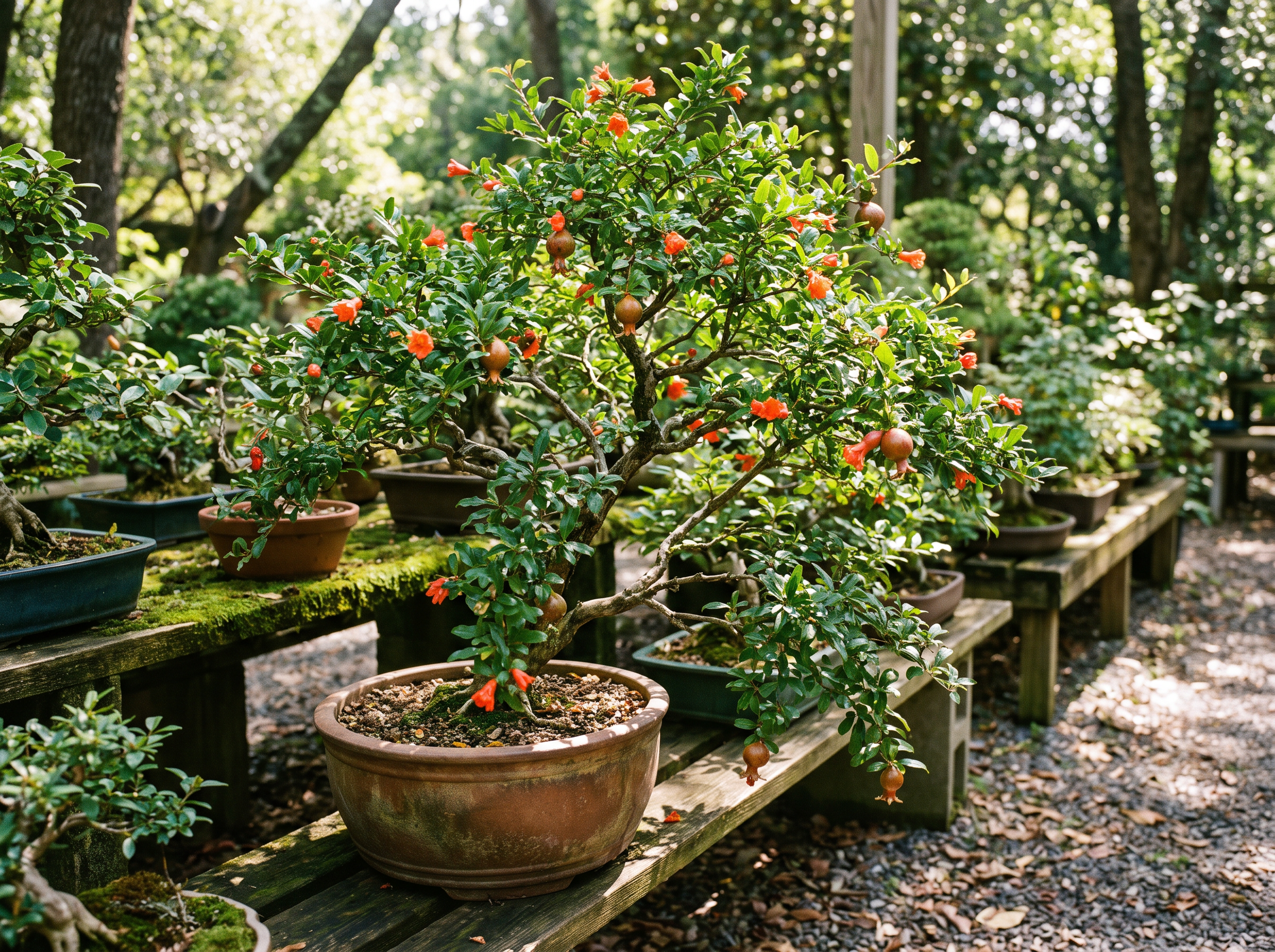
Pomegranate earns its place in a collection for reasons that have nothing to do with trunk drama or deadwood: it's grown for the flowers and the fruit. Given enough sun, a mature pomegranate bonsai produces striking orange-red blossoms through summer, and these develop into small, ornamental fruit that, while not something you'd want to eat off a bonsai-sized specimen, adds genuine seasonal interest most conifers simply can't offer. It's a rewarding species to grow specifically because it does something other than just look sculptural.
It's deciduous, which surprises people who associate it with a Mediterranean, almost evergreen-feeling shrub in the landscape. As bonsai it loses its leaves in winter and needs that dormant rest the same as a maple or zelkova does, then leafs out again in spring ahead of the summer flowering. Dwarf cultivars are common and often preferred for bonsai specifically because they flower and fruit at a smaller scale that suits a pot, without needing the size a full landscape pomegranate would take to bloom well.
The trade-off for that flower show is that pomegranate wants a lot of light, more than people expect from something that looks almost shrubby and modest, and it's moderately frost-tender at the roots even though it grows in similar Mediterranean conditions in the ground. Get both of those right, generous sun and winter root protection below freezing, and it's a genuinely satisfying tree to grow. Skip either one and you'll get a tree that survives but rarely flowers, which defeats the point of growing it in the first place.
Care
Light
Full sun is essential if you want flowers and fruit, and this is the single biggest factor separating a pomegranate that blooms well from one that just sits there producing leaves. Outdoors, in as much direct sun as you can give it through the growing season, is the standard I'd hold myself to. In lower light the tree will generally survive and leaf out fine, but flowering drops off noticeably or stops altogether, since flower bud formation on pomegranate is strongly light-dependent in a way that foliage growth alone isn't.
Watering
Water when the soil starts to dry at the surface, then water thoroughly, keeping a fairly consistent rhythm through the growing season, particularly while the tree is flowering and setting fruit, since letting it dry out too much during that window is a plausible contributor to flower or young fruit drop. It's not as strictly moisture-dependent as maple, and it tolerates some fluctuation better than that, but treat it as a moderate water user rather than assuming the same dry-between-waterings rhythm that works for olive; the two only share a superficial Mediterranean resemblance.
Temperature & hardiness
Pomegranate is moderately frost-tender, more so at the roots than the top growth, and a shallow bonsai pot offers far less insulation than the ground a landscape pomegranate would be growing in. Protect the roots once temperatures approach freezing, moving the pot into an unheated but frost-free space, a cold frame, or at minimum against a sheltered wall with mulch around the container. It's deciduous and does need to experience some winter chill and dormancy to grow and flower well the following season, so this isn't about avoiding cold altogether, just about keeping hard freezes off the roots specifically.
Soil & potting
A free-draining bonsai mix suits pomegranate well, akadama, pumice, and lava in a typical ratio, or a similar coarse, mineral-based equivalent. It doesn't want to sit in constantly wet soil any more than most species do, though it's not as strictly drainage-obsessed as olive. The main practical consideration is that good drainage combined with consistent watering through the flowering season gives the best results, rather than either extreme of constantly wet or repeatedly bone dry.
Fertilizing
Feed through the growing season with a balanced fertilizer, switching to a lower-nitrogen, higher-phosphorus and potassium feed as flower buds begin forming, since that balance tends to support bloom and fruit set better than a nitrogen-heavy feed that pushes leafy growth instead; ease off fertilizing altogether while the tree is actively in bloom, then resume once flowering has finished and fruit is setting. Stop feeding through winter dormancy entirely, resuming again as new spring growth begins. Consistent, moderate feeding through the season tends to produce a better flowering display than sporadic heavy doses.
Pruning & wiring
Pomegranate flowers at the tips of new shoots, so pruning timing matters a lot for bloom: do heavy structural work while the tree is dormant, in late winter or very early spring, before the season's new growth has emerged, and avoid cutting back extension growth once it starts pushing toward flowering if bloom is your priority for that year. Light pinching and shaping earlier in the season is fine, but be mindful that trimming shoot tips right as flower buds are forming removes the very growth that would have bloomed. Wiring works reasonably well on younger branches while flexible; older wood can get brittle, so plan major trunk or branch movement early in the tree's development rather than on a thick, mature branch later on.
Repotting
Repot every two to three years for younger trees, extending further as growth slows with age, timed for late winter or very early spring before new growth begins, similar to the pruning window. Because pomegranate roots are the more cold-sensitive part of the tree, repotting is also a reasonable opportunity to inspect root health generally, checking for any dieback from the previous winter before deciding how much to trim back. Root pruning is well tolerated on an established, healthy tree, and it typically recovers with a normal flowering season provided it isn't stressed by cold or drought shortly afterward.
Common problems
The most common disappointment with pomegranate isn't a pest or disease at all, it's a tree that grows fine but never flowers, and that's almost always down to insufficient light rather than anything wrong with the tree's health. Leaf yellowing and drop through winter is entirely normal for this deciduous species and shouldn't be mistaken for a problem. Root or crown damage from an unexpected hard freeze is a real risk given how frost-tender the roots are, and it typically shows up as delayed or patchy leafing out the following spring. Aphids can cluster on new shoots and flower buds specifically, which is worth watching for since an infestation right at flowering time can reduce the bloom noticeably. Fruit that forms but shrivels or drops early is often related to inconsistent watering during fruit set, though it's also a fairly normal amount of natural thinning on a heavily set tree, so a modest amount of drop isn't automatically a problem.
Styling
Pomegranate is best styled to showcase flowering and fruiting rather than dramatic deadwood or aggressive trunk movement, so informal upright and slanting forms that leave the canopy relatively open, letting light reach the flowering wood and the fruit stay visible, tend to work better than a dense, heavily refined canopy. Because dwarf cultivars flower and fruit well even on younger, smaller material, pomegranate is also a satisfying species to develop from relatively young nursery stock rather than needing decades of trunk development first. Multi-trunk and clump styles suit it too, since pomegranate naturally produces multiple shoots from the base, giving a fuller flowering display across several trunks rather than concentrating it on one.
Common questions
Why won't my pomegranate bonsai flower?
Almost always insufficient light. Pomegranate needs full sun to form flower buds reliably; a tree kept in partial shade will often grow healthy leaves without ever blooming. Moving it to a brighter, sunnier spot is the first thing I'd try before assuming anything else is wrong.
Is pomegranate bonsai cold-hardy?
Moderately, but its roots are more frost-tender than you'd expect from a Mediterranean species. Protect the pot once temperatures approach freezing, ideally moving it somewhere frost-free but still cold enough to provide winter dormancy.
When should I prune a flowering pomegranate bonsai?
Late winter or very early spring, before new growth and flower buds emerge, for any heavy structural work. Pomegranate flowers at the tips of new shoots, so trimming extension growth right before or during the flowering season risks removing the shoots that would have bloomed that year.
Does pomegranate bonsai lose its leaves in winter?
Yes, it's deciduous and needs a genuine winter dormancy period, unlike an evergreen olive. Leaf yellowing and drop through autumn and winter is completely normal, not a sign of a problem, and new leaves return with spring growth.
Can pomegranate bonsai actually produce fruit?
Yes, given enough sun, a mature pomegranate bonsai will set small, ornamental fruit following its summer flowers. Dwarf cultivars are commonly used for bonsai specifically because they flower and fruit reliably even at a small scale.
How much water does pomegranate bonsai need?
A fairly consistent watering rhythm through the growing season, particularly while flowering and setting fruit, since letting it dry out too much during that window is a plausible contributor to flower or young fruit drop. Treat it as a moderate water user rather than applying the dry-between-waterings rhythm that suits a genuinely drought-tolerant species like olive.
Why is my pomegranate's fruit shriveling and dropping early?
Inconsistent watering during fruit set is a common contributor, and keeping a steady rhythm through the flowering and fruiting period generally helps; erratic dry spells followed by heavy watering tend to make it worse. Some natural fruit drop is also normal on a heavily set tree, so a small amount isn't necessarily a problem.
You might also like
General guidance based on 20+ years of practice. Every tree and every climate is different — when in doubt, ask us.