
Deciduous Bonsai Bud Break: What's Normal
One part of a bonsai waking up before another isn't usually a sign something's wrong, it's usually a sign that part has more vigor, better light, or both.
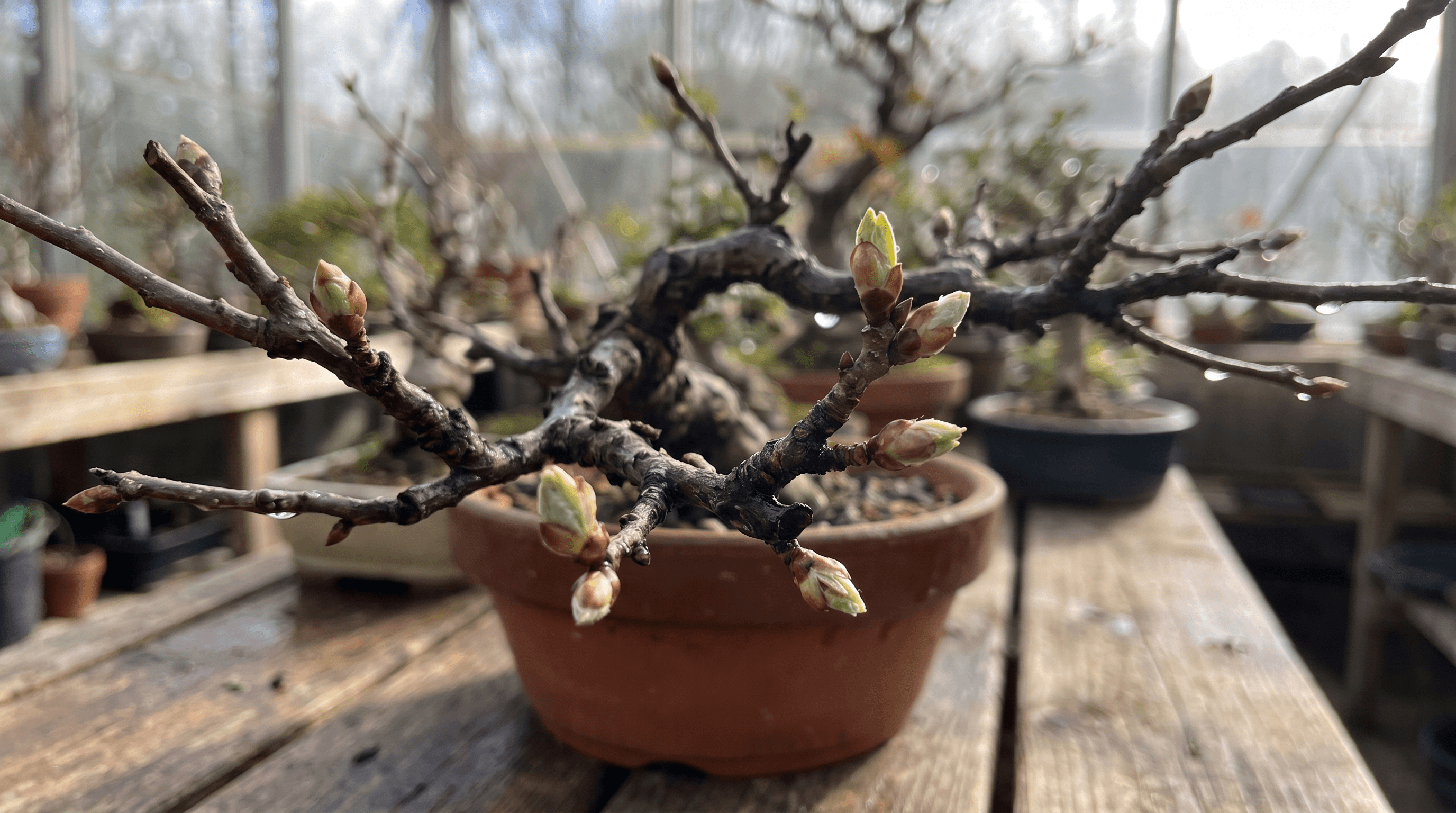
I get a lot of worried messages in early spring about uneven bud break, one branch pushing while its neighbor sits tight, the top of a tree fully leafed out while the lower interior is still bare. The instinct is to read this as a problem, and most of the time it isn't.
Trees aren't uniform machines, and bud break isn't either. Vigor differs branch to branch, light exposure differs branch to branch, and both of those directly affect when a given bud decides it's time to move. Unevenness is closer to the default state than the exception.
That doesn't mean every case of uneven bud break is fine, there's a real distinction between normal variation and a branch that's genuinely struggling. Knowing the difference saves you from either unnecessary worry or, worse, missing an actual problem because you assumed it was normal.
Why vigor drives bud break timing
Stronger branches, ones that have been putting on more growth and generally getting more resources from the tree, tend to break bud earlier and more decisively than weaker branches on the same tree. This is a direct expression of that branch's overall vigor, and it's consistent enough that experienced growers actually use bud break timing as one signal, among others, for reading which branches are strong and which need encouragement in ongoing development work.
Why light exposure matters just as much
Buds on branches getting more direct light, typically the upper and outer parts of the canopy, tend to warm up faster during the day and often break earlier than buds tucked into shaded interior or lower positions on the same tree. This is often about local microclimate around each bud rather than anything wrong with the shaded branch, and it's one of the most common causes of what looks like dramatic unevenness across a tree that's actually perfectly healthy. That said, a branch that's been chronically shaded over multiple seasons can also become genuinely weaker as a result, so light exposure isn't always just a harmless timing difference, it's worth keeping an eye on over the longer term too.
What normal unevenness actually looks like
Normal uneven bud break shows a gradient, not a hard split. Strong, well-lit branches moving first, weaker or shaded branches following within a reasonable stretch of time, generally a matter of days to a few weeks depending on species, climate, and how pronounced the vigor or light differences are. There's no fixed rule for the exact window, it's more useful to compare a slow branch against the rest of the same tree than against a calendar. The buds that are behind should still show clear signs of life when checked, firm and eventually swelling on their own timeline, even if slower.
When unevenness signals a real problem
The distinction I actually watch for is whether a lagging branch eventually catches up at all. If buds on one branch stay completely dormant, dry, or unresponsive well after the rest of the tree has fully leafed out, with no swelling or movement even weeks later, that's not normal variation anymore, that's a sign that branch may have a real problem, sometimes damage, sometimes a dieback issue upstream of that point on the branch, worth investigating directly rather than continuing to wait.
What to do about weaker branches, if anything
For branches that are simply slower but clearly still alive and moving, I generally don't intervene, the pattern is normal and often self-corrects somewhat as the season goes on. If a particular branch is consistently the weakest, spring after spring, that's more useful as ongoing information for development decisions, whether it needs more light exposure, whether it's a candidate for removal, than as something to fix in the moment during bud break itself.
Common questions
Is it normal for some branches on my bonsai to leaf out before others?
Yes, this is very common and usually tied to differences in branch vigor and light exposure across the tree, rather than a problem. Stronger, better-lit branches tend to break bud first, with weaker or more shaded branches following within a window that varies by species and climate, often days to a few weeks.
How long is too long to wait for a lagging branch to break bud?
There's no exact number, but if a branch's buds stay completely dry and unresponsive for weeks after the rest of the tree has fully leafed out, with no swelling at all, that's beyond normal variation and worth investigating rather than continuing to wait.
Why do the top branches of my tree always leaf out before the lower ones?
Upper and outer branches typically get more direct light and often more overall vigor from the tree, both of which push earlier bud break. This top-down or outside-in pattern is one of the most common and normal forms of uneven bud break.
Should I do anything about a branch that consistently breaks bud late every spring?
Not urgently during bud break itself, but it's worth noting as a pattern. A branch that's consistently the weakest across multiple springs may need more light exposure or may factor into decisions about whether to keep developing it or eventually remove it.
Does uneven bud break mean my tree has a health problem?
Not by itself, no. Uneven bud break is the normal pattern in most trees due to differences in branch vigor and light. It only points to a real problem when a specific branch stays fully dormant and unresponsive well beyond the point where the rest of the tree has clearly moved into growth.
How can I check if a branch that hasn't broken bud yet is still alive?
A gentle scratch test on a tiny, inconspicuous area of bark reveals green cambium underneath if the branch is alive, even if the buds themselves haven't shown visible movement yet. I use it sparingly, since repeated scratching damages bark, but it's more reliable than judging by bud appearance alone, especially early in the process.
Can I speed up bud break on a slow branch?
Improving light exposure to that specific branch, if it's shaded by growth above or nearby, can help even out timing over subsequent seasons, but I wouldn't try to force a slow but healthy branch faster in the moment. Let it move on its own schedule and address light exposure as an ongoing development adjustment instead.
You might also like
General guidance based on 20+ years of practice. Every tree, climate, and year is different — when in doubt, ask us.