
Dealing with Weak Spring Growth
A slow spring on one tree isn't automatically a crisis, but it isn't automatically nothing either, and telling the two apart takes a bit of detective work.
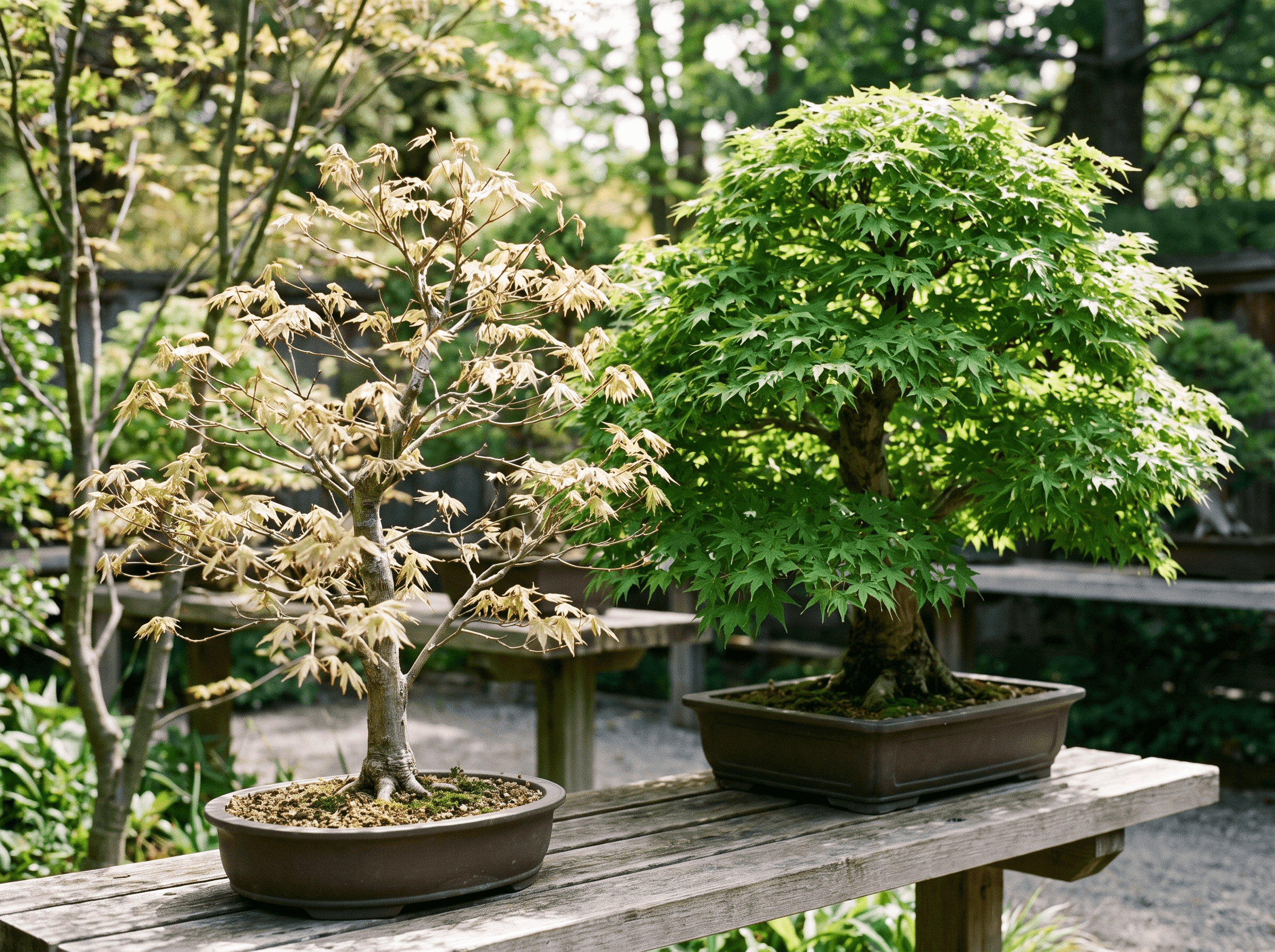
Every spring somebody sends me a photo of a tree that's clearly behind the rest of the bench, thin buds, sparse leaves, growth that just isn't matching what a healthy specimen of that species should be doing. And every spring the answer starts the same way: it depends what's underneath.
Weak spring growth has a handful of common causes, and most of them aren't dramatic. Some years a tree is just slower, full stop, without anything being wrong. Other times it's a real signal that something needs attention before it becomes a bigger problem. The job is figuring out which situation you're in.
I go through roughly the same mental checklist every time, starting with the most common and least worrying explanations before moving toward the ones that need actual intervention.
Insufficient light over winter
A tree that spent winter somewhere darker than ideal, deep shade under an overhang, a dim garage corner, or indoors without supplemental light, tends to come into spring with less stored energy to draw on, and that shows up as weaker, slower growth once the season starts. This mostly applies to trees that needed some form of winter shelter; a hardy species that wintered outdoors in the open rarely has a light problem to begin with. This is one of the more benign explanations, since the fix going forward is simply better winter light placement, and the tree itself usually catches up over the season even if it started slow.
Root problems that aren't visible yet
Weak, uneven growth is also one of the earliest visible signs of a root problem, whether that's rot from poor drainage, compacted old soil that's stopped draining well, an old repotting that didn't recover cleanly, or a pest working underground. This is the explanation I take most seriously, because by the time it shows in the foliage the roots have usually been struggling for a while already. If a tree's weak growth doesn't have an obvious explanation like recent repotting or poor winter light, I start by reviewing watering habits and drainage, checking that water is actually moving through the pot rather than sitting, before going as far as disturbing the roots directly, which I'd rather save for a scheduled repotting unless the signs point more strongly toward something serious.
Soil that's still cold
Above-ground temperatures can feel like spring well before soil temperature, especially in a smaller pot, actually catches up, since air warms faster than the substrate does. Roots are slower to become active in cold soil, which delays the whole growth response even though the tree looks like it should be ready. This tends to resolve on its own as the season progresses and soil temperature climbs, and it's more of a timing lag than a genuine problem.
Just a slower year for that particular tree
Sometimes there's no clean explanation at all, a tree is simply having a slower spring than usual, the way any living thing has off years. I've had trees in my own collection do this more than once, worrying me for a few weeks before pushing perfectly normal growth a bit later than expected. If a tree has a clean bill of health on roots, had reasonable winter light, and isn't freshly repotted, giving it a few more weeks before assuming a problem is often the right call.
Telling normal variation from a genuine problem
The distinction I actually use is whether the weak growth is stable or worsening. A tree that's behind but steadily, if slowly, pushing new growth week over week is probably just slow. A tree that's stagnant, or where growth that did appear is now yellowing or dropping, is more likely telling you something is actively wrong and worth investigating rather than waiting on, though yellowing limited to a handful of the oldest leaves can be a normal part of the seasonal shed too. Comparing against the same tree's own history from previous springs, if you have it, is more useful than comparing against other trees on the bench, since individual trees have individual baselines.
Common questions
My bonsai has much weaker growth than my other trees this spring. Should I worry?
Not immediately. Check for recent repotting, poor winter light or storage, still-cold soil, or a watering and drainage issue first, since these commonly cause weaker growth without anything being seriously wrong. If none of those explain it and growth is stagnant rather than slowly improving, that's when I'd look more closely at the roots.
How can I check if weak spring growth is caused by a root problem?
Rather than disturbing the roots right away, I'd first double check watering and drainage, then, if a look still seems warranted, gently check the root ball at the edge of the pot for soft, dark, or foul-smelling roots, which point to rot, versus firm, pale roots that are simply slow to activate. A careful look during the next scheduled repotting is often the clearest and least disruptive way to confirm what's going on underneath.
Can cold soil really slow down spring growth even when the air feels warm?
Yes. Air warms faster than the soil in a pot does, and roots need soil to reach a certain temperature before they become fully active, so a tree can lag behind what the air temperature alone would suggest, especially early in spring.
Is it normal for a bonsai to just have a slower year sometimes?
Yes, individual trees do vary year to year without a specific cause, the same as any living thing has stronger and weaker seasons. If the tree's roots and recent history check out fine, I give it extra time before assuming a real problem.
How long should I wait before treating weak spring growth as a real problem?
I generally give it a few weeks of watching, checking whether growth is at least slowly improving rather than stagnant. Stable, if slow, progress usually resolves on its own. No progress or worsening signs over that stretch is when I'd stop waiting and start investigating.
Does poor winter light placement actually affect spring growth?
It can, since a tree that had less light over winter tends to have less stored energy heading into spring, which shows up as a slower, weaker start to the season. The tree usually catches up over time once it's back in good light, but the slow start itself is a real effect.
Should I feed a bonsai showing weak spring growth to help it along?
Not as a first response. Feeding a tree with an underlying root problem can add stress rather than help, since the roots may not be functioning well enough to use the fertilizer. I'd diagnose the cause first and only feed once I'm confident the roots are healthy and simply need time.
You might also like
General guidance based on 20+ years of practice. Every tree, climate, and year is different — when in doubt, ask us.