
Cleaning Up Fallen Leaves and Debris
The soil surface under a bonsai collects more than dropped leaves by late autumn, and what's hiding in that litter is usually the reason a healthy tree limps into spring.
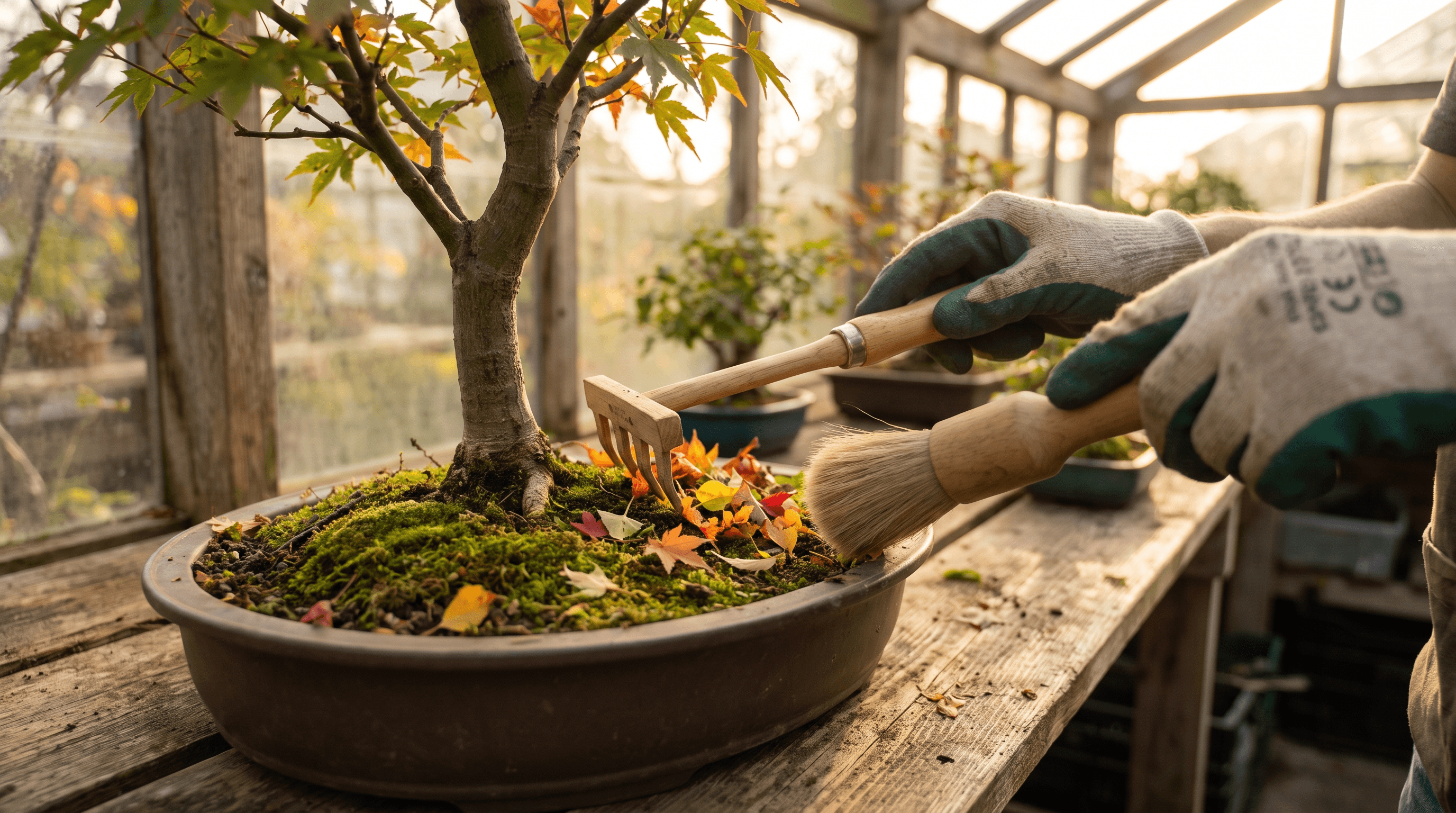
Every October my benches fill up with the same job nobody wants to do twice: picking dead leaves out from between the trunk base and the pot rim. It's not glamorous work, and it's easy to skip when there are more interesting things to do with a tree. It's also one of the few autumn tasks that costs almost nothing and prevents a surprising amount of trouble later.
A fallen leaf sitting on open soil isn't inert. It holds moisture against the trunk collar, gives insects a place to shelter for winter, and if it dropped carrying any fungal spotting, it becomes a ready source of reinfection once spring conditions turn favorable again. Out in the ground this matters less, there's so much surface area for spores and pests to spread across. In a shallow bonsai pot everything is concentrated within a few centimeters of the trunk, which is exactly where you don't want it.
I don't treat this as a one-time chore either. Leaves keep coming down over several weeks depending on the species and the year, so I go through the benches more than once between October and December. Here in Campania I'm usually still finding stubborn leaves clinging on into early December, long after the maples have gone bare.
Why leaf litter is worse in a pot than in open ground
In a bonsai pot the trunk base, the nebari, and the soil surface all sit within a small footprint, so anything decomposing there stays in constant contact with living tissue. A leaf pressed against the trunk collar keeps that bark damp for days after everything else has dried, and damp bark held against the trunk collar is a real risk factor for rot, something I watch for closely on any struggling tree brought to me in spring. Fungal spores from leaf spot or anthracnose that dropped with the foliage also sit right where spring rain will splash them straight back up onto new growth.
What's actually hiding under the litter
Leaf litter and rough bark near the soil line shelter some overwintering pests, spider mites in particular, along with slugs and snails that tuck into damp piles. Aphid eggs and many scale insects are more often found on the twigs and bark itself rather than in the litter, but they're close enough to the same spot that a cleanup pass tends to turn them up too. On a bonsai none of these have far to travel to reach fresh bark or a low branch come spring. I use the cleanup as an inspection pass as much as a tidying one. Turning over the debris with tweezers or a small brush often shows me a scale problem or an early fungal patch I'd have otherwise missed until it was established.
Clearing a bench without damaging moss or surface roots
I work with tweezers or a wooden chopstick and a soft brush rather than my fingers, especially around moss. Yanking at a leaf stuck to a moss mat pulls up the moss with it, and in my experience moss can take a long time to recover once it's torn, so I'm careful around it. In my experience damp leaves also lift more cleanly than bone-dry ones, which crumble and scatter fragments into the soil crevices, so I try to do this pass after a light rain or in the morning while there's still dew rather than on a dry, windy afternoon.
Twigs, spent flowers, and wire off-cuts count too
Leaves get all the attention, but dead twigs, spent flower husks, and the little curls of wire left over from earlier work in the season pile up in the same spots and hold moisture the same way. I go over the whole soil surface, not just the obviously leaf-covered parts. If the top dressing itself has gone slick with algae or built up a crust, this is also a reasonable moment to freshen it, since you're already down there working.
Matching the cleanup to how each tree is actually dropping
Not every species lets go of its leaves on the same schedule, and I don't strip green foliage just to get ahead of the job. I go bench by bench, clearing what's already down and leaving what's still attached, then coming back a week or two later for the next round. By the time the last maple has dropped, most of the earlier trees only need a quick pass rather than a full clearing.
Common questions
Should I pull off leaves that haven't fully dropped yet?
No, I leave them attached. A leaf still holding on is usually still transferring some resources back into the tree before it lets go on its own. Pulling it early doesn't speed anything useful up and can tear bark at the petiole. Wait for it to come away naturally, or fall on its own.
Does leaf litter really cause disease, or is this overcautious?
It's a real risk, not just tidiness for its own sake. Fungal spores from anything that dropped with leaf spot or similar issues survive through winter in the litter and reinfect new growth in spring, and damp leaves against the trunk collar contribute to rot. It's a low-effort task with a genuine payoff.
What about leaves that land on the moss, do I need to clean those too?
Yes, but more carefully. Leaves sitting on moss trap moisture underneath and can smother a patch if left all winter. I lift them off gently rather than raking, since moss tears easily when leaves are pulled instead of lifted.
Can I compost the leaves I remove, or should I discard them?
If any of the foliage showed fungal spotting, mildew, or scale, I discard it away from the growing area rather than composting it, since home compost piles often don't get hot enough to kill off spores or eggs. Clean, healthy leaf drop is fine to compost.
How often should I actually go through the benches in autumn?
I do a proper pass every one to two weeks from the point leaves start coming down until the last stubborn ones have dropped, which for me here in Campania runs from October into early December. The exact months will differ with your climate and the species you grow, but the pattern, several passes rather than one, holds pretty much everywhere. A quick check in between catches anything I missed.
Does this matter for conifers and other evergreens too?
Less so for the foliage itself since evergreens aren't dropping a full canopy, but conifers still shed old interior needles in autumn, and those collect in the same way. Clearing needle litter off the soil surface is worth doing on pines and junipers as well.
Will cleaning up disturb insects I actually want to keep around?
It's a fair concern, but on a potted bonsai the balance runs the other way. The pests overwintering in leaf litter, scale, mites, aphid eggs, far outnumber any beneficial insects sheltering in the same spot, so clearing it is a net gain for the tree's health going into winter.
You might also like
General guidance based on 20+ years of practice. Every tree, climate, and year is different — when in doubt, ask us.