
Autumn Bonsai Root and Soil Health Check
You don't need a full repot to know whether a tree's soil is going to cause trouble over winter, a short drainage and soil check in autumn tells you almost everything you need.
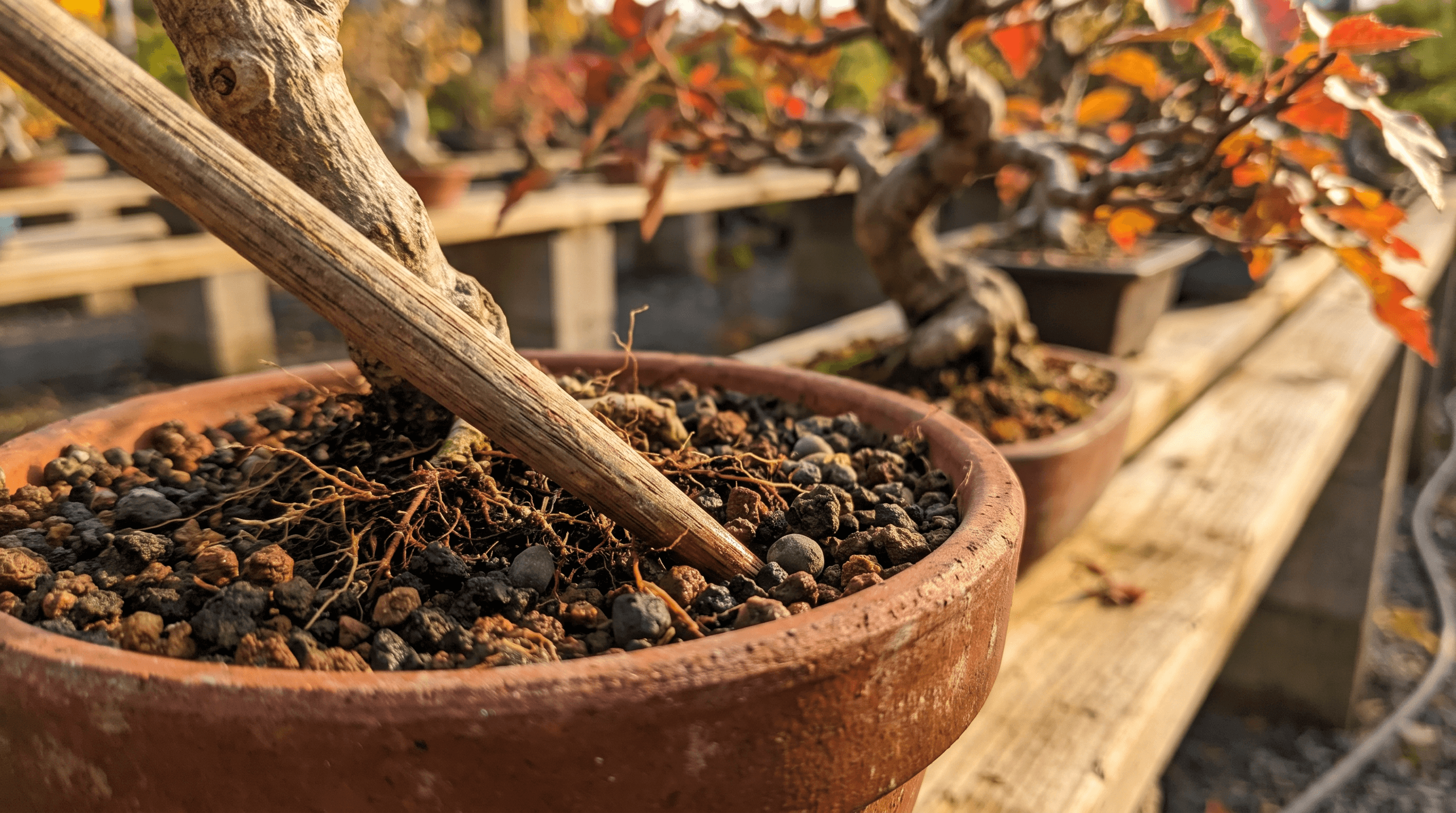
Repotting season is spring for most of my trees, but I don't wait until then to think about what's going on underground. Every autumn I go through the collection and do a quick check on drainage and general soil condition, without disturbing the roots themselves. It takes a few minutes per tree and it catches problems while there's still time to plan around them, rather than discovering a waterlogged root ball in the middle of a January cold snap.
The reason this matters more in autumn than it might seem is that a tree's ability to actually use water drops off sharply once it goes dormant. In summer, slow-draining soil is a real problem but the tree is pulling water through fast enough that it often compensates to some degree. In winter, growth has stopped or nearly stopped, and water that isn't draining just sits there around the roots, cold and stagnant, for far longer. Prolonged wet, low-oxygen soil around the roots is where root damage tends to develop, and that's more likely to happen during the weeks after a wet spell, when the soil should have dried out and didn't, than during the wet spell itself. This is mainly a concern for temperate outdoor bonsai going into a proper winter dormancy, tropical species kept warm year-round don't face the same seasonal drop in water use.
So this check isn't about doing spring's job early. It's a narrower, faster look at one specific thing, whether this tree's soil and drainage are going to hold up through a season where the tree can't help itself.
Why winter is often the riskiest season for slow drainage
A dormant or nearly dormant tree has minimal water uptake, so soil that stays wet does so for much longer than it would during active growth. Combine that with the fact that waterlogged, oxygen-poor soil is where root damage tends to develop, and you get conditions that can damage roots quietly over weeks, often without any visible sign above the soil line until real damage is done. Good drainage matters year-round, but in a cold-winter climate the consequences of poor drainage are often worse in the season when the tree can least recover from them.
What I actually check without repotting
I run a simple watering test: soak the pot thoroughly and time how long it takes to stop draining from the bottom, comparing it against how that same tree drained earlier in the season rather than against some fixed number. Slow, sluggish drainage or water that seems to pool on the surface rather than moving through tells me something's compacted or broken down. I also look at the soil surface itself for a green algae film, which can be one clue that it's staying wetter than it should between waterings, though not proof on its own, and I gently probe the top layer with a chopstick to feel whether it's still got structure or has broken down into something denser and mud-like.
Reading what the check tells you
If drainage still looks reasonable and the surface layer has structure, that tree's fine to leave alone until its normal spring repotting window. If I find slow drainage, particularly on a tree that's a few years past its last repot, that's useful information now rather than a surprise later. Organic components in bonsai substrate breaking down over time and losing structure is a common cause of this kind of slow, compacted drainage, though root congestion, fine dust and particles working their way down, or a partially blocked drainage hole can produce the same symptom, so I don't assume old soil is automatically the culprit without a quick look.
What to do about a problem tree without a full repot
For a tree with clearly declining drainage that isn't due for a full repot yet, I sometimes water more cautiously, only when the substrate actually needs it rather than on the usual interval, for the rest of autumn, and make sure it's sited somewhere it won't collect extra rain, under an eave rather than in the open, for instance. In more concerning cases I'll move up the repot schedule rather than risk the tree through a full winter on bad soil, but I treat that as an exception for a tree that's genuinely at risk, not a routine option, since spring still gives the tree the best recovery window and not every species tolerates an out-of-season repot equally well. It's a judgment call based on how bad the drainage actually is and how sensitive that particular species is to wet roots.
Checking pot elevation and drainage holes too
While I'm at it I check that pots are actually elevated slightly off the bench or ground, using pot feet or a similar spacer, rather than sitting flush on a surface that can block the drainage holes. I also clear any debris that's built up over the growing season around the holes themselves. It's a small thing, but a blocked drainage hole undoes good soil regardless of how well the substrate itself is draining.
Common questions
Do I need to repot in autumn if I find a drainage problem?
Not necessarily. For a moderate issue I'll often just adjust watering and siting for the rest of the season and plan the repot for the normal spring window. A severe drainage problem on a tree that's clearly at risk is worth an earlier repot even outside the ideal season, but that's a judgment call rather than a default response.
How can I tell if drainage is actually a problem versus just normal?
A simple soak-and-time test helps, water thoroughly and see how quickly it stops draining from the bottom. Water that pools on the surface, or drainage that takes noticeably longer than it used to for the same tree, both point to a real issue rather than normal variation.
Is algae on the soil surface always a bad sign?
A light film isn't automatically alarming on its own, and it's a clue rather than proof of a problem, but it's often associated with the surface staying wetter than average between waterings, which is worth noting alongside your drainage test rather than ignoring outright.
Why does slow-draining soil matter more in winter than summer?
Because a dormant tree uses far less water, so soil that would dry out relatively quickly during active summer growth stays wet for much longer in winter. Combined with cold, that prolonged wet period is when root rot most commonly develops.
Should I do this check on every tree or just older ones?
I check everything, but I pay closer attention to trees that are a few years past their last repot, since organic components in the soil break down over time and that's usually where drainage problems start to show up.
What's the fastest way to test drainage without repotting?
Water thoroughly and time how long it takes for water to stop coming out the bottom, comparing roughly to how that same tree drained earlier in the season. A big slowdown is the clearest sign something's changed underground.
Can I improve drainage without disturbing the root ball at all?
Options are limited without some root disturbance, but making sure the pot is properly elevated, drainage holes are clear, and the tree isn't sited somewhere collecting extra rain all help reduce the practical impact of soil that's not draining as well as it should.
You might also like
General guidance based on 20+ years of practice. Every tree, climate, and year is different — when in doubt, ask us.