
Repotting Soil vs Topdressing
Topdressing freshens up the surface of the pot between repots, but it's not a substitute for an actual repot, and confusing the two is one of the more common ways a tree ends up in trouble slowly and quietly.
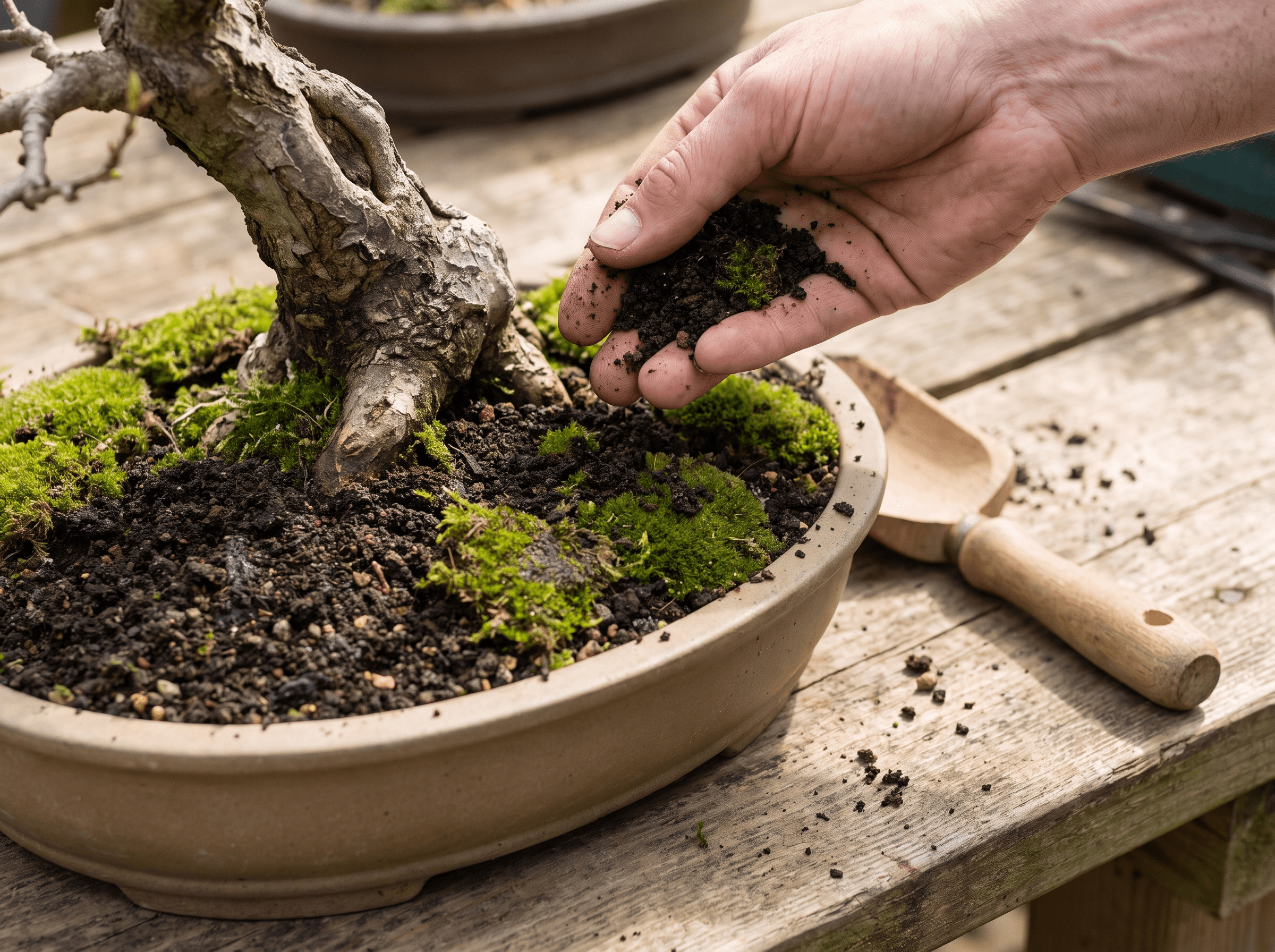
A grower once showed me a tree he'd been maintaining for three years by adding a bit of fresh soil and moss to the surface every spring instead of repotting, convinced he was doing the tree a favor by minimizing disturbance. Underneath that tidy green surface, the substrate deeper in the pot had broken down almost completely, and the roots were circling in a solid, airless mass. The surface looked great. The pot underneath was a different story entirely.
That gap between what topdressing fixes and what it can't reach is really the whole subject here. Repotting and topdressing aren't two versions of the same task at different intensities, they're two different jobs that happen to both involve putting fresh soil into a pot. One addresses the entire root zone. The other addresses the top centimeter or two and nothing below it.
What an actual repot addresses
Repotting means taking the tree out of the pot, working the root system, whether that's partial root work around the perimeter or something more extensive, and replacing a meaningful portion of the substrate throughout the root zone, not just at the surface. This is the only way to actually deal with soil that's broken down and compacted deep in the pot, roots that have circled or become rootbound, or drainage problems originating from the substrate itself rather than the surface. Nothing about topdressing touches any of that, because topdressing never disturbs what's happening below the top layer in the first place.
What topdressing actually does
Topdressing is a surface touch-up: adding a thin layer of fresh substrate, sometimes combined with moss, over the existing soil surface without disturbing the roots or the soil underneath. It's genuinely useful for what it's designed for. It improves the look of a pot between repots, helps retain surface moisture a bit longer between waterings, and can tidy up a surface that's gotten uneven or worn from watering and handling over a season. Moss topdressing in particular does real work for moisture retention at the surface and for aesthetics on display trees. None of that reaches the substrate an inch or two down, though, which is exactly where compaction and root-bound problems actually develop.
Why topdressing can mask a problem instead of solving it
This is where the confusion actually costs people. A tree with declining vigor, poor drainage, or a compacted root zone can look better after a topdressing, at least for a few weeks, simply because the surface looks fresh and green again. The moss or new soil layer creates the visual impression that the substrate is in good shape. Underneath, the actual problem, broken-down granules, a rootbound mass, poor water penetration, is completely untouched and often getting worse. If a tree needed a repot and got a topdressing instead, the underlying issue doesn't go away, it just becomes less visible for a while, which tends to delay someone noticing and addressing it until the tree is further behind than it needed to be.
Telling which one your tree actually needs
The clearest signal is what's happening below the surface, not what the surface looks like. If water still drains through reasonably well, roots aren't visibly crowding the pot's edges or surface excessively, and the substrate simply looks a bit tired or the moss has thinned, topdressing is a perfectly reasonable, low-stress touch-up. If water is sitting on top and draining slowly instead of running through, if there's a sour or stagnant smell from the pot, or if probing the top layer reveals a mushy, compacted texture rather than distinct granules, that points to an actual repot being overdue, and no amount of surface freshening addresses any of it. When genuinely unsure, it's worth probing a little below the surface with a chopstick or your finger before deciding, rather than judging purely by how the top looks.
Common questions
Can topdressing replace a repot if I'm short on time this season?
Not if the tree actually needs a repot. Topdressing can buy you a season of better appearance, but it doesn't fix compacted substrate, rootbound conditions, or drainage problems originating below the surface. Delaying an overdue repot in favor of topdressing usually just means dealing with a more advanced version of the same problem later.
How often should I topdress a tree that isn't due for a repot yet?
This varies by tree and how quickly the surface wears from watering and handling, but once a year, often timed alongside general spring maintenance, is a common approach for trees that are between repot cycles and otherwise healthy.
Is moss topdressing bad for the tree in any way?
Generally no, and it can be genuinely useful for surface moisture retention, but a thick, dense moss layer can make it harder to judge soil moisture by sight or to see early signs of surface-level problems. A thinner, well-maintained moss layer avoids that issue.
If my substrate looks fine on the surface, does that mean the deeper soil is fine too?
Not necessarily. Substrate often breaks down unevenly, and the deeper layers, which stay wetter and get less direct sun and airflow than the surface, can compact and deteriorate faster than what you see on top. Surface appearance alone isn't a reliable indicator of what's happening lower in the pot.
Does topdressing count toward the interval between repots?
No. Topdressing doesn't reset or extend the clock on when a tree actually needs a full repot, since it doesn't address the root zone or the deeper substrate at all. Think of it as maintenance that happens in the gaps between repots, not a substitute step within that cycle.
What tools do I need for topdressing versus a full repot?
Topdressing needs very little, just fresh substrate or moss and something to gently work it into the existing surface without disturbing roots. A full repot needs root hooks or a rake, shears for root pruning, wire for securing the tree in the pot, and the substrate itself, since it involves actually removing the tree and working the root system.
My tree's soil surface looks fine but water is draining slowly. Which one do I need?
Slow drainage despite a normal-looking surface is one of the clearer signs the problem is below the surface, which topdressing can't reach. That points toward a repot being needed rather than a cosmetic touch-up, even if the top layer still looks reasonably tidy.
You might also like
General guidance based on 20+ years of practice. Every tree and every climate is different — when in doubt, ask us.