
Organic vs Synthetic Bonsai Fertilizer
Neither type of fertilizer is objectively better than the other; the real choice is between speed and precision on one side and slow, soil-building nutrition on the other.
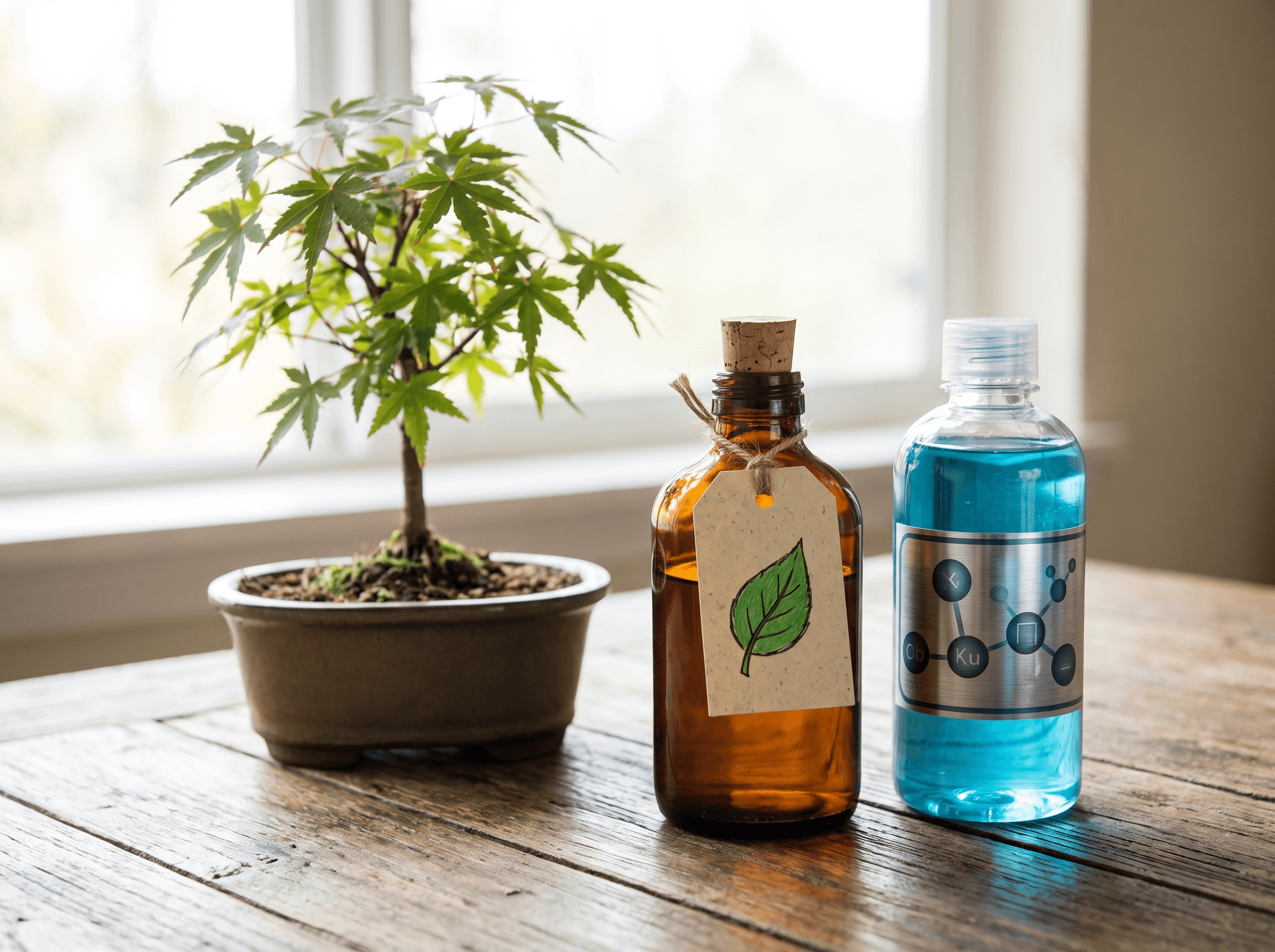
I get asked to settle this one a lot, usually by someone expecting me to declare one camp right and the other wrong. I'm not going to, because in twenty years of growing I've used both, often on the same bench, and each has earned its place for different reasons.
The debate gets more heated online than it deserves to be. Organic growers sometimes talk about synthetic fertilizer like it's poison, and synthetic advocates sometimes dismiss organic feed as slow and inefficient. Both descriptions have a grain of truth buried in the exaggeration, which is exactly why understanding the actual tradeoffs matters more than picking a side.
So let's go through what each one actually does differently in practice, on a bonsai specifically, where the pot is small and the margin for error is narrower than it is in open ground.
What organic fertilizer does well
Fish emulsion, seaweed extract, and pelleted manure-based feeds generally release their nutrients more gradually than synthetic feed, as soil microorganisms break them down, which usually means a lower risk of the sudden nutrient spike that causes fertilizer burn. Solid pellets tend to be the slowest of the group; liquid organics like fish emulsion still rely on some microbial breakdown but act a bit sooner than pellets do. Organic feeds also contribute to soil biology, the bacteria and fungi that support long-term root health, in a way synthetic feeds generally don't. The tradeoffs are real too: fish emulsion smells genuinely unpleasant for a day or two after application, which matters if your trees live near a patio you actually use, and the slower release means you can't push a tree hard in a hurry if you need a quick response.
What synthetic fertilizer does well
Chemical fertilizers act fast, the nutrients are already in a form roots can absorb immediately rather than waiting on microbial breakdown, and dosing is precise and consistent from one application to the next since you're working from an exact formulation rather than a variable organic input. That precision cuts both ways though: it's also much easier to overdose, and the margin between an effective dose and a burning one is narrower than with organic feed. Synthetic fertilizers generally don't contribute to soil biology or organic matter either, they feed the tree directly without building anything in the substrate itself.
Why many experienced growers use both
In practice I mix the two across the season rather than committing entirely to one. Slow-release organic pellets do the steady background work through most of spring and summer, feeding the soil as much as the tree. Then I'll bring in a diluted synthetic liquid feed when I want a fast, visible response, ahead of a show, once new growth is underway after a hard prune, or when a tree's colour tells me it needs something now rather than in three weeks. Neither approach alone covers every situation as well as the two combined.
The real tradeoffs, side by side
It comes down to four things: speed, where synthetic wins outright; precision of dosing, where synthetic is also easier to control exactly; smell and mess, where organic loses if you keep trees somewhere you sit near often; and soil biology and burn risk, where organic wins on both counts. Cost tends to favour synthetic overall, since it's usually cheaper per unit of nutrient delivered, though brand and product quality still swing this more than the category alone. None of this makes one category better in general, only better suited to a particular moment or goal.
Common questions
Is organic fertilizer safer for bonsai than synthetic?
In terms of burn risk, generally yes, because organic feed releases nutrients slowly rather than delivering a concentrated dose all at once. That said, synthetic fertilizer used correctly at label dilution is also perfectly safe; the higher risk comes from misuse, not the category itself.
Does synthetic fertilizer harm the soil over time?
It doesn't add anything harmful directly, but it also doesn't feed the beneficial bacteria and fungi in the substrate the way organic matter does, so soil used exclusively with synthetic feed for years tends to have less biological activity than soil that regularly gets organic input too.
Which is better for a bonsai recovering from a hard prune?
A light synthetic feed once new growth is underway can support a faster visible recovery, since the tree can use those nutrients immediately. Wait until the tree shows active new growth first rather than feeding right after the prune itself.
Why does my organic fertilizer smell so bad?
Fish emulsion and similar organic feeds smell strongly for a day or two after application as the organic matter starts breaking down, which is normal and not a sign anything's wrong. It fades on its own; keep treated trees away from seating areas until it does.
Can I switch between organic and synthetic fertilizer without issue?
Yes, there's no conflict in alternating or combining the two across a season. Many experienced growers do exactly this, using organic pellets as a steady baseline and synthetic liquid feed for targeted boosts.
Is one type of fertilizer better for beginners?
Organic pellet feeds are somewhat more forgiving for beginners because the slow release makes overdosing much harder to do by accident. Synthetic liquid feed is fine too as long as you measure the dilution carefully rather than eyeballing it.
Does organic fertilizer work fast enough for a tree that needs help now?
Not really. If a tree needs a quick nutritional response, a diluted synthetic liquid feed will show results faster than organic feed, which depends on microbial breakdown that takes time regardless of how urgently the tree needs nutrients.
You might also like
General guidance based on 20+ years of practice. Every tree and every climate is different — when in doubt, ask us.