
Homemade Bonsai Fertilizer Ideas
Homemade fertilizer can genuinely help a bonsai between feedings, but the smart way to use it is as a supplement to a real program, not a replacement for one.
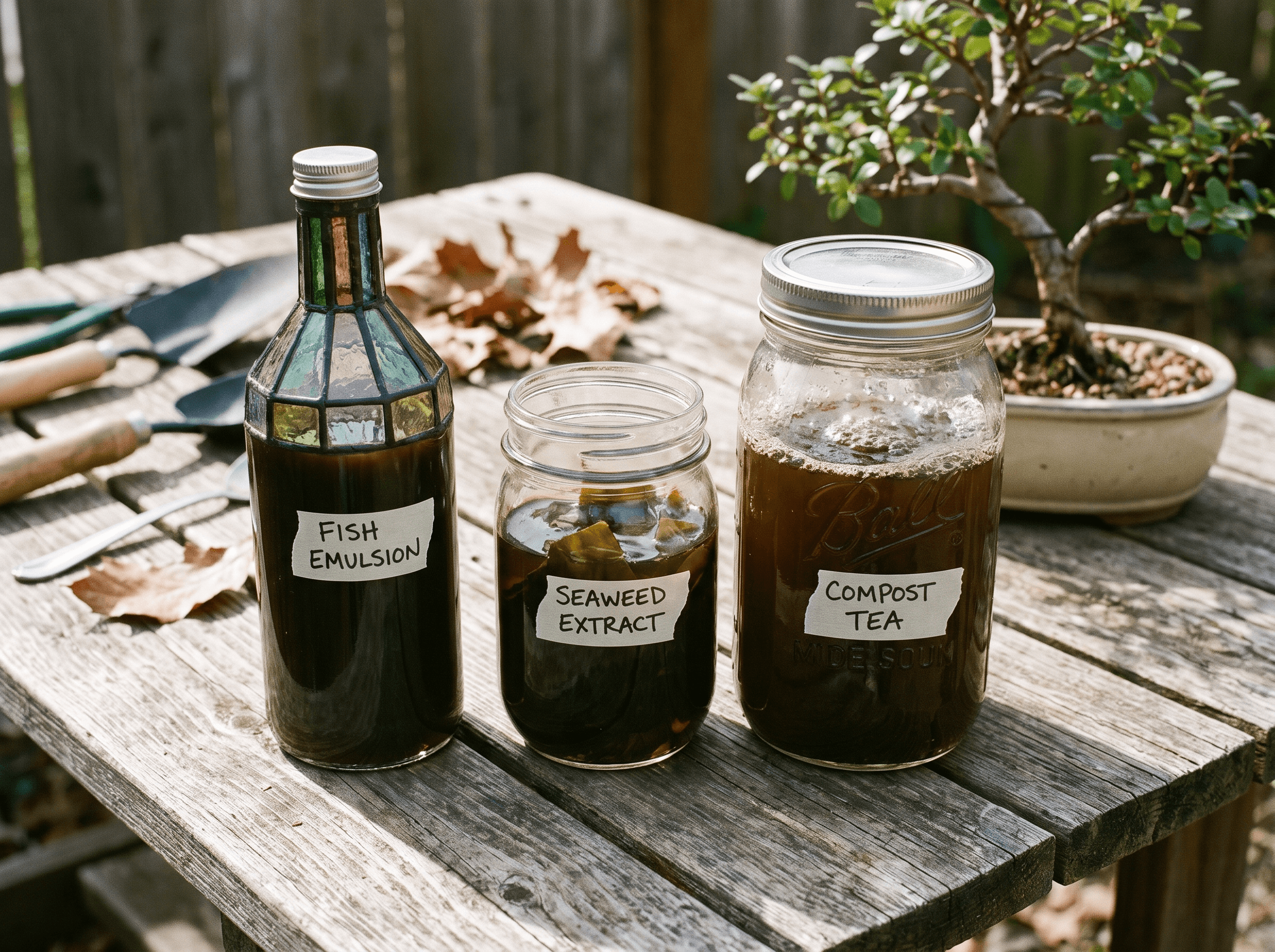
I get asked about homemade feeds constantly, usually by someone who'd rather not spend money on bottled bonsai fertilizer or likes the idea of putting kitchen scraps to use instead of the bin. I understand the instinct, and a few homemade options genuinely earn their place on the bench. But a bonsai growing in a few centimetres of soil doesn't forgive an unbalanced feed the way a rose bush in open ground does. There's very little buffer.
The honest position, after years of trying most of these myself, is that homemade fertilizers work best as a supplement rather than a sole source of nutrition, especially on a tree you'd be upset to lose. Commercial bonsai fertilizer gives you a known NPK ratio you can rely on through the season. A jar of fermented banana peels does not, and that's not a knock on the idea, just a fact about how hard it is to dose precisely.
So here's how I actually sort the homemade options I've used over the years: which ones function as real supplementary feed, and which ones are better thought of as soil amendments that happen to release a bit of nutrition along the way.
Diluted fish emulsion
Fish emulsion is probably the most reliable homemade-adjacent option, and it's what I reach for most often when I want to give a tree a boost between regular commercial feedings. It's rich in nitrogen with a decent trace of phosphorus and potassium, and it mimics what serious growers have used for generations before bottled fertilizer existed. The smell is genuinely unpleasant for a day or two, which is the main reason people avoid it, but diluted properly (follow the product's dilution rate and then cut it further for a bonsai in a small pot) it's a solid feed. Apply it to already-moist soil, never to a dry root ball, so it soaks in evenly instead of pooling around stressed, dry roots.
Seaweed extract
Seaweed extract isn't a strong source of NPK, but that's not really why growers use it. It's used more as a supplementary biostimulant than a nutrition source, full of trace minerals and compounds that many growers believe support root development and general vigour, and I've had good results using it alongside a proper fertilizer rather than instead of one. Think of it as a tonic more than a meal. Liquid seaweed diluted well and applied every few weeks during the growing season is low risk even for a tree that's a little stressed, which is more than you can say for most nitrogen-heavy feeds.
Compost tea, made properly
Compost tea, strained well so you're not pouring solids into a shallow pot, can add a mild, slow release of nutrients and some organic matter to the soil, though I treat the microbial benefits people claim for it as unproven rather than something to count on. The catch is the word properly. Compost tea made from unfinished or poorly aged compost can introduce pathogens or an ammonia smell that tells you it's not ready, and general food-safety guidance on garden soil amendments warns that improperly handled organic teas carry real contamination risk. I only use compost tea made from compost that's fully broken down and doesn't smell sour, and I still test a new batch on a nursery stock plant before I put it anywhere near something I actually value.
Eggshells and banana peels: folk remedies with real limits
These come up constantly in bonsai forums, and I want to be straight about them. Crushed eggshells add calcium as they slowly break down, and banana peels add potassium along with some phosphorus, but both decompose slowly and unevenly in a small pot, which makes them nearly impossible to dose with any precision. They're better used as a soil amendment worked in at repotting time than relied on as a primary feed during the growing season. I've seen people bury banana peel chunks in a bonsai pot expecting a nutrition boost and mostly what they get is a pot that smells odd and attracts fruit flies for a week.
How to introduce a homemade feed without gambling on a good tree
Whatever homemade option you try, dilute it more than you think you need to and test it on a less precious plant first, whether that's nursery stock, a cutting, or a tree you're not emotionally attached to yet. Watch it for a couple of weeks before you use the same mix on something valuable. And keep homemade feeds in rotation with a commercial fertilizer rather than as your only nutrition source. A bonsai's fine feeder roots are concentrated in a small volume of soil, and an imprecise feed applied too strong or too often does damage a lot faster than it would in a garden bed.
Common questions
Can I use homemade fertilizer as my only feeding method?
You can, but I wouldn't recommend it for a tree you care about. Homemade mixes are hard to dose precisely for exact NPK ratios, so most experienced growers treat them as a supplement alongside a commercial fertilizer rather than the whole program.
How often should I apply diluted fish emulsion?
Every two to four weeks during active growth is a reasonable starting point, though the right interval varies by grower and by how the tree responds, diluted further than the bottle recommends for general garden use since a bonsai pot holds so little soil. Always apply to soil that's already moist, never bone dry.
Is banana peel fertilizer actually useful for bonsai?
It contributes potassium as it breaks down, but slowly and unevenly, which makes it a poor primary feed. I treat it as a soil amendment at repotting time rather than something I bury in an established tree's pot during the season.
Will homemade fertilizer burn my bonsai's roots?
It can, if it's too concentrated or applied too often. The risk is actually higher with homemade mixes than commercial ones because you don't know the exact nutrient concentration. Dilute more than seems necessary and always water the soil first so the feed soaks in evenly.
Can I use coffee grounds as bonsai fertilizer?
Used sparingly and well composted first, coffee grounds add a small amount of nitrogen and organic matter, but fresh grounds worked directly into a small pot can compact and clog the soil surface, which hurts drainage more than most people expect. I'd rather see them go into a compost pile that later becomes tea or amendment.
How do I know if a homemade fertilizer is safe to try on a valuable tree?
Test it first on a less precious plant, nursery stock or a spare cutting, and watch for at least two weeks. Look for leaf burn, wilting, or any smell from the soil that suggests the mix wasn't fully broken down before you used it.
Does compost tea replace regular fertilizer?
No. It can add some organic matter and a mild trickle of nutrients, which is worth having, but it isn't a substitute for a fertilizer with a known NPK ratio during the growing season, and its microbial benefits are more folklore than proven fact.
What's the biggest mistake people make with homemade bonsai fertilizer?
Treating it as equivalent to commercial fertilizer and applying it on the same schedule and confidence. Homemade feeds vary batch to batch, so the safest approach is diluting generously, applying less often than you'd think, and keeping a commercial fertilizer as your baseline.
You might also like
General guidance based on 20+ years of practice. Every tree and every climate is different — when in doubt, ask us.