
How Long to Leave Wire on a Bonsai
There's no fixed number of weeks that applies to every tree, the honest answer is you leave wire on until the branch holds its new position on its own, and you check often enough to catch it before that.
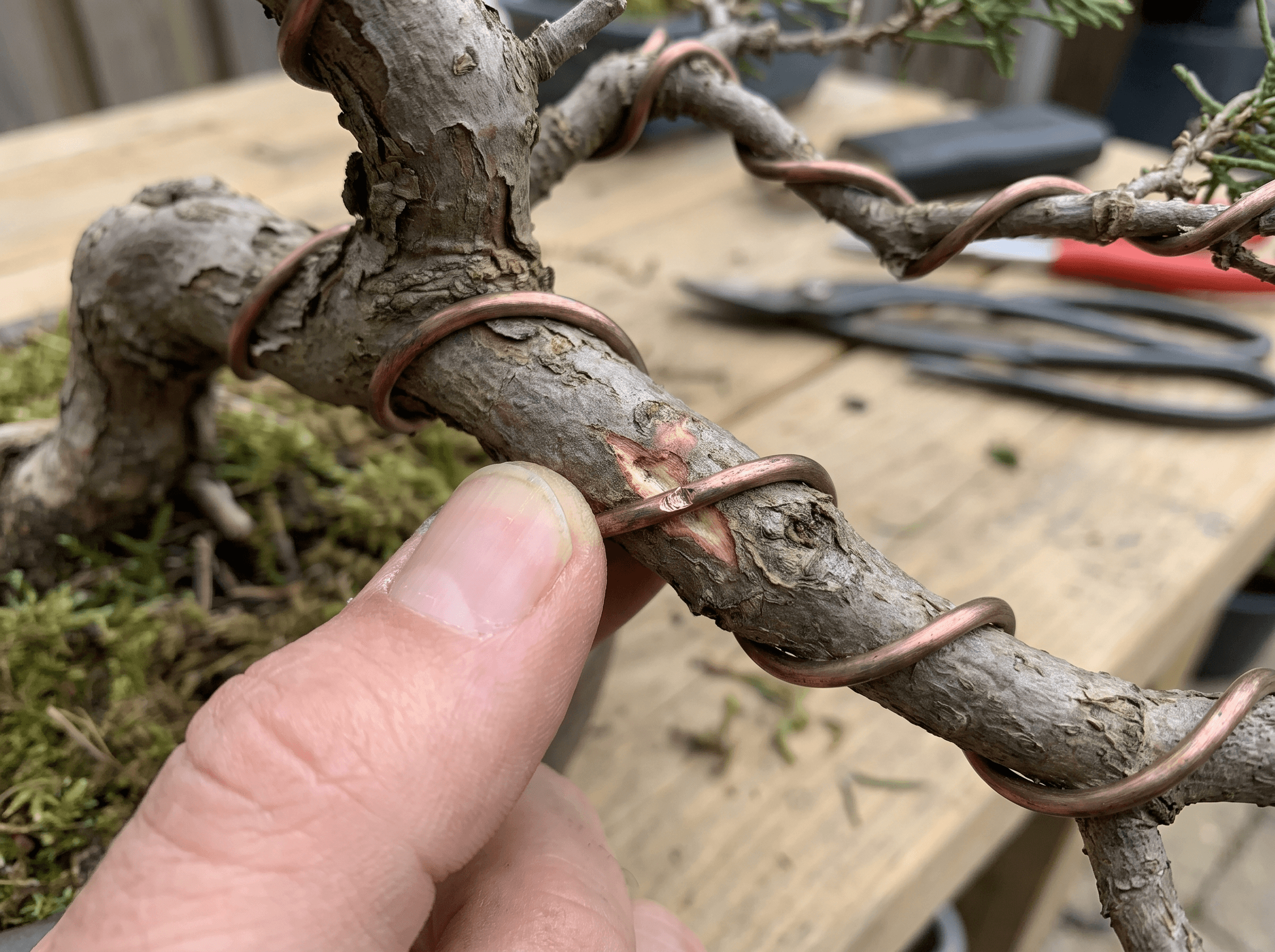
People want a number for this, and I understand why. It would be much easier to say six months and move on. But I've had junipers carry wire comfortably for the better part of a year with barely a mark to show for it, and I've had a vigorous young maple bite in around a wire within three weeks during a warm, wet spring. Same tool, wildly different timelines, because the tree is doing the growing, not the calendar.
As a starting rule of thumb: begin checking within three to four weeks on vigorous deciduous trees in spring, expect most trees to need wire off somewhere in the one to four month range, and treat anything approaching a year as unusual, mostly limited to slow growing conifers rather than the norm.
What actually determines how long wire should stay on is how fast the branch is thickening underneath it. Wire sets a bend by holding the branch rigid while new wood grows in that shape, and the same growth that fixes the position is what eventually pushes the wire into the bark if you leave it too long. Fast growing species and fast growing seasons shorten the window. Slow growers and dormant periods stretch it out considerably.
So rather than counting weeks from a calendar, the practical approach is to build in regular checks from the start, know roughly what to look for as the wire starts to bite, and remove it based on what you actually see on the branch.
Why there's no universal timeframe
Growth rate depends on species, on the season, on how vigorous that particular tree is, and even on which part of the tree you're looking at. A shoot near the top of a healthy tree in full spring growth can thicken noticeably in a matter of weeks. The same species in late summer, or a weaker branch lower down on a stressed tree, might barely move. Deciduous trees in active leaf tend to set wire faster than conifers, which generally grow more slowly and can often carry wire for many months without trouble. As a rough range, most trees need wire removed somewhere between one and four months, with vigorous deciduous branches often at the shorter end and slow growing conifers sometimes stretching close to a year as more of an exception than the rule. Treat that as context for what to expect, not a date to circle on the calendar.
Check regularly, especially on fast growers
I tell people to physically look at every wired branch at least every few weeks during the growing season, and more often than that on anything young, vigorous, or deciduous. It takes a minute to walk the bench and run a finger along the wired branches. During a warm, wet stretch in spring or early summer, a fast growing branch can go from fine to noticeably marked in under a month, so this isn't a once-a-season task. Slower conifers can be checked less frequently, maybe monthly, but I'd still rather check too often than find out too late that a branch has swollen hard against the coils.
What to look for as wire starts to bite
The first sign is subtle, usually just the faintest impression of the wire coil starting to show as a slight ridge or shadow line in the bark, before it's actually cutting in. That's your signal to remove the wire promptly, ideally at that next check rather than waiting for it to become obvious, since reputable guidance consistently favours removing wire as it begins to bite rather than well after. Left further, those marks deepen into visible grooves, and eventually the wire can be pulled taut enough into the bark that removing it becomes a more delicate job in itself. Catching it at the early ridge stage is really the whole game, since that's the point where removal is easiest and the branch has already done most of the work of holding its new shape.
Knowing when the branch will hold on its own
The point of wiring is to get the branch to set in a new position through growth, not to hold it there permanently. A branch is generally ready to have its wire removed once it shows resistance if you gently try to move it back toward its old position, meaning the wood itself has stiffened into the new shape rather than the wire being the only thing keeping it there. Combine that check with the early wire-marking you're watching for, and between the two you'll usually land on the right removal window without needing to guess.
The cost of removing too early or too late
Take wire off too soon and the branch can spring back, at least partially, toward its original line, undoing some or all of the work and meaning you'll have to rewire it later. Leave it on too long and the growth that was supposed to set the bend instead grows around and into the wire itself, leaving grooves in the bark that can take years to grow out, and in bad cases leave a permanent scar even after the branch has thickened well beyond that point. Neither mistake ruins a tree outright, but both cost you time, and the scarring from leaving wire on too long is the harder of the two to undo.
Common questions
How often should I check wired branches?
At least every few weeks during the growing season, more often on young or fast growing deciduous material, and you can space checks out further on slow growing conifers or during dormant winter months. A quick visual and finger check along each wired branch takes very little time.
Can I leave wire on over winter?
Generally yes, since growth slows or stops during dormancy and the risk of wire biting in drops with it. It's still worth a check now and then, particularly as the tree wakes up in spring, since growth can resume faster than expected.
What does early wire bite actually look like?
A faint ridge or shadow line where the coil sits against the bark, not yet a deep groove. That early stage is exactly the point at which you want to remove the wire, before it progresses to a visible cut into the bark.
Is it bad if wire leaves a mark on the branch?
A light mark that's caught and removed early usually fades or smooths out as the branch continues to thicken. It's only when wire is left on well past that early stage, cutting a deep groove, that the scarring becomes more stubborn and sometimes permanent.
How do I know if a branch will spring back after wire removal?
Gently test it by nudging the branch slightly toward its old position before you remove the wire. If it resists and holds the wired shape, it's likely set. If it moves easily back toward where it started, the branch probably needs more time wired.
Do conifers and deciduous trees need different wiring timelines?
As a general pattern, yes. Deciduous trees, especially in active spring and summer growth, tend to thicken and set faster, so wire often needs closer monitoring and earlier removal, commonly within one to two months in vigorous growth. Conifers usually grow more slowly and can often carry wire for several months, sometimes close to a year, with less frequent checking.
Should I rewire a branch immediately if it springs back?
Not always right away. Give the tree a short rest if it's had a lot of wire removed and reapplied recently, then rewire once you're confident the branch is healthy and the season is suitable, rather than forcing it back into shape the same day.
You might also like
General guidance based on 20+ years of practice. Every tree and every climate is different — when in doubt, ask us.